


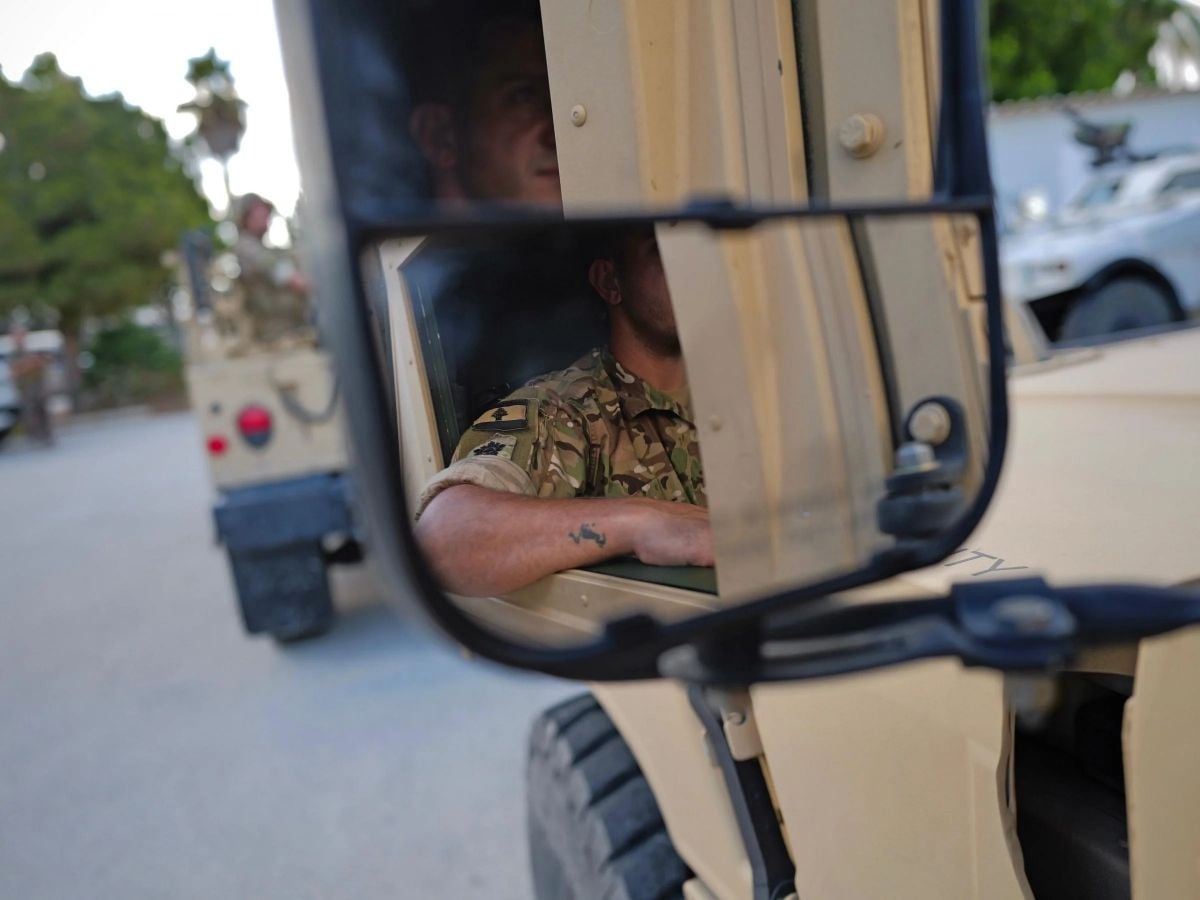
Lebanese Army convoy at a base located in Sour, south Lebanon, on July 8, 2025. (Credit: Matthieu Karam/L’Orient-Le Jour)






BEIRUT — The U.S. Senate’s version of next year’s defense spending bill introduces new restrictions on the Pentagon's support to the Lebanese Army, according to U.S.-based news website Al-Monitor on monday, citing conditions tied to aid over Hezbollah disarmament and recruitment reporting.
An executive summary of the National Defense Authorization Act for 2027, published by the Senate Committee on Armed Services confirms that the bill "conditions defense funding to the Lebanese Armed Forces [LAF] on its willingness to counter Hezbollah."
The bill, currently being debated in the Senate, would cap U.S. Defense Department’s assistance to the Lebanese Army to $36 million. However, no more than 5% of those funds ($1.8 million) would be released until the Pentagon certifies to Congress that "Lebanon’s military is working to completely disarm the militant faction ... while actively denying attempts by Iran to send weapons and financial support to Hezbollah," Al-Monitor reported.
The legislation would also allow the U.S. secretary of defense to suspend all U.S. military support for the Lebanese Army if it is deemed insufficiently committed to confronting and disarming Hezbollah.
Compared to the current law, which require Pentagon officials to report to the relevant congressional committees no later than June 30 on the Lebanese Armed Forces’ progress in disarming Hezbollah, the Senate proposal would require quarterly reports every 90 days to Congress.
The bill requires the Department of Defense (DoD) to report quarterly on the number and type of weapons the LAF has seized from Hezbollah, Iran’s latest ability to support the group, its latest threats posed to Israel and Syria, and details on the LAF’s personnel deployments to combat the group. It would also require that the DoD report on the specific training, equipment and exercises run by U.S. forces, and even require reporting the number of new special forces personnel recruited into the LAF for such training — "and the confessional religious makeup of such forces."
It would further instruct the "secretary to prioritize efforts to train specific LAF special operations units, deliver an explanation of the DOD's process for vetting such units and assess any gaps in their capabilities, along with providing metrics and plans to fix those gaps via training and equipment provisions."
The proposed legislation would also broaden the scope of U.S. assistance to support the Lebanese Army in countering not only Hezbollah, but also "the Islamic State of Iraq and Syria, al-Qaeda, the Muslim Brotherhood, Hamas, Palestinian Islamic Jihad, and all United States-designated terrorist organizations in Lebanon."
Al Monitor noted that the measures have been met with "cautious optimism on Capitol Hill, but some Republican lawmakers have increased the pressure in recent months, arguing the Lebanese Army is not moving aggressively enough."

In April, the Republican chair of the Senate’s Armed Services Committee, Sen. Roger Wicker, said that "Congress should halt support to the Lebanese Army unless it moves to disarm Hezbollah completely and immediately."
However, a month later, he expressed reserved support for the Pentagon’s ambitions to build up the Lebanese army's capabilities, saying it would be "tremendous achievement" if Hezbollah "could be eliminated."
The United States is the largest foreign donor to the Lebanese Army, providing hundreds of millions of dollars in Foreign Military Financing and Building Partner Capacity programs over the past eight years. The Trump administration approved a $230 million package for Lebanon’s security forces late last year, including $190 million for the LAF and $40 million for the Internal Security Forces.
Launched in September 2025, the Lebanese Army's plan to disarm Hezbollah was paused due to the war between the group and Israel, which resumed on March 2.
In January 2026, the Lebanese Army announced that it completed the disarmament of Hezbollah south of the Litani River. However, following the start of the war, Hezbollah's Radwan forces returned to the area to fight Israeli forces.
Despite the U.S.-Iran deal reached on Monday, which reportedly includes provisions related to Lebanon, Israeli attacks have continued — albeit at a lower intensity — killing several people in south Lebanon. Hezbollah has also carried out several operations, mainly targeting Israeli forces still deployed in south Lebanon.

 7 p.m. recap: Netanyahu seeks mastermind behind Flydubai incident; Washington sanctions 2 French nationals; Ben Gvir's 'I want to kill you' threat