






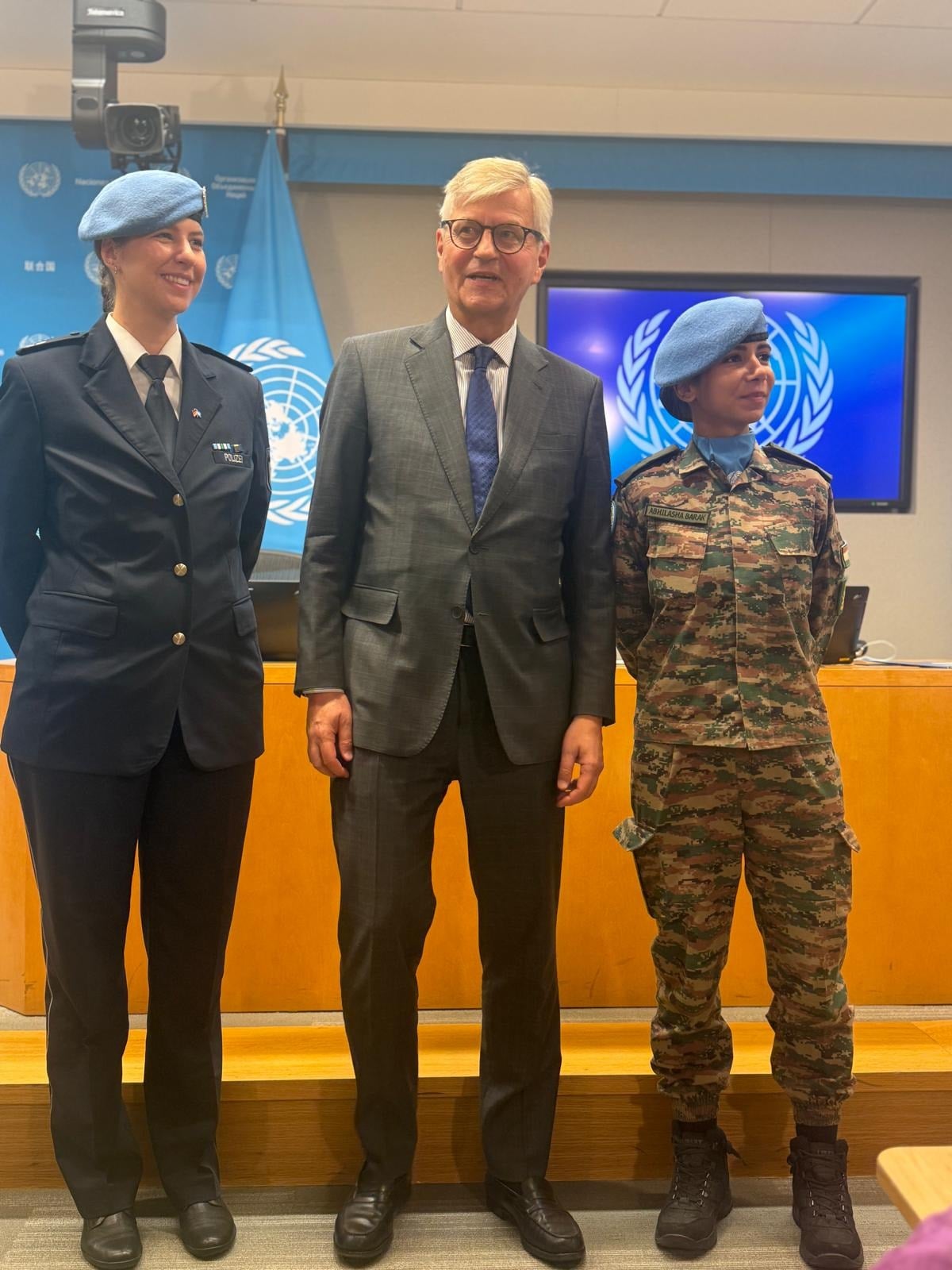
Photo Sylviane Zehil






During the latest observance of the International Day of United Nations Peacekeepers, U.N. Under-Secretary-General for Peace Operations Jean-Pierre Lacroix paid special tribute to peacekeepers who have fallen in Lebanon, praised the growing role of women in U.N. missions and delivered a major political message about the future of the U.N. presence in the country.
Asked by L’Orient-Le Jour, Lacroix confirmed that the proposals submitted by Secretary-General António Guterres to the Security Council for the post-UNIFIL period were developed in close consultation with the Lebanese authorities and are intended to support the implementation of Resolution 1701 while strengthening state sovereignty.
At a time when peace operations are facing unprecedented budget constraints, Lacroix issued a strong defense of peacekeeping.
’’If there is one lesson I hope you relay today, it is this: The work of our peacekeepers matters. It deserves to be defended. Peacekeeping is worth the investment.’’
The French official noted that the annual budget for the U.N.'s 10 peacekeeping operations stands at around $5.4 billion.
’’That's roughly what the world spends on military expenditures in just sixteen hours,’’ he said, arguing that the cost of prevention remains far lower than the cost of war. ‘’The cost of peacekeeping is much lower than the cost of conflicts when they spiral out of control.’’
His remarks come as U.N. missions have been grappling for months with the consequences of delayed contributions from some member states, forcing the organization to scale back certain operational capacities in the field.
Post-UNIFIL: The question that gave the conference its strategic significance
Yet it was Lacroix's response to a question from L’Orient-Le Jour that gave the press conference its greatest strategic significance.
Asked about Guterres's June 1 letter to the Security Council on the future of the U.N. presence in Lebanon after UNIFIL's mandate expires on Dec. 31, 2026, the head of peace operations confirmed that the secretary-general had presented several options for a future international presence tasked with supporting the implementation of Resolution 1701.
The letter itself has been public for several days. What made Lacroix's answer noteworthy, however, was the insight it offered into the political thinking behind the proposals and the role played by Lebanese authorities in shaping them.
’’We listened to what the Lebanese authorities told us,’’ he said.
According to Lacroix, consultations with Beirut revealed two fundamental priorities.
The first is the Lebanese authorities' stated commitment to fully implementing Resolution 1701 and gradually strengthening the state's exclusive authority over arms.
’’The Lebanese authorities have made important decisions to actively commit to the implementation of Resolution 1701, notably working to guarantee the exclusive control of weapons by the authorities, the army and the security forces.’’
The second concerns maintaining an international presence in South Lebanon.
’’They let us know that it was important to keep a human presence tasked with monitoring, observing, reporting, liaison and incident prevention.’’
This may have been the most consequential statement of the conference. It suggests that discussions about the post-UNIFIL period are not based on the prospect of a U.N. withdrawal but rather on a transformation of its presence, with the explicit support of the Lebanese authorities.
New international framework to support Lebanese sovereignty
Guterres's letter fits squarely within that logic.
The secretary-general notes that the situation in Lebanon has ‘’dramatically deteriorated’’ since March and argues that a U.N. uniformed presence would remain necessary under all scenarios examined in order to support a reinforced political mission tasked with seeking a lasting solution to the conflict.
All the options under consideration are based on the same principle: gradually replacing the current UNIFIL structure with a lighter presence focused on observation, reporting, liaison, de-escalation and monitoring the cessation of hostilities.
Each option includes military observers supported by protection, mobility, medical evacuation, engineering and demining capabilities, as well as advanced technologies such as drones, radars, helicopters and satellite imagery.
For Lacroix, these proposals must be understood in the context of a broader shift: the desire of Lebanese authorities to assume greater responsibility for implementing Resolution 1701.
’’Resolution 1701 remains the reference political framework,’’ he stressed. ‘’It is essentially aimed at reestablishing Lebanon's full sovereignty over its entire territory, including exclusive control over weapons by the Lebanese authorities.’’
What emerges is a significant evolution in the U.N.'s thinking. The organization is now envisioning a security framework in which the Lebanese Army would gradually assume a larger role south of the Litani River, while a reconfigured international presence would continue to provide monitoring, liaison and incident-prevention functions along the Blue Line.
’’All of these proposals have a single objective: to support Lebanon, support the implementation of Resolution 1701 and accompany the political efforts currently underway,’’ Lacroix said.
Then, in what sounded almost like a political testament after more than seven years at the helm of U.N. peace operations, he offered a reflection that perhaps best captures the purpose of peacekeeping:
’’I have never heard people tell us: Leave. They always tell us: Do more and stay with us.’’
At a moment when the United Nations is already contemplating the post-UNIFIL era, the remark serves as a reminder that the central question is not only what form tomorrow's international presence in Lebanon will take, but whether it can continue helping a country still seeking stability, sovereignty and lasting peace.
