







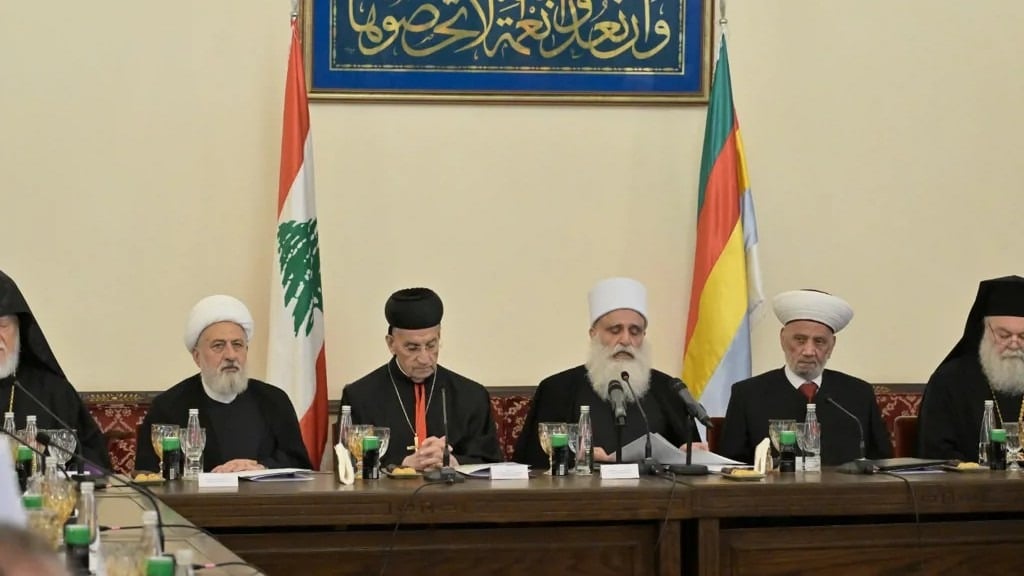
Christian and Muslim religious leaders gather at the Druze House in Beirut, June 2, 2026. (Credit: National News Agency)






Gathered in Beirut on Tuesday at the initiative of Druze Sheikh Akl Sami Abi al-Mona, Lebanon's highest Christian and Muslim religious authorities issued a joint call for national unity in the face of escalating Israeli attacks, growing threats to the country, regional uncertainty and the humanitarian consequences of the war.
At the conclusion of the interfaith summit, held at the Druze House in Beirut, participants declared that any attack on one region of Lebanon constitutes an attack on the entire country and all its people. They stressed that the defense of Lebanon must take place exclusively within the framework of the state, which they described as the sole legitimate representative of all citizens.
In their final statement, the religious leaders voiced their "support for the steps taken by the Lebanese authorities to achieve a comprehensive cease-fire, preserve the country's sovereignty and secure the withdrawal of Israeli forces from Lebanese territory."
They also emphasized "the need to spare Lebanon the repercussions of regional and international conflicts" while preserving "its Arab identity and its role as a model of coexistence."
The participants called on Arab countries, friendly nations and international organizations to increase support for Lebanon, particularly for displaced people, war-affected regions and future reconstruction efforts.
Throughout the discussions, speakers warned against the dangers of internal division. They reaffirmed their commitment to coexistence among Lebanon's communities, respect for state institutions, national dialogue and the role of the Lebanese Army as the guarantor of sovereignty and territorial integrity.
Maronite Patriarch Bechara al-Rai stressed "the need to prioritize the spirit of national dialogue and devote ourselves to building a strong state in Lebanon that exercises authority over its entire territory."
"This summit reflects the true brotherhood that forms the brilliant image of Lebanon, as well as the importance of its role and mission for both East and West," he said.
Grand Mufti Sheikh Abdel Latif Derian, Lebanon's highest Sunni authority, described the gathering as a "summit of hope and optimism in a time of challenges, storms and disasters."
"As Muslim and Christian authorities, we call for a strong and just state, which is indispensable, since the alternative would be chaos and civil war, which we do not wish for," he said.
He also called for support for Lebanon's institutions and for the positions adopted by President Joseph Aoun, Parliament Speaker Nabih Berri and Prime Minister Nawaf Salam.
The vice president of the Higher Shiite Islamic Council, Sheikh Ali al-Khatib, likewise voiced support for "a strong, just and sovereign state" that guarantees equality among citizens.
"We support the project of a strong state that protects its borders and citizens and preserves the country's sovereignty and independence," he said.
He also called for full implementation of the Taif Agreement and warned against the dangers facing Lebanon.
"Our country, in all its territory and components, is in great danger if the situation is not controlled at all official and popular levels," he said.
Al-Khatib warned that no Lebanese should believe they are immune from what he described as Israel's expansionist ambitions in the region.
For his part, Abi al-Mona said convening the summit was both a moral and national obligation.
"We are gathered together as spiritual leaders out of a sense of moral, spiritual and national duty, to affirm solidarity in the face of danger, strengthen national unity, preserve civil peace and support the state in overcoming this ordeal," he said.
The Druze leader added that religious authorities should promote dialogue, reconciliation and social cohesion rather than engage in political rivalries.
He condemned Israeli attacks on Lebanon, endorsed state efforts to end the war and restore national sovereignty, and reiterated his commitment to Lebanon's model of pluralism, coexistence and partnership among communities.
According to Abi al-Mona, national unity remains the country's strongest protection.

 8 p.m. recap: Israel again threatens Beirut’s south suburbs; 2 ships hit near Hormuz; Riyadh football matches canceled