


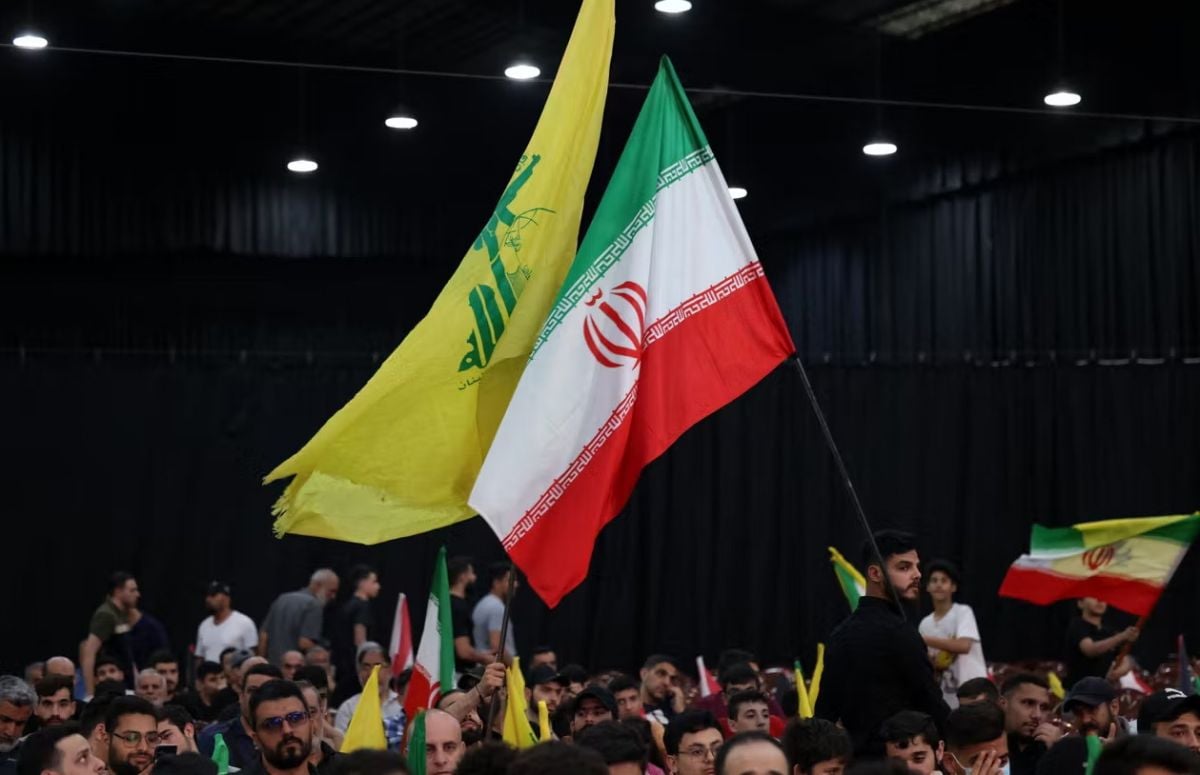
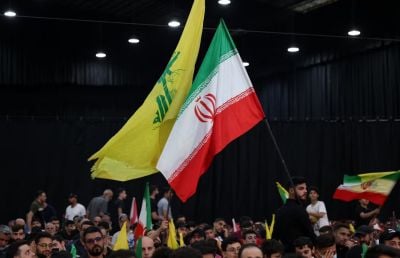
The Iranian flag held up next to the Hezbollah flag at a gathering following the death of Iranian President Ebrahim Raisi, in the southern suburbs of Beirut, on May 24, 2024. (Archive photo: Anwar Amro/AFP






BEIRUT — Just hours before direct security and military negotiations between Lebanon and Israel sponsored by the U.S. in Washington, several figures close to Hezbollah denounced any prospect of disarming the party and warned against "internal discord."
The vice president of the Higher Shiite Council, Ali Khatib, called on the authorities to "not count on the United States, which through direct negotiations, seeks to push toward internal discord that would serve as a lifeline for the Israeli enemy, and to revisit the decision to disarm the resistance under the pretext of the arms monopoly."
"Those who advocate for the theory of disarmament should abandon their bet as long as there is occupation," he declared, in a thinly veiled jab at President Joseph Aoun and the Nawaf Salam government.
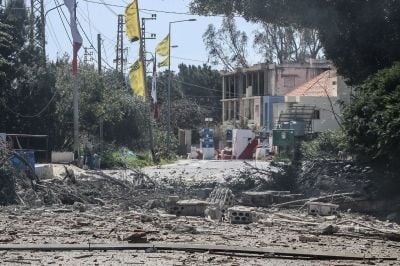
In turn, Shiite cleric Ali Fadlallah expressed hope that "the ongoing negotiations between Iran and the United States will succeed, to avoid the repercussions of their failure on the region's security and stability, from which Lebanon would naturally benefit as it would help end the bloodshed and destruction it is enduring."
The religious leader also called on the state "to fulfill its duties towards its citizens by insisting on the principles it has announced, the most important of which are a complete cessation of hostilities, the withdrawal of the enemy from occupied territories, and the return of displaced residents," and also emphasized the need for the Lebanese "to work during this phase to strengthen their unity."
No agreement 'that would not include Lebanon'
For his part, Hezbollah MP Hassan Fadlallah stated Friday that "Iran has not accepted any agreement that would not include Lebanon," as Washington and Tehran attempt to reach a deal to end the war in the Middle East. He added that "coordination is permanent" with Parliament Speaker Nabih Berri.
"There is Iranian insistence to stop the aggression against Lebanon," said the lawmaker, noting that "Iran has not accepted any agreement that would not include Lebanon." "That is why the enemy is trying to preempt this by intensifying its attacks and taking advantage of those in power in Beirut and their insistence on continuing negotiations," he said.
The MP also affirmed that "coordination is ongoing with President Nabih Berry to confront these dangers." "We are both working to end the aggression, and we have a common vision of the direct negotiations, each expressing it in their own way. Any decision regarding how to address solutions will be shared and there will be no disagreement," he continued.
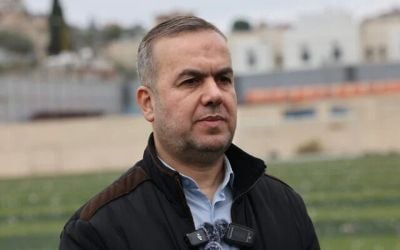
Fadlallah finally emphasized that "the resistance is not a regular army that sets up defense lines to prevent a heavily equipped army with the most modern weapons, which presents itself as the region's most powerful, from entering and occupying certain villages. The mission of the resistance is to prevent it from taking hold in these areas and to exhaust it through operations."
'Internal Lebanese settlement'
Jaafarite Mufti Ahmad Kabalan, known to be close to Hezbollah, said that "the stability of Lebanon constitutes a Saudi-Iranian interest as well as a local and regional necessity. There is no more important interest for Saudi Arabia and Iran than to take the initiative now to protect Lebanon from the worst political discord that awaits it."
The mufti believes that "Washington has lost the regional war and is seeking to set these countries on fire and plunge them into a spiral of destructive conflicts." According to him, "Saudi Arabia and Iran must ensure an internal Lebanese settlement that protects Lebanon from the final hour."
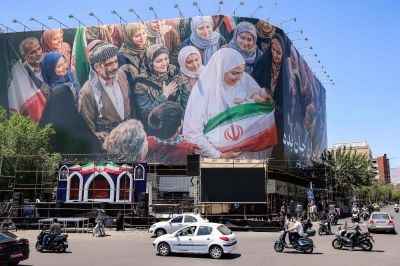
Meanwhile, the Free Patriotic Movement (FPM, Aounist) said in a statement that "building a capable state and restoring all sovereign and defensive responsibilities to legitimate institutions remains a common national demand."
However, it noted that "the scale of the current aggression and the danger it poses to people, land and the Lebanese entity requires unified efforts to stop the catastrophe." The FPM also stressed that "this is not the time for trading accusations, but the time to act to end the crime, because we are all targeted and all responsible."
Lebanon and Israel have begun direct negotiations, with the Lebanese side notably aiming to obtain a withdrawal of the Israeli army, which is making it conditional on the effective disarmament of Hezbollah. A new round of negotiations is scheduled for Friday between Lebanese and Israeli delegations in Washington concerning the security and military aspect. The United States and Israel want to jointly implement with the Lebanese army a plan to disarm Hezbollah.

 7 p.m. recap: Netanyahu seeks mastermind behind Flydubai incident; Washington sanctions 2 French nationals; Ben Gvir's 'I want to kill you' threat