






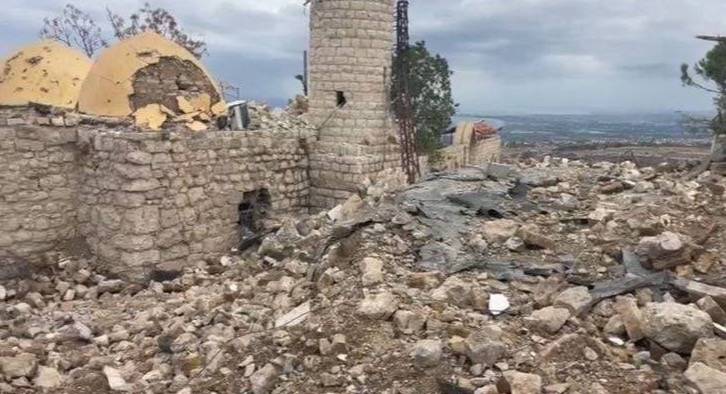
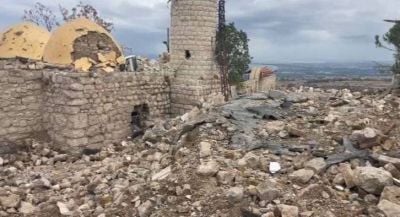
The Chmoun as-Safa maqam in Chamaa was targeted on April 12 by Israeli army strikes, in the context of intensifying destruction in southern Lebanon. Photo from 2024 provided by Haydar Hawila.






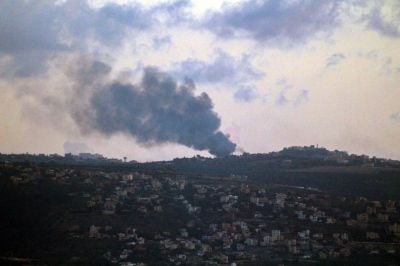
Israel's destruction campaign has increased and expanded across several areas in Lebanon since 2024. According to Culture Minister Ghassan Salameh, a scorched-earth policy is underway and could continue. On April 12, Israel targeted and severely damaged the medieval citadel of Shamaa, in the Sour district, which had been already targeted in the 2024 war, the Shiite shrine of Shamaa, attributed to the prophet Shmoun al-Safa.
The ongoing fighting and bombardment campaign has prevented a precise assessment of the damage to the monument, which local tradition associates with the tomb of the prophet Shmoun al-Safa. Adjoining the citadel, the maqam (shrine), dating to the first century, is regarded in local tradition as "a funerary monument housing relics of the one whom Christianity reveres as the 'prince of the apostles,'" according to research conducted by former L’Orient-Le Jour colleague Fadi Noun, a specialist in theology, history and sociology. He explains that the funerary monument of Saint Simon, one of Jesus' 12 apostles, is "nicknamed Cephas [Peter] by Jesus [Matthew 16:18-19], who became Semaan al-Safa in the Arabic language." According to Shiite belief, he was also an ancestor of Imam Mahdi. The minaret next to the maqam dates back to the 11th century; the fortress from the 12th century was part of the Kingdom of Jerusalem. Archaeologist Ali Badaoui, head of the antiquities in Sour for the Directorate General of Antiquities (DGA), describes: "The maqam of Shamaa consists of an underground crypt, a sort of sealed funerary chamber accessed via a circular opening covered with wooden planking. The whole is enclosed within a rich arcade hall topped by four domes."
How can a Shiite funerary monument, from a branch of Islam dating from the 8th century, be dedicated to Saint Peter, who was martyred in Rome in the year 64? "The answer to this question is provided by the oral tradition of Shamaa, which states that Shmoun al-Safa appears in the genealogical list of the Mahdi's ancestors, whose mother was Christian before embracing Islam," Noun says, adding that the Mahdi, in Shiite Muslim tradition, is a descendant of the Prophet Muhammad. The 12th imam in a hereditary line, a redeemer who is "hidden" or "occulted" (circa 9th-10th centuries), he is to reappear at the end of time to restore justice and true religion in a world consumed by disbelief and moral corruption. "Not all branches of Islam agree on this eschatological figure. We should leave this matter to the specialists. For now, we are satisfied with Shamaa's local tradition," says Noun.
According to archaeologist Badaoui, the maqam was restored a few years ago, but no examination of the remains in the crypt has been attempted, this "in accordance with the Eastern custom of respect for the dead," thus preventing science from providing answers in this area. When asked if it is possible that the maqam once contained relics of Saint Simon, the first bishop of Rome, Badaoui said: "Near the sanctuary, remnants of a chapel have been found, which proves that this place was consecrated as a Christian religious site well before the advent and spread of Islam in the region." Dating from the 1st century and close to the Holy Land, the maqam of Shamaa may yet hold surprises for researchers.
Restored, destroyed, vanished
Since the start of Israel's ground invasion, several villages in southern Lebanon have been massively destroyed. Centuries of history and archaeology are now in ruins. "In just three weeks of war, 34 villages have disappeared from the map. All completely flattened," Minister Salameh laments. "Lebanon's heritage does not rest on a few isolated sites, but on a continuous accumulation of relics that we have not yet finished cataloging. Each village contains several layers of history, both archaeological and cultural. The territory as a whole can be seen as heritage," explains Sarkis Khoury, Director General of Antiquities (DGA). In addition to the five sites already classified as World Heritage, in 2024, the UNESCO committee granted reinforced protection status to 34 cultural assets, including the citadel of Shamaa, which was destroyed the same year.
UNESCO announced on April 1, in a press release, "the granting of reinforced temporary protection to 39 cultural properties, along with international financial assistance totaling more than $100,000 for emergency operations on the ground."
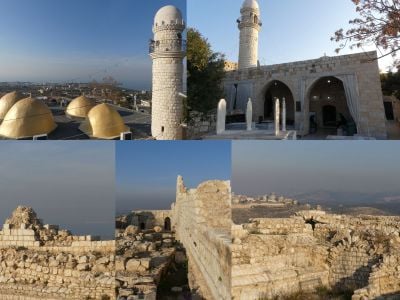
Shamaa is located in the Sour district, southern Lebanon, 99 kilometers from Beirut. Built on a high plateau with a magnificent view of the Mediterranean and Palestine, the citadel has occupied a strategic position in the region since Roman times and up to the Israeli-Lebanese conflicts. From 1978 to 2000, it served as a military post for the Israeli army, which occupied part of southern Lebanon. Then, during the 2006 war, its cannons and missiles were trained on the north and east walls of the fortress and on the Shiite sanctuary built next to the fortification. The area was severely damaged.
A grant from the Italian Agency for Development Cooperation (AICS), amounting to 700,000 euros, allowed restoration of the castle and its return to the Lebanese state in June 2021. Italian expert Marisa Calia, who supervised the restoration work, indicates that the archaeological data gathered show that it had previously been restored in 271 A.D., a date confirmed by the discovery of a mosaic floor fragment during excavations led by archaeologist and Sour antiquities chief, Ali Badaoui. He also notes that Shamaa oversaw a number of nearby hilltop communities, such as Iramt, Oum al-Rab, and Alexandrette (not to be confused with Turkish Alexandrette).
In the 6th century, the site was damaged by an earthquake that struck the entire region. However, documents are lacking as to what happened to the Shamaa colony after the Islamic conquest of the area. In the 12th century, the Franks seized and occupied the site until 1291. Badaoui's research also uncovered old documents showing that, around 1750, the castle and village underwent a major revival. They were restored by the governor of Sour, Sheikh Abbas Mohammad al-Nassar, of the Shiite Ali al-Saghir dynasty, a lord of Mount Amel (locally known as Jabal Amel), who established de facto autonomy over the region, and the castle became the family's property. The citadel, used for military and residential purposes, underwent significant renovation. His son, Sheikh Kayed, who would later be killed by the Ottomans, subsequently added structures to the north side of the castle, according to expert Marisa Calia. A century later, in 1875, during a scientific mission to the Near East, French archaeologist and geographer Victor Guérin noted that the castle, "in ruins," was surrounded by a wall studded at regular intervals with semicircular towers. The interior was divided into two parts: a northern part, where "the pasha" lived; the other, to the south, was occupied by about 60 private dwellings. "The diwan hall was adorned with several monolithic columns of gray granite … Nearby, still standing with its white dome and minaret, a sanctuary dedicated to the prophet Shmoun al-Safa."
This article was originally published in French in L'Orient-Le Jour.

 7 p.m. recap: Saudi Arabia warns Houthis as Israeli strikes hit south Lebanon