







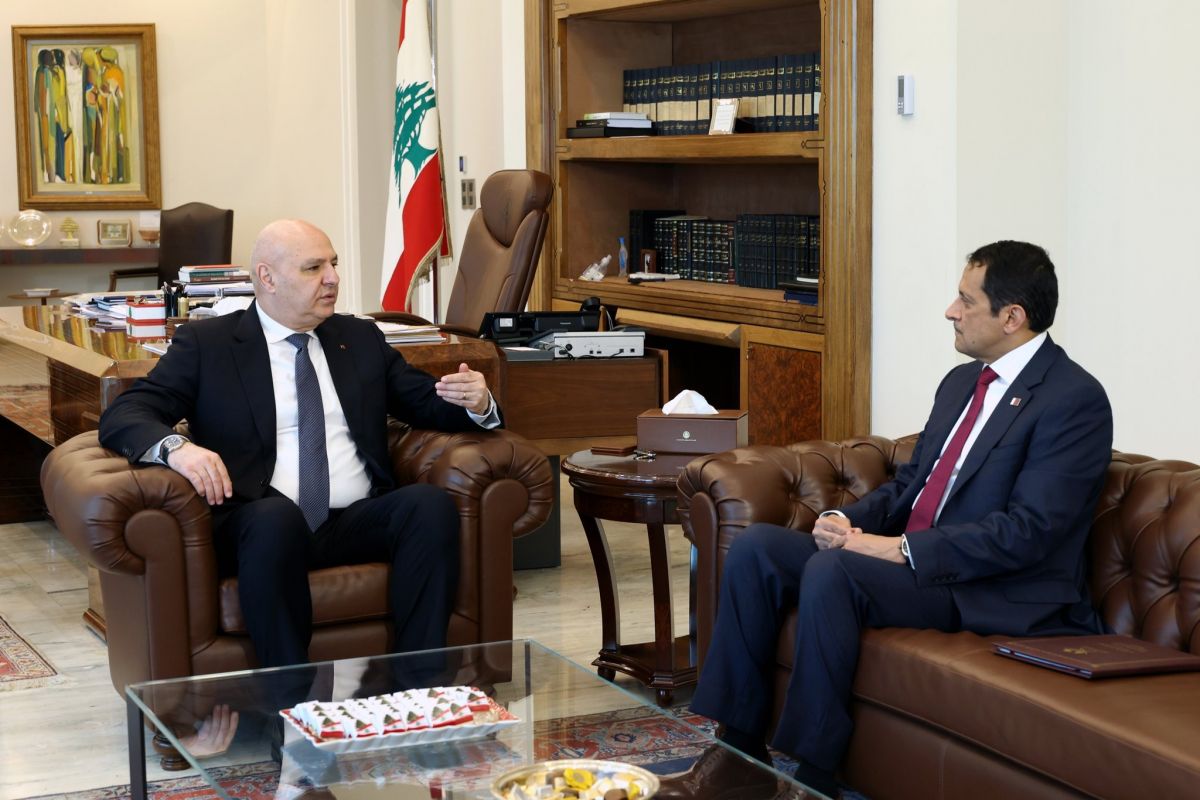
President Joseph Aoun (left) meets with Qatar's ambassador to Lebanon (right) Sheikh Saud bin Abdulrahman Al Thani at Baabda Presidential Palace on May 21, 2026. (Credit: @LBpresidency/X)






Qatar's ambassador to Lebanon, Sheikh Saud bin Abdulrahman Al Thani, confirmed to Lebanon's President Joseph Aoun during a visit to the Presidential Palace in Baabda his country’s "continued support for Lebanon and its commitment to its stability and support for the Lebanese government and de-escalation measures," the Lebanese Presidency said on X Thursday.
He also reiterated Qatar’s "commitment to providing assistance according to the established program for that purpose."
Separately, Aoun also met with Egyptian Ambassador to Lebanon Alaa Moussa to discuss the latest developments in Lebanon and the region, particularly the course of the Lebanese-U.S.-Israeli negotiations currently taking place in Washington and Lebanon’s position on them, in addition to bilateral relations between the two countries," the Presidency said on X.
The Washington negotiations are U.S.-brokered direct talks between Lebanese and Israeli government delegations aiming to achieve a "comprehensive peace and security agreement."
Qatar and Egypt are both members of the Quintet Committee for Lebanon, alongside the United States, France, and Saudi Arabia. The five-nation group coordinates international diplomatic efforts to support Lebanese state institutions and push for political solutions, such as ending institutional deadlocks and implementing U.N. Security Council Resolution 1701.
For their part, Gulf states were unified in calling for a de-escalation of the Middle East war and the Israeli war on Lebanon. In the midst of the regional war in March, Iran targeted hydrocarbon infrastructure in the oil-rich Gulf nations while effectively closing to shipping the strategic Strait of Hormuz, through which one-fifth of global oil usually passes.
Following the 2024 war, Doha pledged $480 million for development, which includes plans to rebuild heavily destroyed villages in southern Lebanon such as Kfar Kila and Aita al-Shaab. Qatar also remains one of the primary financial backers of the Lebanese Armed Forces. Doha has supplied the military with millions of dollars in fuel for operations and continues to regularly fund salary packages (such as $100 monthly stipends) to assist soldiers facing the country's severe economic crisis.
