






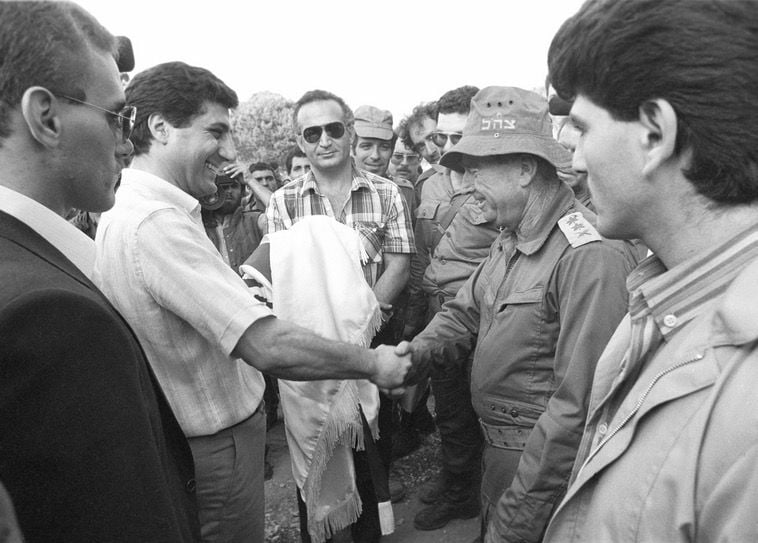
Handshake between Lebanese Forces commander Bachir Gemayel (left) and Israeli army chief of staff Rafael Eitan, in the presence of Avner Azoulay, Mossad representative, on June 1, 1982, in Lebanon, five days before the Israeli invasion. (Credit: Royalty-free photo/Creative Commons)






There were seven of them: Sobhi, Charbel, Hussein, Adel, Ahmad, Fares and Hassan. Seven Lebanese soldiers killed in an Israeli ambush in the middle of the night near the village of Aita al-Shaab.It was May 25, 1975, and the Lebanese (1975-90) Civil War was still in its early stages. The clash marked the deadliest confrontation between Lebanon and Israel in three years. Israel described it the next day as an “incident” during what it said was a “routine operation” against Palestinian fighters, insisting it “was in no way directed against the Lebanese Army.” Previous episode Episode III: Lebanese paralysis and the Palestinian-Israeli tug-of-war Asked at the time by The New York Times why Israel continued launching ground and air raids across the border while Lebanese forces were themselves fighting Palestinian guerrillas, an Israeli...
There were seven of them: Sobhi, Charbel, Hussein, Adel, Ahmad, Fares and Hassan. Seven Lebanese soldiers killed in an Israeli ambush in the middle of the night near the village of Aita al-Shaab.It was May 25, 1975, and the Lebanese (1975-90) Civil War was still in its early stages. The clash marked the deadliest confrontation between Lebanon and Israel in three years. Israel described it the next day as an “incident” during what it said was a “routine operation” against Palestinian fighters, insisting it “was in no way directed against the Lebanese Army.” Previous episode Episode III: Lebanese paralysis and the Palestinian-Israeli tug-of-war Asked at the time by The New York Times why Israel continued launching ground and air raids across the border while Lebanese forces were themselves fighting Palestinian guerrillas,...