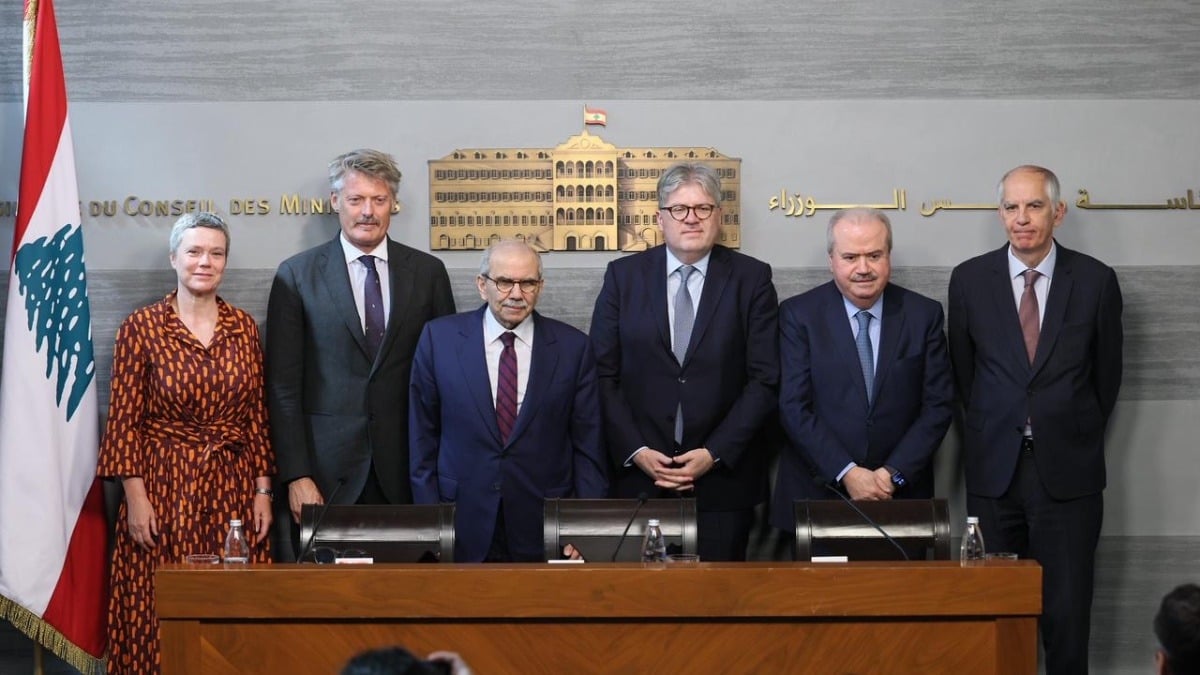
Prime Minister Nawaf Salam at the Grand Serail alongside Finance Minister Yassine Jaber, the ambassadors of France, Denmark, and the European Union in Lebanon, as well as the acting Director General for the MENA region at the European Commission, on May 19, 2026. Photo Ani






The European Union, Denmark, and France have allocated a package of 32 million euros (about $37 million) to the Lebanese government to support areas affected by the conflict between Hezbollah and the Israeli army in southern Lebanon and the Bekaa Valley.
Set to run over four years (2026-2029), the program aims to support recovery efforts in the regions most affected by the repercussions of the conflict, especially through strengthening the capacities of local authorities, supporting sustainable agriculture, small and medium-sized enterprises, and creating jobs, according to a European Union statement.
"Lebanon needs an end to hostilities and a return to lasting peace, not fragile truces that do not guarantee sustainable stability," said Lebanese Finance Minister Yassine Jaber during a ceremony held at the Grand Serail, attended by Prime Minister Nawaf Salam, the European Commission’s director general for the MENA region, Michael Karnitschnig, EU Ambassador Sandra De Waele, as well as the ambassadors of France and Denmark, Hervé Magro, and Kristoffer Vivike.
Thanking the EU, France, and Denmark for this "generous gift ... intended to support areas affected by the war, small and medium-sized businesses and local governance," Jaber stressed that the support comes "at a critical time for Lebanon," as the country faces "renewed hostilities, massive destruction and significant population displacement." He said the current challenges demand "more than traditional aid" and require "flexibility, speed, and a true partnership." The minister also emphasized the need for "strong, coordinated, and flexible support to preserve social cohesion, meet urgent humanitarian needs and lay the foundations for a credible recovery and inclusive growth."
The funding consists of a 24.8 million euro grant from the European Union, about 5.35 million euros in Danish co-financing, and a 2 million euro contribution from the French Development Agency.
According to the EU statement, the program was initially developed after the November 2024 cease-fire, but later adapted to the current context to support national institutions in preparing for recovery, while addressing urgent needs on the ground. "As soon as conditions permit, the program will support long-term recovery by strengthening the capacity of local authorities, helping institutions resume operations, supporting sustainable agriculture, and creating job opportunities for the most vulnerable populations," the statement said.
Michael Karnitschnig said that Brussels "stands by Lebanon, providing humanitarian aid and concrete support for economic recovery." He added that the EU was prepared to mobilize additional funds to restore livelihoods and rebuild confidence in Lebanon's economy, while highlighting the urgent need for structural reforms. He said that “true recovery requires close cooperation between the public and private sectors.”
For his part, Danish Ambassador Kristoffer Vivike said that this project could become "an important model for future recovery and stability efforts," while French Ambassador Hervé Magro emphasized that "France has always chosen to stand with Lebanon for the long term," saying that reviving South Lebanon and the Bekaa is also about revitalizing local economies and creating concrete opportunities for affected communities.
At the end of April, the European Union had already provided 45 million euros in funding to Lebanon’s Ministry of Social Development.