


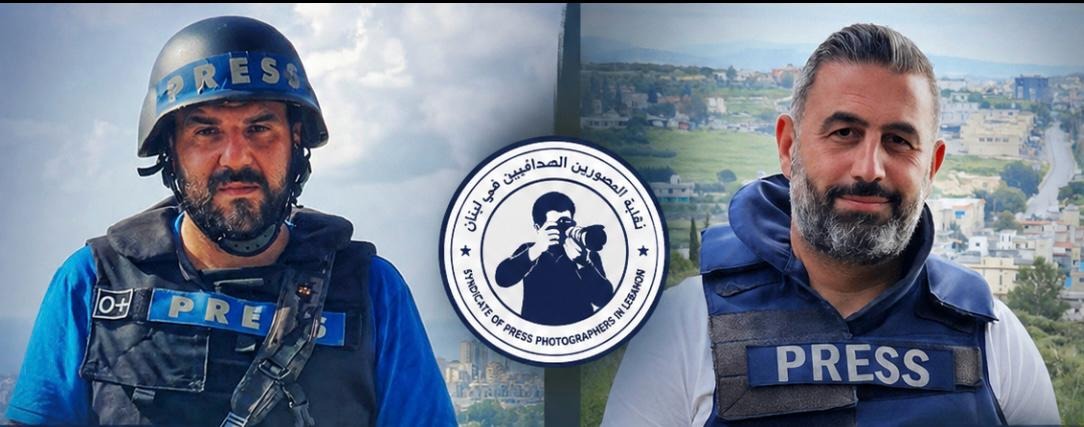
The two press photographers, Fadel Itani (on the left) and Mohammed Zeinati. (Credit: Photo provided by our correspondent in south Lebanon, Muntasser Abdallah)






SOUTH LEBANON — A heated altercation broke out Wednesday in Saida between a Lebanese Army officer and several press photographers who had come to cover the site of an Israeli drone strike that targeted a utility vehicle earlier in the day.
The incident involved shoving, tense verbal exchanges, and the temporary confiscation of a photographer’s phone, before the situation was eventually defused following interventions from the army’s Orientation Directorate and the Press Photographers Syndicate.
According to our correspondent in south Lebanon, the events took place shortly after an Israeli strike before 1 p.m. that killed the driver of a vehicle and injured his passenger near the city’s stadium. Several photographers quickly arrived on the scene to document it.
"When we arrived, everything was over. There were no dead or wounded in the vehicle that remained at the site. Other photographers were already present, some broadcasting live. We were just doing our job as we do after every strike, and the security forces were on site," independent photographer Fadel Itani told L’Orient-Le Jour.
"That’s when an officer from the Lebanese army arrived with his team, and he seemed determined to push the photographers away. Without hesitation, he ordered us to move back, using gutter language.
As we moved back, my colleague Mohammad Zeinati (Al-Afdal TV) was shoved and responded by asking the lieutenant to moderate his language. The exchange escalated between them. I tried to intervene to calm things down, but I was shoved as well. Mohammad was hit twice. He then threatened to call the army’s Orientation Directorate (which handles media relations), which led the officer to confiscate his phone," Itani continued.
The incident was quickly contained after interventions from both sides, and Mohammad Zeinati recovered his phone. But confusion remained. "Why such foul language, when we did not show any disrespect to the army?" the photographer asked.
The reaction from the Syndicate of Press Photographers in Lebanon was swift. In a statement, it condemned "the assault on Mohammad Zeinati, Fadel Itani, and other colleagues, as they were carrying out their professional duty covering the Israeli attack in Saida." "The syndicate deems this assault unacceptable from a historic national institution meant to protect journalists and civilians fulfilling their mission to convey the truth."
While affirming its respect for the role played by security institutions in maintaining order, the syndicate categorically rejects any attacks on journalists during the course of their work and emphasizes that press photographers are not a party to the conflict, but simply witnesses to the events and transmitters of facts.
"Targeting them represents a blatant violation of press freedom and citizens’ right to information," the statement insisted, calling on the army’s commander-in-chief to conduct an investigation to clarify the facts. The syndicate also called on the minister of information to take a firm stand and ensure the protection of journalists and photographers as they carry out their missions.
Reporting by our regional correspondent, Muntasser Abdallah.

 7 p.m. recap: Netanyahu seeks mastermind behind Flydubai incident; Washington sanctions 2 French nationals; Ben Gvir's 'I want to kill you' threat