






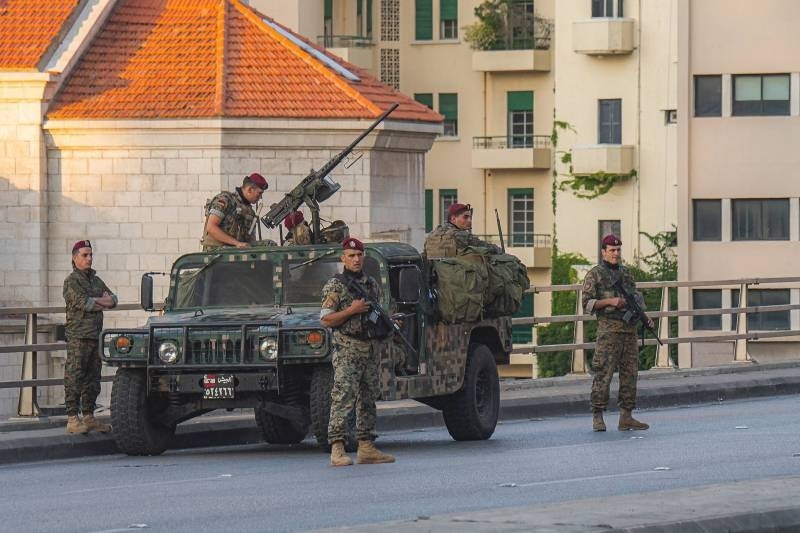
A deployment of the Lebanese Army in Beirut. (Credit: Archive photo Nabil Ismail/L'Orient-Le Jour)






BEIRUT — The army’s intelligence directorate announced the arrest in Lebanon of an Iraqi national, T.N., who is suspected of having impersonated a member of the Iraqi security forces. According to a military source speaking to AFP, this individual had reportedly been in contact with Lebanese security and military officials.
In a statement published on its X account, the army stated that it had monitored the individual and followed him to verify his identity. It added: “It emerged, following an investigation, that the man was in possession of false documents and that he had a military uniform, which was seized. He has been referred to the competent judicial authorities.”
A military source told AFP, speaking on condition of anonymity, that the man was “married to a Lebanese woman and had managed to gain the trust of an intelligence official in Beirut by posing as an Iraqi counter-terrorism officer and as a security attaché at the Iraqi embassy.” The Lebanese intelligence official allegedly helped him “make contact with security and army officials and meet with them,” the source added. During these meetings, “he promised to provide financial aid from Iraq,” according to the source, who noted that the motive for the identity fraud had not yet been established. The suspect actually works in a café on the road to the airport in the southern suburbs of Beirut, having started there as a valet, the military source said.
In a statement issued by the state-run National News Agency (NNA), the communications office of the Directorate General of General Security “denied that a meeting had taken place between the Director General, General Hassan Choucair, and the man nicknamed ‘Iraqi colonel’ who had impersonated a Lebanese security agent.” This response was addressed to the al-Hurra channel, which had published the report.
This case is reminiscent of that of Abu Omar, a mechanic from Akkar (far north of Lebanon) who pretended to be a member of the Saudi Arabian royal court to Lebanese political figures and businessmen, and was arrested with an accomplice in December 2025.
The incident highlights the deep-rooted corruption in Lebanon and the fragility of its institutions, which are based on a system of power-sharing between religious communities in a country plagued by widespread foreign interference, where personal connections often play a key role in securing influence, money and privileges.
This article was amended on 11 May at 2 p.m. to correct the statement that the suspect was posing as a member of the Lebanese security forces.
