


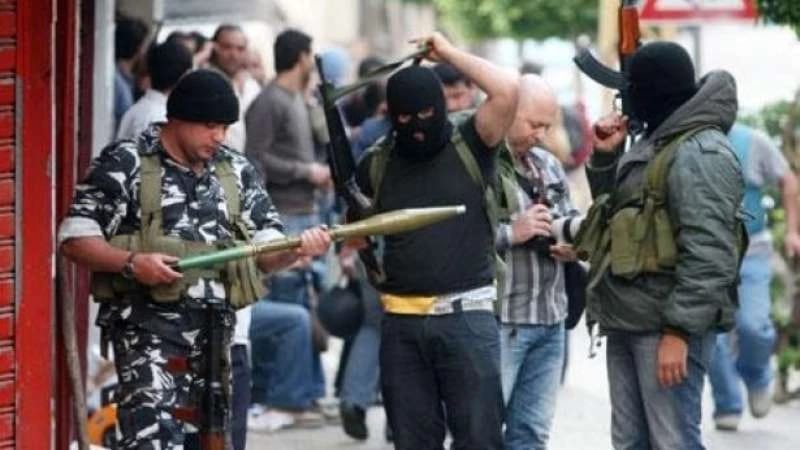
In the streets of Beirut, on May 7, 2008, heavily armed Hezbollah members. Photo taken from MP Waddah Sadek's X page.






BEIRUT — Several political figures commented Thursday on the 18th anniversary of the clashes of May 7, 2008, during which armed Shiite militiamen from Hezbollah stormed the streets of Beirut amid a political and security crisis, stating that Lebanon experienced a "black day" but is now working to move past it since "the masks have fallen."
"May 7 will remain a black day in the history of the militia and uncontrolled weapons that did not contribute to building the state and its institutions, but rather caused their destruction and that of their future," Bahaa Hariri, the elder brother of former Prime Minister Saad Hariri, emphasized on X.
Eighteen years ago, militiamen from the pro-Iranian Shiite party faced off with armed men from the Future Movement, Saad Hariri's party, in the heart of Beirut amid tension and after 18 months of political paralysis. The conflict began when the government led by Fouad Siniora ordered the dismantling of Hezbollah's telecommunications network.
For his part, the head of the Kataeb party, Samy Gemayel, an opponent of Hezbollah and ally of the pro-Western camp, said on X that May 7, 2026 marks the end of May 7, 2008—"the end of the show of force."
"May 7 is an important date because it refutes the idea that the weapons were directed outward. In reality, Hezbollah's weapons were turned inward and demonstrated their use to subdue the state and institutions, and to impose internal balances unrelated to fighting Israel. May 7, 2026 marks the end of May 7, 2008, the end of the show of force, through the unity of the Lebanese in the face of the confiscation of their decision and their future," he emphasized.
Meanwhile, MP Adib Abdel Massih, who joined the Kataeb party on Thursday, mentioned a "painful anniversary of the takeover by the state within the state," stating that "May 7 today is different because there are voices saying no to arms and no to discord, and yes to a demilitarized Beirut," as reported by the state-run National News Agency (NNA).
Beirut MP Fouad Makhzoumi, in turn, posted the following comment on X: "May 7 is the day all the masks fell. The day when Hezbollah used its weapons against Beirut and against the Lebanese, thus proving that a weapon outside the state does not protect a homeland but destroys the country from within."
He lamented that "since that day, May 7 has never left Lebanon. It continues in various forms: a collapsed state, paralyzed institutions, a stifled capital, and villages in the South abandoned to occupation and destruction, while Hezbollah insists on keeping its weapons above the state and the law." "Hezbollah's weapons have not protected Lebanon; they have led it from one collapse to another, opening the doors of Beirut, the South, and the entire country to chaos and isolation," assessed the Sunni MP.
MP Waddah Sadek, from the Opposition, recalled that May 7 is the date that "laid bare the real function of the weapons." "The day the party [Hezbollah] invaded Beirut with the same weapons it had, for years, presented to the Lebanese as directed against Israel, while they were in fact pointed at the residents of Beirut," he noted.
"That day, the city was not occupied by an external enemy, but tasted the bitterness of the use of internal weapons, and the mask fell on a project that only knew 'resistance' as a slogan to justify control and intimidation," he added.
Sadek stated that "May 7 will remain a black mark in the history of this party, and a day that proved the gravest danger to nations is not the enemy’s weapons, but those turned against a country's own citizens."
Despite repeated warnings from Lebanese officials, Hezbollah brought Lebanon into the conflict with Israel, first on Oct. 8, 2023, to support the Palestinian Islamist movement Hamas in its war against the Israeli state, and then on March 2, 2026, after Israeli strikes against Iran killed the leader of the Republic, Ali Khamenei.
Hezbollah still refuses to hand its arsenal over to the Lebanese state, despite repeated Israeli strikes on the country and calls from Lebanese authorities and the international community.
Since March 2, Israeli attacks on Lebanon have killed at least 2,704 people and wounded 8,311, displacing more than 1.6 million people — about one fifth of the country's population — according to the latest official figures.
 Israeli army carries out demolition at Jabal Amel School in Houla as strikes continue