






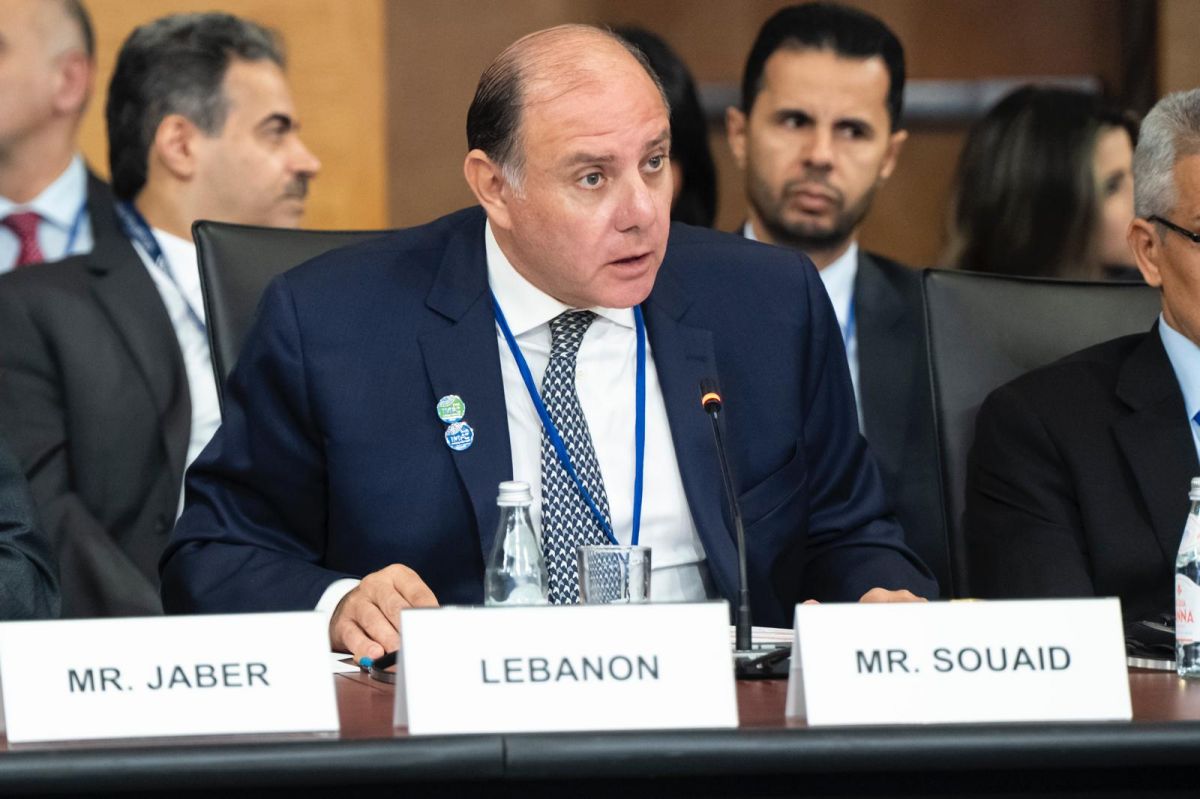
The governor of the Banque du Liban (BDL), Karim Souhaid, during a meeting in Washington in October 2025. (Credit: BDL)






BEIRUT — In a statement released Tuesday, May 5, the governor of the Banque du Liban, Karim Souhaid, defended his monetary policy in response to recent media reports on the evolution of the institution’s foreign currency assets.
He attributed the recent decline in foreign exchange reserves to a combination of geopolitical factors—particularly since the resumption of the war between Hezbollah and Israel on March 2 — as well as the impact of government social measures. He stated that the temporary drop of $516 million recorded in February, March, and April 2026 “does not reflect any failure of monetary or financial policies,” but rather exceptional geopolitical developments that slowed the central bank’s foreign currency purchases and market interventions.
Souhaid added that cash payments increased at the start of 2026 due to higher public sector spending and increased withdrawal limits under Circulars 158 and 166, which allow limited withdrawals of “fresh dollars” from bank accounts frozen since 2019. These factors, he said, placed “temporary pressure” on asset levels.
He also noted that the value of BDL assets is affected by accounting factors linked to global exchange rate fluctuations, particularly movements of the euro against the dollar, stressing that these do not reflect real cash flows. He maintained that the central bank continues to control the money supply in Lebanese pounds in coordination with the finance ministry, contributing to long-term exchange rate stability.
Appointed in late March 2025, Souhaid called for assessing reserve trends over his full first year in office. Based on official data, he said BDL assets recorded a net increase of $372 million—reaching about $11.43 billion—between April 2025 and April 2026. He added that reserves rose by approximately $888 million between April and December 2025.
He concluded that the central bank’s monetary policies, alongside the الدولة’s financial policies, have helped maintain relative market stability and protect assets despite limited financial resources and exceptional conditions.
Visit to Washington announced
Two days after issuing his statement, Souhaid met with President Joseph Aoun in Baabda Presidential Palace to discuss monetary and economic stability, as well as recent developments related to banking reform laws, according to a presidency statement published on X.
Souhaid also informed the president of an upcoming visit to the United States, where he is expected to meet key officials from the International Monetary Fund and U.S. authorities responsible for monetary, financial, and Treasury affairs.
This comes after the Lebanese government approved amendments on April 30 to the July 2025 bank resolution law to better align it with IMF requirements, while a draft law addressing the country’s financial gap is still pending.
Discussions are also expected to cover regulations on non-bank financial institutions, which the central bank has tightened over the past year amid growing U.S. and international pressure on Hezbollah’s financing networks.

 Evening recap: Netanyahu announces West Bank offensive; 7 killed in Jordan church shooting; tents burned in south Lebanon
 US strike on Iran this weekend? ‘Absolutely,’ says Barrack; ‘I have no idea,’ says Trump