





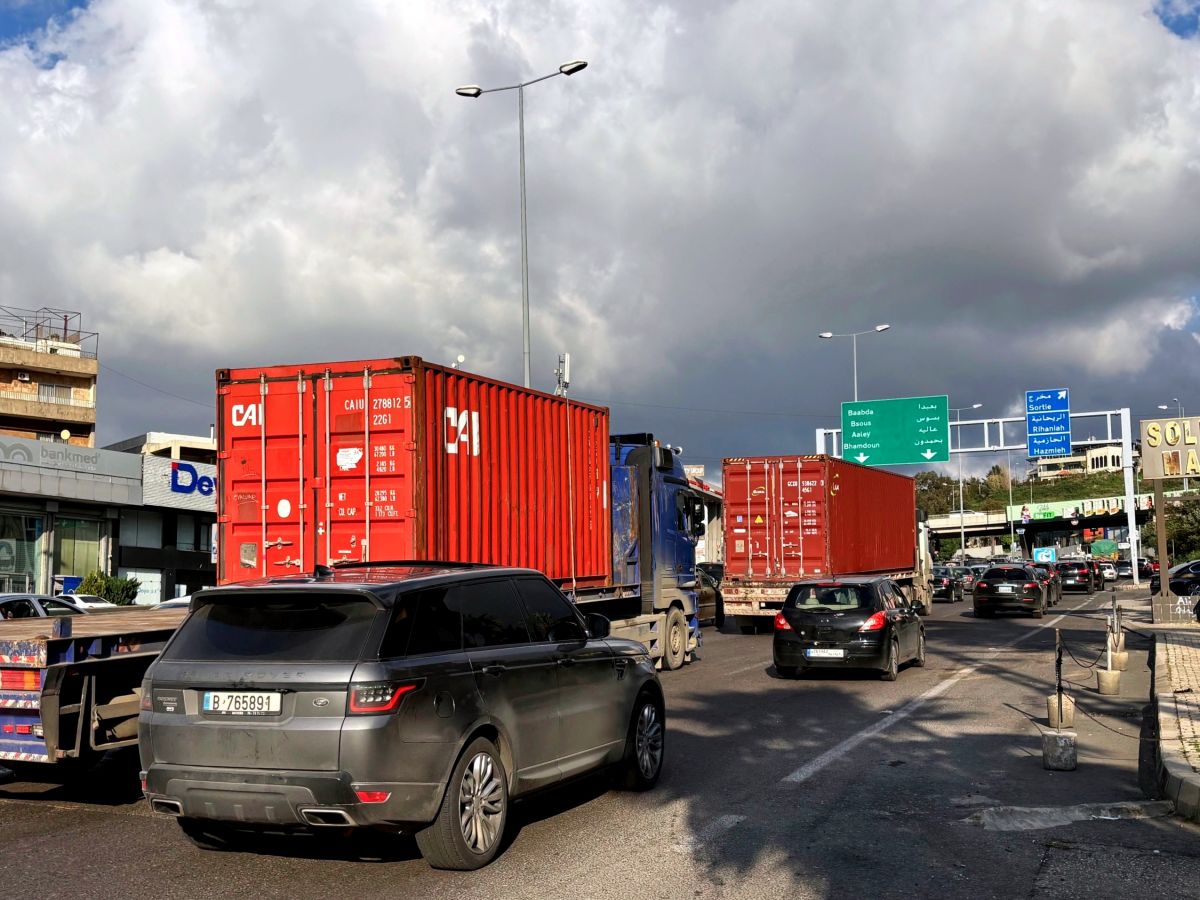
Vehicles leaving the capital en masse on April 8, 2026, the date when Israel carried out around a hundred strikes across the country without warning. (Credit: Philippe Hage Boutros/L’Orient-Le Jour)






The economy is expected to enter a recession in 2026, combined with strong inflationary pressures, if the war with Israel, which resumed on March 2, does not end quickly, warns the economic service of Bank Audi.
"Although it is still too early to assess the impact of the war on the 2026 fiscal year, its repercussions should be both recessionary and inflationary. They are recessionary due to the large-scale uncertainties it generates. They are also inflationary, due to a supply shock caused by the rising prices of oil and gas. Thus, Lebanon has, in the short term, entered a scenario of stagflation, with all its macroeconomic and social repercussions, in the hope that these unfavorable conditions will end quickly," the bank wrote in its latest quarterly report.
Double-digit inflation and recession?
In its study, Bank Audi estimates that Lebanon lost $75 million for each day of war in March, based on an internally developed methodology, which distinguishes — as the World Bank’s does, for example — direct damages ($35 million) from lost earnings ($40 million) incurred.
While this report, published in mid-April, also offers an optimistic scenario — based on the assumption of a more or less respected truce, even without a peace agreement — which would allow the country to record zero growth in 2026 (notably supported by continued diaspora transfers and domestic consumption), inflation in the country is expected to surpass 20% in 2026 "due to higher oil and transport costs."
More importantly, "in our other scenarios [not quantified in the report, Editor's note], we believe the country could see a contraction of 5% in GDP in 2026 if the war spreads and continues through June, and 11% if it does not end in 2026," summarizes Marwan Barakat, head of the bank's research department, speaking with L’Orient-Le Jour, while the truce, which has been renewed for three weeks, continues to see multiple Israeli and Hezbollah violations in South Lebanon.
Several economists already estimate the war could contract GDP in a range of 12% to 16%, according to the Institute of International Finance.
Finance Minister Yassin Jaber recently stated that losses suffered by Lebanon since March 2 amounted to $3 to $4 billion, while indicating that he is awaiting more precise estimates from the World Bank.
The latter had estimated a 7.1% drop in GDP in 2024 — marked by the previous conflict between Hezbollah and Israel — and growth of 3.5% in 2025. Meanwhile, the Central Administration of Statistics (CAS), which only recently published the 2024 numbers, calculated that GDP declined by 5.4% that year, but was unable to provide estimates for the following year.

 7 p.m. recap: Iran warns Egypt, Israeli soldiers vote in south Lebanon, Haret Hreik responds to Kataeb