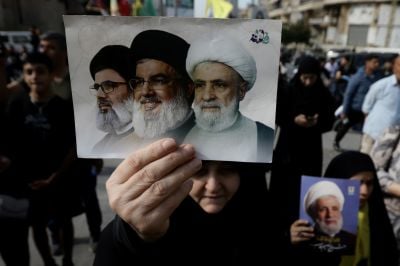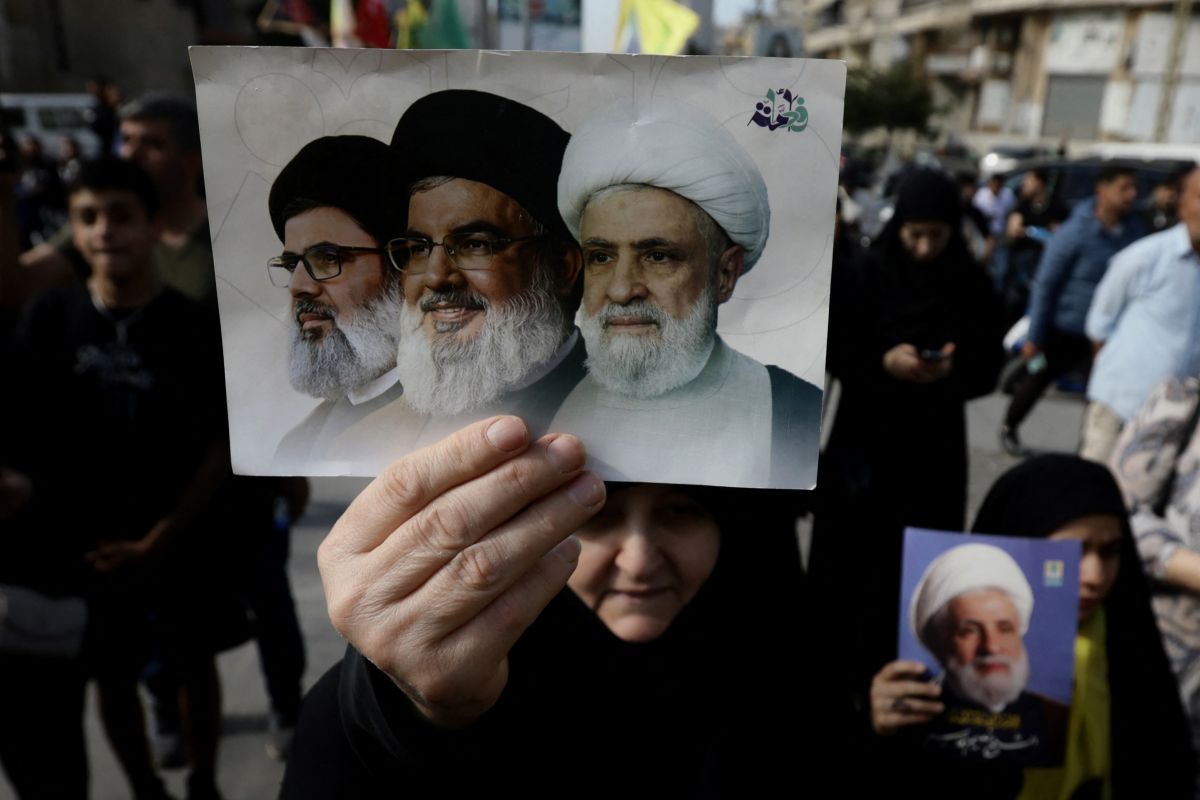
A Hezbollah supporter holds an image of Hezbollah leaders assassinated by Israel, Hashem Safieddine (L), Hassan Nasrallah (C), and current leader Naim Qassem, during a solidarity rally against the United States and Israel, in Beirut's southern suburbs on April 25, 2026. (Credit: Ibrahim Amro/AFP)






BEIRUT — Hezbollah chief Naim Qassem on Thursday again urged Lebanese authorities to reverse their decision to enter direct negotiations with Israel, warning it “plunges Lebanon into instability,” and to rescind their move to ban the group’s military wing.
In a statement broadcast on Al-Manar, Qassem said Israel is “at an impasse” against the “resistance.”
He criticized the government for pursuing direct talks with Israel, calling them a “gratuitous, humiliating and unnecessary concession” that amounts to “submission without compensation.”
Qassem reiterated his “categorical rejection” of direct negotiations, calling instead for indirect talks. He accused the Lebanese executive of “giving up Lebanon’s rights, ceding territory and confronting its own resisting people.”
Israel continues strikes in southern Lebanon and is demolishing border villages to establish a “buffer zone,” despite a cease-fire in effect since April 17.
'We will not abandon our weapons'
Qassem said Lebanese leaders must reverse what he described as “serious mistakes that plunge Lebanon into a cycle of instability,” including the government’s March 2 decision that criminalizes “the resistance and its supporters.”
On that date, after Hezbollah launched rockets into Israel and war resumed, authorities declared all military and security activities by the group and other non-state actors illegal.
“The weapons of the resistance are defensive,” Qassem said. “We will not abandon them.”
He also repeated Hezbollah’s five demands: an end to Israeli attacks, withdrawal from occupied territory, the release of prisoners, the return of displaced residents to their villages, and reconstruction.
Qassem thanked Iran for the cease-fire reached on April 17, which followed a call between President Joseph Aoun and U.S. President Donald Trump, two days after a meeting at the State Department in Washington that brought together Lebanese and Israeli ambassadors.
He described that day as a “day of shame,” adding that he considers the direct negotiations and their outcomes “nonexistent.”
'A fire will break out and consume the cedars of Lebanon'
Israeli Defense Minister Israel Katz went on to say that Hezbollah would lead Lebanon to disaster. “Naim Qassem is playing with fire, and that fire will consume Hezbollah and the whole of Lebanon... If the Lebanese government continues to take refuge under the wing of the terrorist organization Hezbollah, a fire will break out and burn the cedars of Lebanon,” Katz told the U.N. Special Coordinator for Lebanon, Jeanine Hennis-Plasschaert, according to a statement issued by his office.
Meanwhile, the Israeli Foreign Minister, Gideon Sa'ar, stated that the Lebanese government must “take decisive action against Hezbollah and its fighters” during a meeting with Hennis-Plasschaert, according to a post on his X account. He noted that this must involve “in particular financial measures targeting its sources of funding.” He also accused Hezbollah of deploying near the United Nations Interim Force in Lebanon (UNIFIL), several of whose members the Israeli army is accused of having killed in late March. “We are seeing an increasingly dangerous pattern: Hezbollah is systematically deploying its fighters and resources near UNIFIL positions, exploiting its presence to carry out hostile actions. It is using these positions to monitor Israeli forces and is moving its fighters in vehicles identical to those of UNIFIL,” the Israeli minister stated.
According to him, Hezbollah has fired “around 10,000 rockets, missiles and drones at Israel since March 2,” the date on which the group entered the regional conflict. “Many of these attacks were carried out in the vicinity of UNIFIL positions,” he added.
Later in the day, Israeli Prime Minister Benjamin Netanyahu stated that the dual threat posed by Hezbollah’s rockets and drones necessitated the continuation of military action in Lebanon, according to a statement from his office. “There are still two main threats from Hezbollah: 122-mm rockets and drones. This requires a combination of operational and technological measures,” Netanyahu said.