




A view of Lebanese Middle East Airlines airplanes on the tarmac at Beirut's international airport, March 31, 2026. (Credit: Amr Abdallah Dalsh/Reuters)






BEIRUT — Emirates announced that it will resume flights between the United Arab Emirates and Lebanon starting April 27, joining a growing list of regional carriers returning to Beirut.
The announcement follows the earlier resumption of services by Etihad Airways, Air Arabia, Flydubai, and Qatar Airways. On Tuesday, EgyptAir said it would restart flights between Beirut and Cairo on April 23.
According to two Lebanese travel agency sources, Emirates plans to operate one daily flight until at least June 30, with frequencies to be adjusted depending on demand. EgyptAir said it will operate two daily flights starting April 28 and is considering adding a third “as soon as possible.”
The announcements come amid uncertainty over the durability of cease-fires in the region — between Iran and the United States on one hand, and Lebanon and Israel on the other.
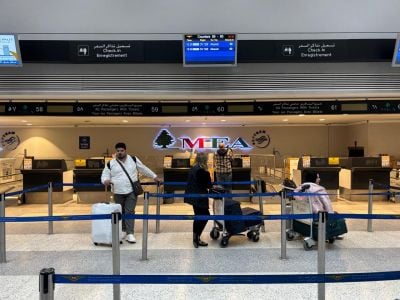
The two-week truce between Tehran and Washington expired overnight from Tuesday into Wednesday, while the 10-day agreement between Beirut and Tel Aviv is due to be discussed again in Washington on Thursday.
Air traffic had been severely disrupted after most foreign airlines suspended operations at Beirut’s international airport following the outbreak of hostilities in late February, triggered by U.S. and Israeli strikes on Iran and followed by renewed fighting between Hezbollah and the Israeli army on March 2. Several countries in the region also partially closed their airspace during the escalation.
In recent weeks, however, announcements of flight resumptions have accelerated. Alongside Gulf carriers and Qatar Airways, Cyprus Airways, Royal Jordanian, and Iraqi Airways have confirmed their return to Beirut. Air France and Turkish Airlines have yet to announce a timeline.
The broader regional war has nonetheless strained the aviation sector. Rising oil prices and supply chain disruptions have driven up airfares globally, while airlines are closely monitoring fuel supplies. Kuwait International Airport, which was hit by Iran during the war, has yet to reopen.
On Wednesday, the European Union unveiled measures to address the energy shock caused by the war, including tighter monitoring of jet fuel supplies to prevent shortages that could disrupt air travel this summer.


 7 p.m. recap: 1 person killed near border with Lebanon; 200 kilos of explosives carried by mules; Riyadh shuts its airspace