






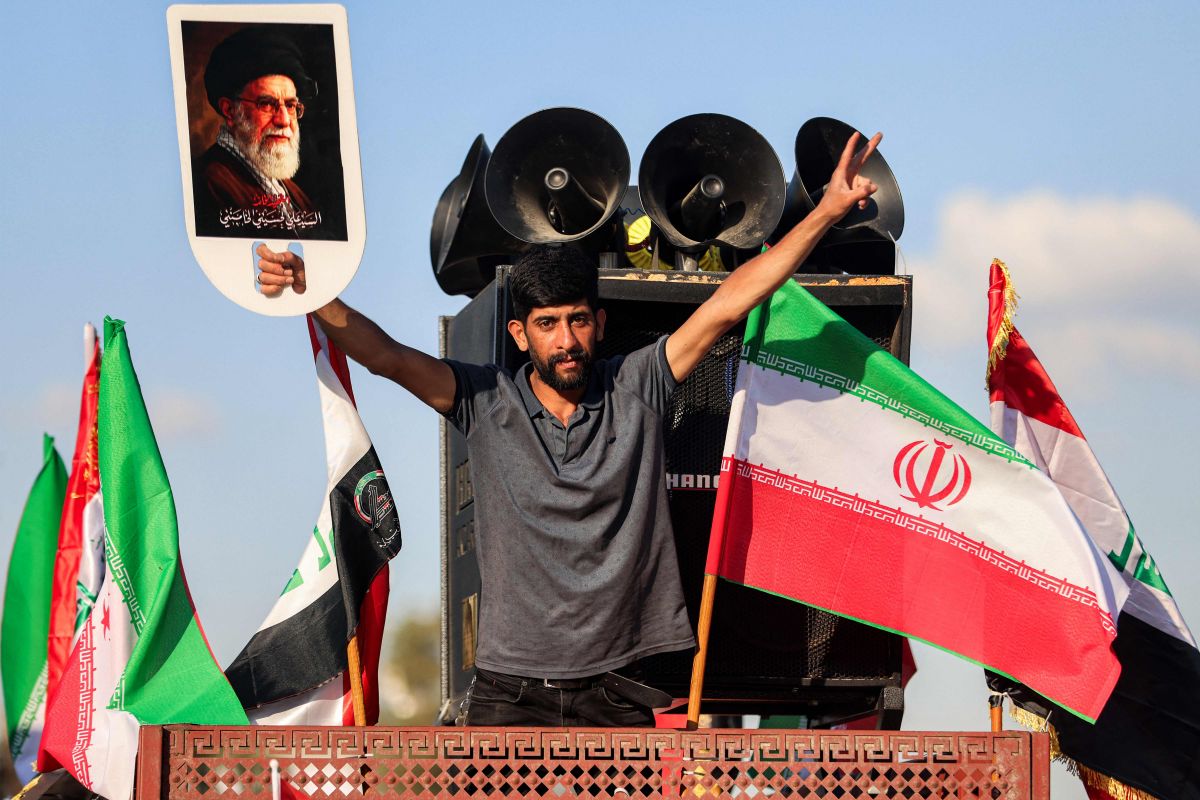
A man holds up a photo of Ayatollah Ali Khamenei, the assassinated Supreme Leader of Iran, next to Iranian and Iraqi flags, from the roof of a truck, during celebrations marking the two-week cease-fire between the United States and Iran, at Tahrir Square in central Baghdad, on April 8, 2026. (Credit: Ahmad al-Rubaye/AFP)






As tensions between the United States and Iran have shifted to an open confrontation, Iraq, long a space of managed rivalry between the two powers, has again been drawn toward the front lines. The election, Saturday, April 11, of Kurdish politician Nizar Amedi as president, after nearly five months of deadlock, offered a semblance of a breakthrough. But the main challenge remains: appointing a prime minister capable of navigating a political system under pressure, both internally and externally. Today in Iraq, forming a government is inseparable from a broader regional realignment shaped by U.S. pressure, Iranian influence, and the growing autonomy of armed groups integrated into the state apparatus.Maliki sidelined, Soudani weakenedAt the center of this equation is former Prime Minister Nouri al-Maliki, backed by part of the Shiite...
As tensions between the United States and Iran have shifted to an open confrontation, Iraq, long a space of managed rivalry between the two powers, has again been drawn toward the front lines. The election, Saturday, April 11, of Kurdish politician Nizar Amedi as president, after nearly five months of deadlock, offered a semblance of a breakthrough. But the main challenge remains: appointing a prime minister capable of navigating a political system under pressure, both internally and externally. Today in Iraq, forming a government is inseparable from a broader regional realignment shaped by U.S. pressure, Iranian influence, and the growing autonomy of armed groups integrated into the state apparatus.Maliki sidelined, Soudani weakenedAt the center of this equation is former Prime Minister Nouri al-Maliki, backed by part of the Shiite...

 Evening recap: Netanyahu announces West Bank offensive; 7 killed in Jordan church shooting; tents burned in south Lebanon