


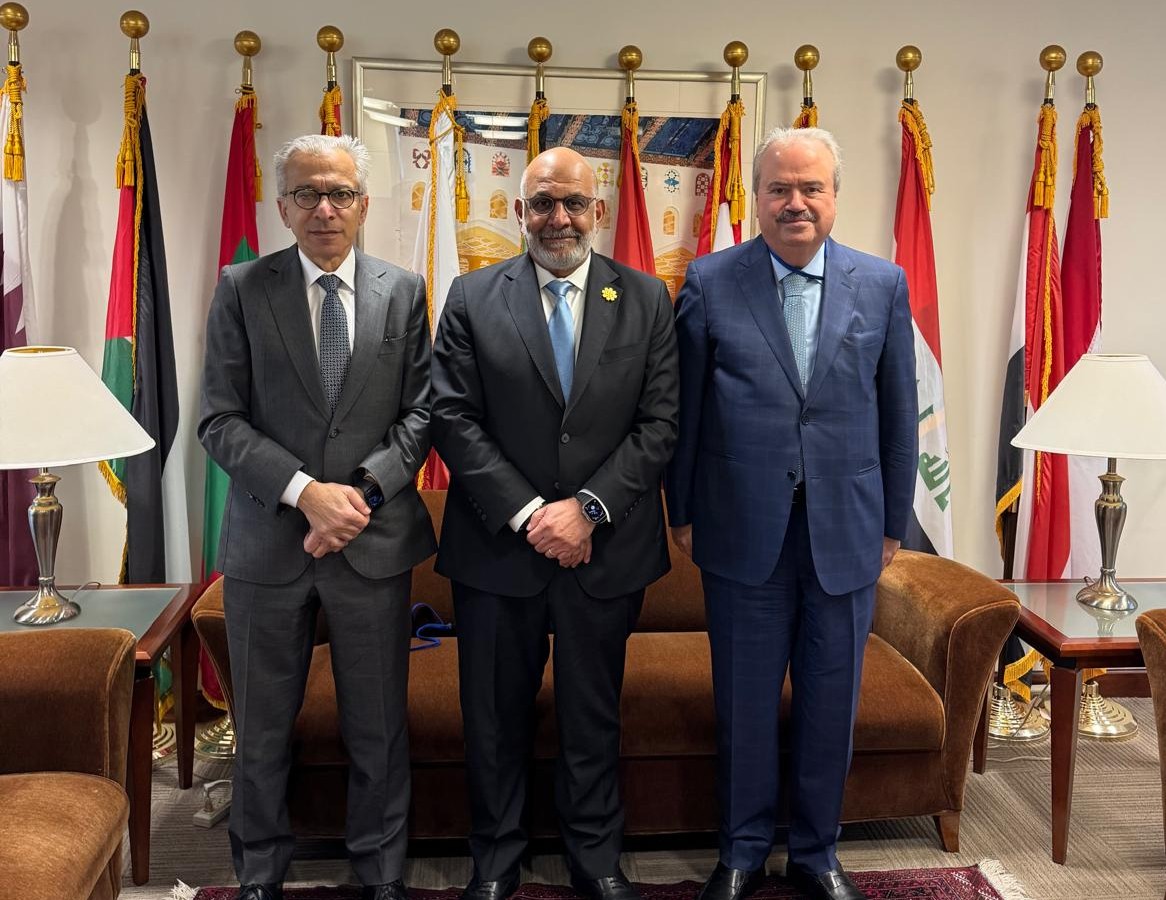
The World Bank’s Regional Executive Director for the Middle East, Abdulaziz Ibrahim al-Mulla, flanked by the Lebanese Ministers of Finance, Yassine Jaber, and Economy, Amer Bisat, in Washington on April 14, 2026. (Photo released by the Finance Ministry)






BEIRUT — Arriving in Washington over the weekend to take part in the International Monetary Fund (IMF) and World Bank (WB) spring meetings, which will run throughout the week, Finance Minister Yassine Jaber said that the negotiations between Israel and Lebanon, being held in the U.S. capital, are "key" to unlocking the parallel talks Lebanon is conducting with the Bretton Woods organizations. These talks aim to secure more reconstruction aid and a financial assistance program from the IMF, conditional on reforms, more than six years after the onset of the crisis that devastated the country’s financial system.
The minister, who is leading a small delegation — accompanied by Economy Minister Amer Bisat, presidential palace representative Roula Harati, and Finance Ministry economic affairs adviser Zeina Qassem — spoke to al-Jadeed several hours before the Israel-Lebanon talks began at 6 p.m. Lebanon is caught in the spiral of war that resumed on March 2 between Hezbollah and Israel.
While Lebanon’s participation in the spring meetings was initially intended to advance the reform dossier, the ongoing situation has forced the delegation to focus much of its discussions on "the losses suffered by Lebanon as a result of successive crises," and on "highlighting urgent needs and national priorities," the minister said in a statement released in the afternoon.
He said the Lebanese delegation began its official meetings Monday in Washington with a session with Abdulaziz Ibrahim al-Mulla, the World Bank’s regional executive director for the Middle East, and Ernesto Ramirez, the IMF mission chief for Lebanon, whose mandate may soon end. "The meeting was dedicated to assessing the economic and financial repercussions of the war and their effects on Lebanon, including an evaluation of the impact of recent developments on financial and monetary stability, as well as the growing economic costs of the current situation," the minister wrote.
The delegation also held a meeting with European representatives from Lebanon’s main donor countries, followed by another meeting with IMF executives focused on ways to support Lebanon in the present context, the impact of the war, and social protection programs. On this occasion, the minister recalled that the loan approved by the World Bank in January — providing a new $200 million allocation to the Emergency Social Safety Net (ESSN) project — will be signed Wednesday. The World Bank’s board had approved this loan last Wednesday.
The minister added that the redirection of certain aid to meet needs imposed by the current situation was a central topic, as was the plan to conduct specialized studies to organize mechanisms to mitigate economic and social damage, in light of the significant changes Lebanon has undergone over the past five years.

 7 p.m. recap: Netanyahu seeks mastermind behind Flydubai incident; Washington sanctions 2 French nationals; Ben Gvir's 'I want to kill you' threat