






UNIFIL position hit by Israeli artillery in southern Lebanon
A position of the UNIFIL was struck by Israeli artillery fire in Aad Sheet al-Qoussair, according to state-run National News Agency.
The report said the position was manned by Indonesian peacekeepers, with local media indicating that some of the wounded were evacuated by helicopter. The Israeli Army has advanced in the area in recent days.
UNIFIL has not immediately confirmed any casualties among its forces.
Hezbollah targets Israeli troops inside house in Houla
Hezbollah said it targeted a unit of 15 Israeli army soldiers inside a house in Houla at 17:30, claiming “direct hits.”
Rescue teams and military vehicles were reportedly dispatched to evacuate the wounded under heavy smoke cover.
The group also said it struck a Merkava tank in Qouzah, and targeted gatherings of Israeli soldiers and vehicles in Deir Seryan.
Hezbollah further reported targeting another Israeli unit inside a house near Beit Lif and firing rocket salvos toward Nahariah.
Electricity cut in parts of Tehran after attacks on infrastructure, energy ministry says
Electricity was cut in parts of the Iranian capital Tehran and in Alborz province after attacks on infrastructure, Iran's state media cited the country's ministry of energy as saying on Sunday.
Shrapnel hit a part of the electricity grid in Alborz province, causing power to be cut in several areas of Tehran and the city of Karaj. Authorities were working on reinstating it, state media added.
Hezbollah fires surface-to-air missile at helicopter over Naqoura
After claiming to have fired on an Israeli aircraft over Nabatieh and shot down a drone over Mansouri, Hezbollah said it launched a surface-to-air missile at a helicopter over Naqoura at 17:40, reportedly forcing it to turn back.
Hezbollah also said it targeted a Hummer and a bulldozer east of the Khiam prison, a location recently captured by Israel. The group claimed a drone strike on a Merkava tank on a hill overlooking Qantara, and fired rockets at Israeli troops in the plains near Aitaroun.
Additionally, Hezbollah said it launched rockets toward the Keilaa barracks and the Hadab Yaron position.
Over 1,200 killed in Israeli attacks on Lebanon since March 2
Forty-nine people were killed in the past 24 hours in Lebanon due to Israeli strikes, the Ministry of Health reported, bringing the total death toll since March 2 to 1,238.
Among the 1,238 killed, 87 were women, 124 were children, and 52 were medical personnel or first responders.
Southern Lebanon remains under Israeli fire
Alongside ground clashes, the Israeli Army continues to shell southern Lebanon. Artillery strikes have hit Debbin, Baraa Sheet, Shaqra, as well as Qoussair, Qalawieh, Majdel Selm, Swaneh, Qabrikha, and Touline. Illuminating shells were also fired over Baraa Sheet.
An Israeli artillery bombardment using white phosphorus shells targeted the western part of Taybeh.
Meanwhile, the Israeli Air Force conducted multiple airstrikes, including near Zawtar al-Gharbieh, Blat, Khiam, Touline, and Haris. Intense strikes also targeted the outskirts of Yohmor al-Chaqif, alongside bombardments on Adsheet al-Qoussair.
Hezbollah claims multiple attacks on Israeli positions in southern Lebanon
Hezbollah said it targeted an Israeli Army Merkava tank in Bayyada at 14:00, another in Deir Seryan at 15:45, and two more near Beit Lif at 16:25, using guided missiles with claimed direct hits.
The group also reported targeting gatherings of Israeli soldiers with artillery at Bayyada at 16:00 and with a rocket salvo at Deir Seryan at 16:45, prompting the Israeli army to evacuate wounded under a smoke screen.
Additional clashes were reported at Shamaa at 16:30, along with an air defense operation against an Israeli aircraft over Nabatieh at 00:30. Hezbollah claimed to have shot down an armed Israeli drone over Mansouri at 17:25.
Israeli positions were reportedly hit repeatedly, including a soldier gathering at Aitaroun at 00:20, the Malkiya site at 00:30, 12:30, and 14:55, a soldier assembly at Alma al-Shaab, and an artillery position at Arab al-Louaizeh at 16:45.
In addition, Hezbollah said it fired rocket salvos toward northern Israeli towns including Malkiya, Yir’on, and Avivim.
Israeli 146th Brigade advances in southern Lebanon amid clashes with Hezbollah
The 146th Brigade, part of the northern command, said it has “expanded” the buffer zone in southern Lebanon and is “advancing toward another objective,” though the exact location was not specified.
According to Israel’s Channel 14, the brigade has been active near Bayyada, where intense clashes with Hezbollah took place south of Sour. The Ras Bayyada area was reportedly captured within hours, with fighting now focused around Shamaa.
Separately, the Israeli Army said its 769th Brigade carried out an airstrike on a building, in an undisclosed location, targeting members of Hezbollah.
Netanyahu says Israel has created deep security zones in Lebanon, Syria, and Gaza
Benjamin Netanyahu held a situation assessment in northern Israel with the Israeli Army chief of staff and the defense minister, highlighting the creation of three deep security zones in enemy territory, including Syria the Middle East, Lebanon and over half of the Gaza Stripestinian territory.
Netanyahu said the operations have changed Israel’s security doctrine, claiming that thousands of Hezbollah fighters were eliminated and the threat of 150,000 missiles and rockets aimed at Israeli cities has been reduced.
He added that Hezbollah still retains “a reasonable ability to launch rockets,” and discussions with commanders focused on ways to remove this remaining threat.
Netanyahu orders Israeli army to expand buffer zone in southern Lebanon
Benjamin Netanyahu said he has instructed the Israeli Army to “further expand the existing security zone” in southern Lebanon.
In a video statement, he said the move aims “to permanently neutralize the threat of infiltration and push anti-tank missile fire away from the border” as operations continue against Hezbollah.
Hezbollah targets Israeli advances in central border zone
Clashes between Hezbollah and the Israeli Army have concentrated in the central sector of the Lebanon-Israel border, particularly near Ainata, about four kilometers from the closest point of the Blue Line.
Hezbollah said it launched rocket attacks on the heights of Ghadmatha and targeted Israeli troops near Khallet al-Hajjah. Overnight, the group reportedly carried out four separate attacks on Israeli soldiers and vehicles in Maroun al-Ras, south of Ainata.
Access to Holy Sepulchre restricted for security reasons, says Netanyahu
Benjamin Netanyahu said the Israeli police decision to bar the Latin Patriarch of Jerusalem from entering the Church of the Holy Sepulchre for Palm Sunday mass was based solely on security concerns, with “no malicious intent.”
According to his office, the Jerusalem Police prevented Cardinal Pierbattista Pizzaballa from officiating the service out of concern for his safety.
Fighting intensifies in south Lebanon as Merkava tanks reported destroyed
Fighting between Hezbollah and the Israeli Army escalated in several areas of southern Lebanon, including Bayada, Shamaa, and the outskirts of Ainata.
Hezbollah said it targeted multiple Merkava tanks in Bayada, while in Shamaa it claimed its fighters forced Israeli troops to retreat and struck a tank with a “tandem charge,” setting it on fire. Clashes have been ongoing for hours, with reports of close-range combat.
In the central sector, fighting also broke out between Aitaroun and Aïnata, where Hezbollah said it carried out an ambush using roadside explosives, machine guns, and rockets, and targeted two Merkava tanks with drones.
Meanwhile, Israeli forces reportedly demolished homes in Deir Seryan in the Marjayoun district.
ADAMA plant in southern Israel hit by Iranian missile or debris
Israel's ADAMA , a maker of active ingredients and crop protection materials, said its Makhteshim plant in southern Israel had been hit by either an Iranian missile or debris from a missile, but no injuries were reported.
ADAMA, part of Chinese owned Syngenta Group, said the damage to the plant was not immediately known.
Israeli operation in Lebanon could last 'months or years'
The military operation in Lebanon could last for "months or even years," according to Israeli officials cited by Yedioth Aharonoth.
Officials said the Israeli Army is likely to remain in the area for an extended period, arguing that the Lebanese government cannot disarm Hezbollah. A continued Israeli military presence deep inside Lebanese territory could persist for months or longer, even in the event of a cease-fire.
🔗More details here.
AUB moves online after Iranian threat to US universities
The American University of Beirut (AUB) will operate remotely for two days after threats by the Islamic Revolutionary Guard Corps targeting U.S. universities in the region.
President Fadlo Khouri said no direct threat has been identified, but classes and exams will be held online as a precaution.
The IRGC warned of possible retaliation following alleged U.S.-Israeli strikes on Iranian universities, urging people to stay at least one kilometer away from American campuses in the Middle East.
Israeli army reiterates its call to evacuate 7 districts in Beirut's southern suburb
In a statement posted on X via its Arabic-language spokesperson Avichay Adraee, the Israeli army renewed its evacuation warning for seven neighborhoods in the southern suburbs of Beirut: Haret Hreik, Ghobeiri, Laylaki, Hadath, Burj al-Barajneh, Tahwitat al-Ghadir, and Chiyah.
The statement, which has been repeatedly issued since March 2, said the army “continues its attacks against Hezbollah military infrastructure” in these areas “with increased intensity.”
Southern Israel industrial zone likely hit by 'missile debris'
The Israeli army told AFP that an industrial zone in southern Israel was likely hit by “missile debris,” after media outlets released images showing a thick plume of black smoke over the site.
According to television channels, the site is the Ramat Hovav industrial zone, north of Beersheva, the main city in southern Israel located in the Negev desert.
Asked by AFP, the army — which had earlier reported a missile launch from Iran toward Israeli territory — said: “We understand there was an impact from missile debris.”
Middle East war: Pakistan hosts foreign ministers of Saudi Arabia, Turkey and Egypt
The foreign ministers of Pakistan, Saudi Arabia, Egypt and Turkey are meeting in Islamabad today for talks on the war in the Middle East, where Pakistan is playing a mediating role between the United States and Iran, AFP reported.
Scheduled for the afternoon, the meeting of foreign ministers from these Muslim-majority countries is expected to address “a range of issues, including efforts to de-escalate tensions in the region,” said Pakistan’s foreign ministry.
Ishaq Dar said the agenda includes de-escalation efforts in the region.
Badr Abdelatty and Hakan Fidan arrived in Islamabad on Saturday evening, while Saudi Foreign Minister Faisal bin Farhan arrived on Sunday afternoon for the meeting, which is expected to continue into Monday.
Several roads leading to Islamabad’s “red zone” — where key government buildings and diplomatic missions are located — were closed, AFP journalists reported. Security was tightened, and the road leading to the foreign ministry was decorated with flags of the four countries.
Bahrain bans night navigation in its territorial waters amid 'Iranian aggression'
The Bahraini Ministry of Interior announced a ban on night navigation in response to what it described as “flagrant Iranian aggression,” referring to strikes targeting the small island kingdom and its Gulf neighbors for more than a month, AFP reported.
The navigation ban, which takes effect “today and until further notice,” applies from 6:00 p.m. to 4:00 a.m. local time, the ministry said in a statement.
2 more LPG carriers bound for India cross the Strait of Hormuz
Two Indian-flagged vessels carrying liquefied petroleum gas (LPG) have crossed the Strait of Hormuz, India’s Ministry of Ports, Shipping and Waterways said on Sunday.
Following U.S.-Israeli military strikes that triggered the war on Feb. 28, Iran has almost halted maritime traffic through the Strait of Hormuz, a vital route for global crude oil and LPG shipments.
The LPG carriers BW TYR and BW ELM, carrying a combined cargo of around 94,000 tonnes, are en route to India’s west coast, the ministry said in a statement.
The BW TYR is heading to Mumbai, while the BW ELM is bound for New Mangalore.
Four other Indian LPG carriers had already crossed the strait earlier, but 18 India-flagged ships carrying 485 Indian seafarers remain in the Gulf region.
Houthis’ attacks on Israel: An 'irresponsible act,' says France
France on Sunday condemned attacks carried out by Yemen’s Houthis against Israel, calling them an “irresponsible act” that “increases tensions in the region.”
“The Houthis must refrain from any attacks,” said Pascal Confavreux, spokesperson for the French Ministry of Foreign Affairs, urging efforts “to avoid an even greater escalation of the conflict.”
The Houthis in Yemen claimed responsibility on Saturday for two attacks within a few hours against Israel, marking the entry of the Iran-aligned rebel group into the wider Middle East conflict.
At a time when global maritime traffic is already heavily disrupted by Iran’s blockade of the Strait of Hormuz, the Houthis’ involvement could further worsen the situation. The group had already carried out numerous attacks on commercial ships in the Red Sea between 2023 and 2025 during the war between Israel and Hamas in Gaza.
This could also have consequences for European Union countries, which have since 2024 deployed a maritime protection mission in the Red Sea called Operation Aspides.
On March 16, EU foreign ministers ruled out deploying this naval mission to the Strait of Hormuz. The operation currently consists of three warships — Greek, Italian, and French — based in Greece but under Italian operational command.
To extend its mandate to the Strait of Hormuz, an official modification of the mission’s scope would be required.
The Israeli army says it no longer accepts 'half-measures'
The Israeli army said on Sunday that it no longer accepts “half-measures” or “old equations” in Lebanon, arguing that the Lebanese state has “failed in its missions, both by not disarming Hezbollah and by failing to prevent Iranian entrenchment.”
“We are facing a historic moment to shape a new security reality whose impact extends from Tehran to Beirut. Our goal is to undermine the Iranian terrorist regime and eliminate existential threats to our citizens,” said the army’s Arabic-language spokesperson, Ella Waweya, in a post on X.
The message added that the army had struck more than 100 infrastructures in Iran, including ballistic missile factories, launch platforms and air defense systems, as well as 170 “terrorist” targets in Lebanon, while eliminating more than 850 militants since the beginning of the fighting.
“Today, we strike the head of the octopus in Iran and cut off its tentacles in Lebanon,” the spokesperson concluded.
Israel says it has carried out a cross-border operation from Mount Hermon for the first time.
The army’s mountaineering unit announced it had conducted, for the first time since the start of the war, a cross-border operation from Mount Hermon (on the Syrian side) into southern Lebanon, under the command of the Mountain Brigade (810). The operation aimed to counter attempts by armed groups to establish themselves in the border area with Lebanon, the army said.
“In the framework of this operation, Israeli army mountaineers operated in complex mountainous terrain, crossing the border by climbing through snow from Mount Hermon on the Syrian side into the Mount Dov (Har Dov) area in southern Lebanon, in order to sweep the area, gather intelligence, and detect enemy infrastructure, using the specific capabilities of this mountain commando unit,” the statement said.
“Forces of Division 210 continue to deploy in the region to ensure the security of Israeli citizens, particularly those in the north,” it added.
Iran threatens to target USS Abraham Lincoln if it moves within range
The head of the Iranian army’s navy, Shahram Irani, said the USS Abraham Lincoln would be targeted if it comes within firing range, AFP reported.
“As soon as the USS Abraham Lincoln carrier strike group is within range, we will avenge the blood of the martyrs of the Dena ship by launching various types of surface-to-surface missiles,” he warned, according to state television, referring to the Iranian frigate sunk by the United States on March 4.
Update from northern Bekaa and south Lebanon
At dawn, Israeli air force carried out a strike in Maqneh, a town near Baalbeck, targeting a concrete mixer. No casualties were reported, according to our correspondent in the Bekaa.
In south Lebanon, our correspondent reported an airstrike on the outskirts of Qleileh and Haniyeh (Sour). Artillery shelling involving phosphorus rounds also targeted al-Mansouri, in the Sour district.
The Qatari television channel Al Araby said that its office in Tehran was damaged in a strike
Al Araby channel said an Israeli missile hit the building housing its bureau in the Iranian capital, causing damage, AFP reported. “An Israeli missile targets the Al Araby building in Tehran. Significant damage and interruption of live broadcasts,” the channel said in a post on X.
Images filmed inside the office showed shattered windows, broken glass, and debris. Outside, nearby buildings were also damaged and the streets were covered in rubble. The intended target was not immediately known. The Al Araby office is located in a residential neighborhood in northeastern Tehran.
The head of the bureau, Hazem Kallas, said he was covering the war live when the missile struck the building.
Israel says it destroyed a rocket launch platform in the Bekaa overnight
The Israeli army's Arabic-language spokesperson, Avichay Adraee, said that it destroyed “a loaded launch platform ready to be fired toward Israeli territory,” which was “detected and destroyed in the Bekaa region” during the night, as well as other infrastructure.
“Ammunition depots and military buildings across Lebanon, used by Hezbollah elements to carry out hostile activities against Israeli forces and Israeli civilians, were also targeted,” he added.
Lebanon: Journalists must 'never' be targeted, says French diplomacy
France’s foreign minister, Jean-Noël Barrot, said that journalists working in war zones should “never” be targeted, “including when they have links with parties to the conflict,” AFP reported.
“If it is indeed proven that the journalists in question were deliberately targeted by the Israeli army, then that is extremely serious and a blatant violation of international law,” he told the public broadcaster France 3, a day after three Lebanese journalists were killed, including a prominent correspondent for Al-Manar, the TV station of the pro-Iranian Shiite group Hezbollah.
The Israeli army said it had killed Ali Choeib, whom it described as a member of the al-Radwan force, an elite unit of Hezbollah, operating “under the cover of a journalist” and, according to Israel, identifying Israeli army positions in southern Lebanon.
“Journalists must never be targeted in theaters of war, including when they have links with parties to the conflict,” Barrot said.
Ghalibaf accuses US of preparing a ground offensive despite public diplomatic efforts to end the war
“The enemy publicly sends messages of negotiation and dialogue while secretly planning a ground attack,” the Speaker of the Iranian Parliament, Mohammad Bagher Ghalibaf, said, according to the official IRNA news agency, as reported by AFP.
He added: “Our men are waiting for the arrival of American soldiers on the ground to burn them and punish their regional allies once and for all.”
The statement comes after a month of regional war which started on Feb. 28, when Israel and the United States launched airstrikes on Iran, killing its supreme leader and sparking a conflict that has spread across the Middle East.
Maritime traffic in the strategic Strait of Hormuz — through which around 20 percent of the world’s crude oil and liquefied natural gas normally transit — has been almost completely paralyzed by the conflict.
Ghalibaf called for unity among Iranians, saying the country was in a “major world war” that has reached “its most critical stage.”
“We are certain we can punish the United States, make it regret attacking Iran, and firmly secure our legitimate rights,” he concluded.
Israel accuses Hezbollah of using ambulances and medical facilities for military purposes
The Israeli army threatened Hezbollah again, saying it could target its medical facilities and ambulances, and calling on the group to immediately stop using medical installations for military purposes.
“Hezbollah is widely using ambulances for military purposes. We reiterate our warning that the military use of facilities must stop immediately, and we emphasize that if this practice does not cease, Israel will act in accordance with international law against any military activity carried out by the terrorist group Hezbollah using these facilities and ambulances,” said Israeli army Arabic-language spokesperson Avichay Adraee in a post on X.
The 3 journalists killed on Saturday buried in Choueifat
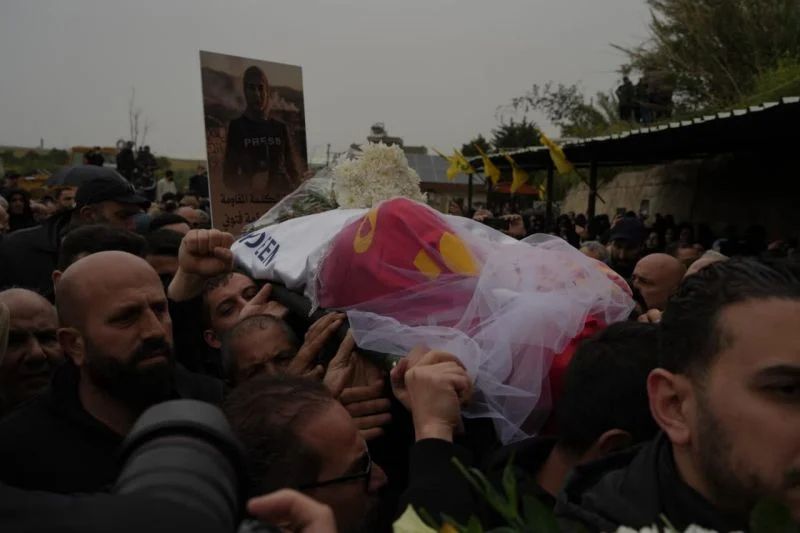
The coffin of journalist Fatima Ftouni, carried during her funeral on March 29, 2026, in Choueifat. (Credit: Mohammad Yassine / L’Orient-Le Jour)
Journalists Ali Choeib, Fatima Ftouni, and Mohammad Ftouni, who were killed on Saturday in a targeted Israeli drone strike on their vehicle in Jezzine in southern Lebanon, were buried on Sunday in Choueifat, in the presence of dozens of mourners.
Iran’s Ghalibaf accuses US of seeking Iran’s surrender
Iranian Parliament Speaker Mohammad Bagher Ghalibaf said: “The Americans are trying to force us into surrender, but our response will be clear and we will never submit.”
He added that the United States publicly talks about negotiations while secretly planning a ground offensive, according to the Arabic-language newspaper Annahar.
Update from 11 a.m. on south Lebanon:
An Israeli strike killed paramedic Youssef Atoui from the Al-Rissala Scouts affiliated with the Amal Movement colleagues in Aitit (Sour district). The strike targeted Atoui and his colleagues, according to our correspondent.
According to rescuers from the movement, a strike that destroyed the home of Daoud Amis in the village of Aaba (Nabatieh) after midnight killed two: Ahmad Daoud Amis (whose brother was killed two months ago in a drone strike on the Doueir road) and Samer Qteich.
Separately, the Israeli army reportedly demolished houses using explosives this morning in Khiam (Marjayoun), while artillery fire targeted the outskirts of Mazraat Majidieh (Hasbaya).
South Lebanon: 2 paramedics killed this morning in Bint Jbeil.
An Israeli strike killed two paramedics this morning which targeted the Hezbollah-affiliated health authority in the town of Bint Jbeil, near the hospital, according to our correspondent.
An airstrike also targeted the locality of Khiam (Marjayoun district), and a drone strike hit the headquarters of the health authority in Deir Kifa linked to Hezbollah in Sour, without causing casualties.
Separately, at dawn, an Israeli infantry unit reportedly infiltrated the outskirts of Kfar Shuba (Hasbaya). It entered three abandoned houses before withdrawing toward the Hassan Gate near the village.
Qatari television network Al Araby reports that its office in Tehran was damaged in a strike, AFP reported.
Oman says no party has claimed responsibility for attacks on its territory.
Oman’s Ministry of Foreign Affairs said it condemns the attacks on its territory, adding that no party has claimed responsibility for them, Reuters reported.
It said authorities are investigating the “sources and motivations” of the attacks without providing further details.
Oman said on Saturday that a worker was injured in a drone attack on the port of Salalah in the Gulf country. Danish shipping group Maersk later announced it had temporarily suspended operations at the port following Saturday’s attack.
Iran condemns Israeli strikes that killed 3 Lebanese journalists.
Iranian Foreign Minister Abbas Araghchi has condemned the Israeli strike that killed three Lebanese journalists the previous day, AFP reported.
On his official Telegram channel, Araghchi said the killings amounted to "targeted assassination" and "flagrant violation of international law."
Syria says it has repelled a drone attack from Iraq targeting a US base
Syria's assistant defense minister said Sunday that his country's forces had repelled a drone attack from neighboring Iraq targeting one of Syria's last U.S. military bases, AFP reported.
"Earlier today, the U.S. base in Qasrak, located on our territory, was attacked by four drones launched from Iraqi territory," Sipan Hamo said on X, adding that "the drones were shot down without casualties."
"We hold Iraq responsible and call upon it to prevent the recurrence of attacks that threaten our stability," the deputy minister added.
The previous day, the Syrian army had announced it repelled a drone attack coming from Iraq against al-Tanf, a base in southeastern Syria that previously hosted U.S. forces.
Funeral for the 3 journalists killed on Saturday by Israel are scheduled today at 10 a.m.
The funeral for the three journalists killed on Saturday by Israel is scheduled for 10 a.m. in the southern suburbs of Beirut.
Hezbollah announced that the funerals of the three journalists killed on Saturday — Ali Choeib, Fatima Ftouni, and her brother, cameraman Mohammed Ftouni — will take place this morning from 10 to 11 a.m. at Rawdat Al-Imam Al-Sadiq in Choueifat.
Lebanese Interior Minister in Saida for meetings on situation of displaced people from southern Lebanon
Interior Minister Ahmad Hajjar visited Saida this morning for a series of meetings with local officials and elected representatives from southern Lebanon to discuss the situation of people displaced by Israeli shelling in the south of the country. Saida governor Mansour Daou also took part in the meeting.
According to a statement, the minister also visited the disaster management room, “where he was briefed by the committee coordinator and the Lebanese Red Cross on the situation on the ground, the consequences of population displacement, and the needs of displaced residents as well as those remaining in their homes.”
Israeli strikes overnight in Lebanon, homes hit in Kafra
Israeli air force and artillery targeted southern Lebanon overnight.
Israel carried out strikes at dawn on the villages of Shaqra, Tiri (Bint Jbeil district) and Jwayya (Sour district), according to our correspondent.
Artillery shelling also hit the Wadi Slouqi valley (between the Bint Jbeil and Marjayoun districts), as well as Kabrikha (Marjayoun) and Majdal Selm, Safad al-Batikh, Shaqra, Braasheet, Beit Yahoun, Haris and Haddatha (all in Bint Jbeil district).
Earlier, around 4 a.m., three airstrikes targeted residential buildings in Kafra (Bint Jbeil).
Between 2 and 3 a.m., airstrikes also hit Jwayya (Sour district), Aabba and Habboush (Nabatieh).
Hezbollah carried out series of attacks at dawn on Sunday
Hezbollah announced a series of attacks carried out early Sunday morning against Israel.
The group said it struck the Israeli Beria base north of Safed at 2 a.m. using explosive drones, describing it as one of the main bases assigned to the Northern Command for air and missile defense.
At 2:25 a.m., a rocket barrage hit the Misgav Am base southwest of Safed. Hezbollah then struck, at 2:30 a.m. and 2:45 a.m. — for the second and third time on Sunday — the Israeli site of Malikiya, facing the Lebanese town of Aita al-Shaab (Bint Jbeil), using rocket fire.
At 2:30 a.m., the group also targeted an Israeli armored vehicle with artillery fire while it was attempting to recover a vehicle hit by shelling in Deir Siryane (Marjayoun).
A rocket barrage hit the Israeli town of Metula at 5 a.m. At 6:05 a.m., the Ruwaiya base in the occupied Golan Heights was attacked with explosive drones.
At 6:20 a.m., Hezbollah fired rockets at the Israeli town of Shtula, followed at 6:25 a.m. by another barrage targeting the disputed village of Ghajar.
US and Israeli strikes hit Iranian port near the Strait of Hormuz
U.S. and Israeli strikes targeted a dock at an Iranian port near the Strait of Hormuz on Sunday, killing five people, the official IRNA news agency reported.
“The U.S.-Zionist enemy carried out a criminal attack on the dock of Bandar Khamir, killing five people and injuring four,” IRNA said.
9 rescue workers, 3 journalists and 2 soldiers killed in Lebanon on Saturday
Nine rescue workers were killed yesterday in separate strikes targeting ambulances belonging to the Islamic Health Authority linked to Hezbollah and the al-Rissala Scouts Association linked to Amal, in Kfar Tibnit, Zawtar Gharbieh (Nabatieh district) and Ghandourieh (Bint Jbeil), according to our correspondent.
Two Lebanese Army soldiers were also killed in a strike that hit Deir Zahrani (Nabatieh).
In addition, three journalists were killed in a strike that targeted them on the Jezzine road while they were carrying out their professional duties. They include al-Manar correspondent Ali Choeib, al-Mayadeen correspondent Fatima Ftouni, and cameraman Mohammad Ftouni.
The death toll also includes around twenty civilians, with casualties reported in separate strikes on the localities of Haniyeh (Sour), Nabatieh, Haddatha (Bint Jbeil), Mayfadoun (Nabatieh), Deir Zahrani, Kfar Tibnit (Nabatieh) and Zawtar, as rescue and recovery operations continue.
Foreign ministers of Pakistan, Saudi Arabia, Egypt and Turkey to meet in Islamabad
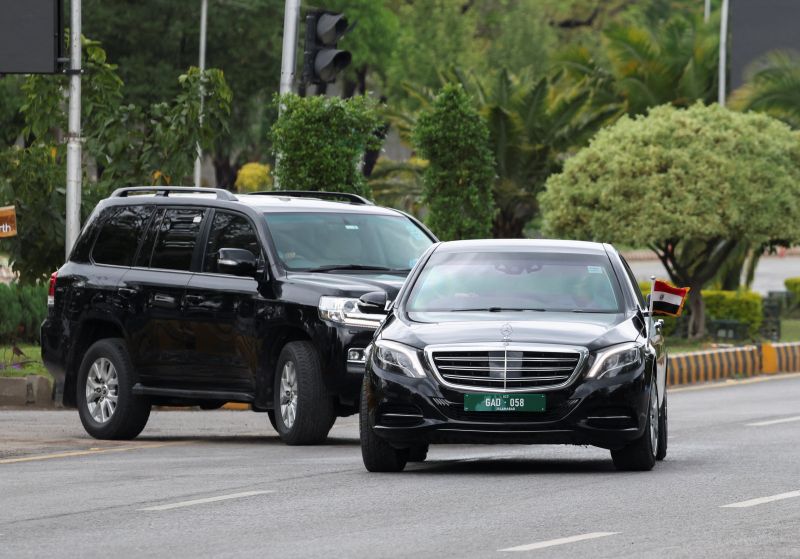
The car carrying Egyptian Foreign Minister Badr Abdelatty leaves the Foreign Ministry office in Islamabad, Pakistan, on March 29, 2026. (Credit: Akhtar Soomro / Reuters)
The foreign ministers of Pakistan, Saudi Arabia, Egypt and Turkey are due to meet today and Monday in Islamabad to discuss the war in the Middle East, the Pakistani government announced on Saturday.
The agenda includes “in-depth discussions on a range of issues, including efforts to reduce tensions in the region,” as well as a meeting with Pakistani Prime Minister Shehbaz Sharif.
Iran threatens to strike US universities in the Middle East
Iran’s Revolutionary Guards have threatened on Sunday to target U.S. universities in the Middle East, claiming that U.S.-Israeli strikes had destroyed two Iranian universities, AFP reports.
“If the U.S. government wants its universities in the region to be spared from retaliation … it must condemn the bombing of universities in an official statement by Monday, March 30 at noon, Tehran time,” the statement published by Iranian media said.
The text adds: “We advise all employees, professors and students of American universities in the region, as well as residents of nearby areas, to stay at least one kilometer away from campuses.”
Several U.S. universities have campuses in the Gulf region, including Texas A&M University in Qatar and New York University in the United Arab Emirates.
Strikes carried out overnight from Friday to Saturday hit Tehran, including the University of Science and Technology in the northeast of the capital, damaging buildings but with no reported casualties, according to media reports.
Over 5,700 injured in Israel since the start of the conflict
The Israeli Ministry of Health said this morning that since the beginning of the war between Israel and Iran, 5,768 people have been evacuated to hospitals, including 137 currently hospitalized, Haaretz reports.
Among them, one is in critical condition, 15 are seriously injured, 37 are in stable condition, and 84 are lightly injured.
In the past 24 hours, 148 people were admitted to hospitals, including one in serious condition, eight in moderate condition, 115 lightly injured, and 24 suffering from anxiety.
The Israeli army also announced this morning that a soldier “in combat” was killed in southern Lebanon — the fifth killed since the resumption of hostilities with the Iran-backed Hezbollah, AFP reports.
Israeli army says it struck temporary headquarters and military production sites in Tehran on Saturday
In a post on X, the Israeli army’s Arabic-language spokesperson, Avichay Adraee, said the army had struck “infrastructure belonging to the Iranian regime in the heart of Tehran” on Saturday, including “dozens of storage and production sites for military equipment” as well as “temporary headquarters,” some of which were allegedly destroyed “with the commanders inside.”
The army also said it had hit “missile production and storage sites, air defense systems, and observation posts belonging to the Iranian regime.”
2 loud explosions heard in northern Tehran
Two loud explosions were heard this morning in Tehran, according to an AFP journalist in the north of the Iranian capital.
The blasts occurred at around 7:20 a.m., the journalist reported, adding that Iranian air defenses were active in the northeast of Tehran.
Iran claims attacks on major industrial sites in the Gulf
Iran said this morning that it had carried out attacks on two of the world’s largest aluminum smelters in Bahrain and the United Arab Emirates, raising fears of major disruptions to the global economy after a month of war in the Middle East, AFP reports.
In a conflict showing no signs of de-escalation, Iran and Israel continued to exchange strikes on Sunday, while several Gulf countries again reported Iranian attacks on their territory. The day before, Iran-backed Houthi rebels in Yemen opened a new front in the war by launching two attacks on Israel.
Iran’s Revolutionary Guards, the country’s ideological military force, said via state broadcaster IRIB that missile and drone strikes had damaged the Aluminum Bahrain (Alba) and Emirates Global Aluminum (EGA) plants on Saturday.
The Alba smelter, one of the largest in the world, had already announced on March 15 that it was shutting down 19 percent of its production capacity due to supply disruptions caused by Iran’s closure of the strategic Strait of Hormuz.
It confirmed on Sunday that two of its employees were slightly injured in the Iranian attack and said it was assessing the extent of the damage at its facility.
Good morning and welcome to our live coverage of the war in the Middle East, with a focus on the escalation on the Lebanese front, where fighting between Hezbollah and the Israeli army continues.
In the night of Saturday into Sunday, two Israeli fighter jets broke the sound barrier at very low altitude over civilian areas, shattering the windows of several homes, according to eyewitness accounts reported by local media. Israeli strikes also killed many civilians in Lebanon, as well as nine rescue workers and three journalists, while 21 Israeli soldiers were reported killed.
We will also be reporting on developments across the rest of the Middle East, where exchanges of strikes between Tehran, Washington, and Tel Aviv continue to affect the entire region.
➡️ To catch up on Saturday news, you can find yesterday's live coverage here.
Already have an account? Login here
You have reached your article limit
Stay informed about a Middle East in crisis.
Subscribe now and save 30%: just $8.9/month instead of $12.9.
This article is only available to L’Orient Today subscribers.
Already have an account? Login here
