






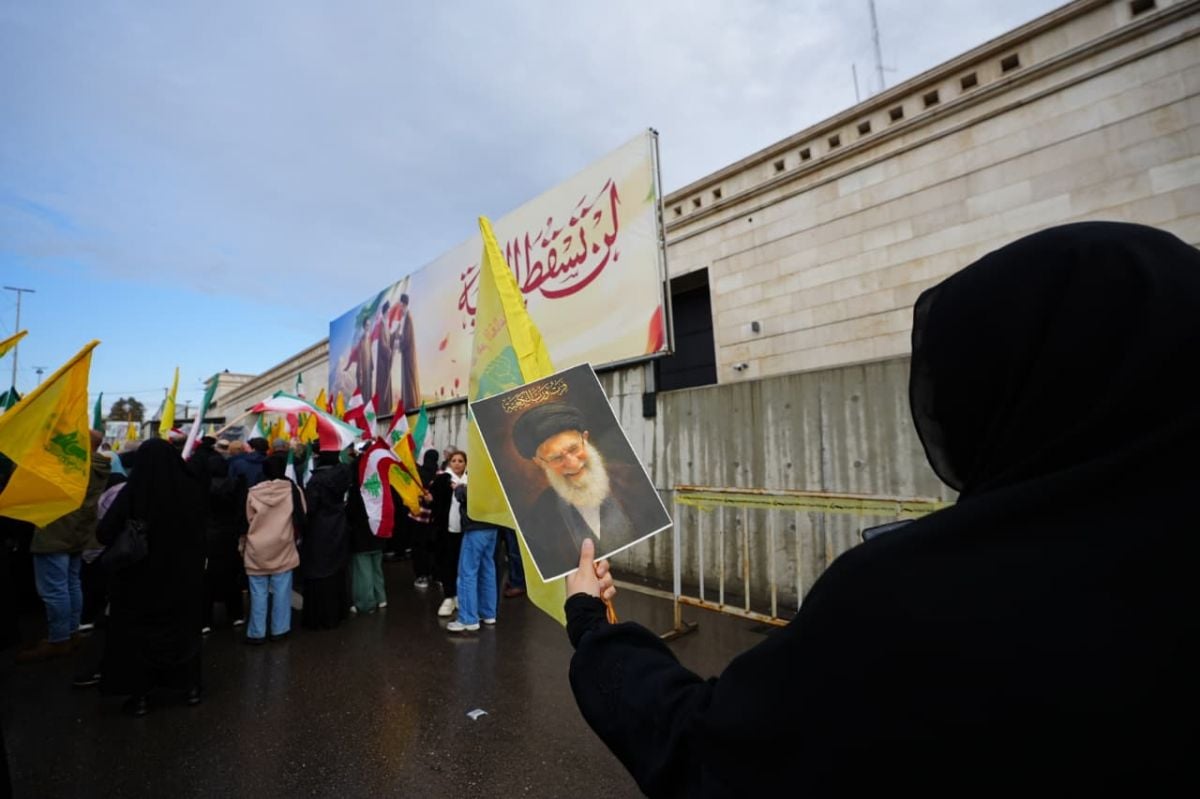
A demonstration in front of the Iranian embassy, on March 26, 2026. (Credit: Mohammad Yassine/L'Orient-Le Jour)






BEIRUT — Just over 100 protesters gathered Thursday afternoon outside the Iranian Embassy in Bir Hassan, a southern suburb of Beirut, to protest Lebanon’s expulsion of Iranian Ambassador Mohammad Reza Sheibani. The crowd, mostly young men, waved Iranian, Lebanese and Hezbollah flags.
Local resident Diana held a Lebanese flag and denounced what she called a humiliation for the country. “This decision is not Lebanese. It’s a decision of humiliation,” she told L'Orient Today's reporter.
“I stand with Iran, which defends everyone without distinction, regardless of religion,” said Hassan, from Baalbeck and a resident of Beirut’s southern suburbs. “They defend us, and we treat them like this? Where do they want the country to go? [Foreign Minister Joe] Rajji is not my minister.”
“If our leadership asks us to act, we’ll bring down the president and the prime minister,” he continued, Iranian flag in hand. “But our leadership is patient. It does not want civil war. Our hearts are burning. The state doesn’t see us. Only the resistance and good people help us.”
The Internal Security Forces, Lebanese Army and paramedics from Hezbollah’s Islamic Health Committee were present. A large banner showed former Iranian Supreme Leader Ali Khamenei handing the Iranian flag to his son and successor, Mojtaba Khamenei.
Hezbollah entered the Middle East war on March 2 to avenge Khamenei’s assassination on the first day of U.S.-Israeli strikes on Iran on Feb. 28. Israel has since launched a massive military offense on Lebanon, including airstrikes across the country and ground advances in the South, with the aim of establishing a buffer zone. Hezbollah continues rocket barrages across the border.
On Tuesday, the Foreign Ministry summoned Iran’s chargé d’affaires, Toufic Samadi Khoshkhou, to notify him of Sheibani's accreditation withdrawal. The decision came as Lebanon seeks distance from Iran and its Revolutionary Guards to avoid the war pitting Tehran and Hezbollah against the United States and Israel, days after an Israeli strike in Hazmieh, an eastern Beirut suburb, targeting a Quds Force member of the Revolutionary Guards elite unit.
Hezbollah called Lebanon’s decision “devoid of any legal basis” and a “manifest submission to external pressures and dictates.” Its ally, the Amal Movement, urged the state to reverse course “to prevent the country from sinking into a political and national crisis.”
Slogans rang out: “Death to America!,” “Death to Israel!” and “Labayka ya Nasrallah!” — referring to Hezbollah’s former leader, killed by Israel in 2024.
Leila, 56, held portraits of Ayatollah Ruhollah Khomeini, Ali Khamenei and Mojtaba Khamenei. “We are not afraid. Israel should fear us. I came to defend our presence and our position. They stood by us in every war. We are here to say thank you. The ambassador will not leave Lebanon.”
Another man took the microphone: “Reverse your decision. We will come out of this war victorious. The Lebanese people want Sheibani to stay.”

