








View of the coastal highway in southern Lebanon near Qasmieh, showing the bridge before it was blown up by the Israeli army, March 22, 2026. (Credit: Amr Abdallah Dalsh/Reuters)






SOUTH LEBANON — Israel aims to erase border villages “like in Rafah and Beit Hanoun” and cuts off Sour from the rest of Lebanon
The Israeli army has bombed the Qasmieh bridge, marking a first strike on a crucial infrastructure connecting Sour to Saida, following orders from Defense Minister Israel Katz and Prime Minister Benjamin Netanyahu to destroy “all bridges” over the Litani River.
Israel intends to wipe out villages along the southern Lebanese border, as its army did in Rafah and Beit Hanoun in the Gaza Strip, and to cut off the entire south of the Litani River by destroying the bridges.
Katz made these threats on Sunday, which were immediately carried out by Israeli forces with the bombing of the Qasmieh bridge, just hours after the warning.
Bridges over the Litani still targeted
Shortly before 3:30 p.m., fighter jets carried out a raid on this critical bridge, located about 10 kilometers from the city of Sour along the coastal highway.
The Lebanese Army, which had positions on both sides of the bridge, evacuated quickly.
For the Israeli army, which had threatened this infrastructure around noon, the destruction aims to “prevent the transfer of Hezbollah reinforcements and military equipment” to the south, according to Arabic-language spokesperson Avichay Adraee.
“The Prime Minister [Benjamin Netanyahu] and I have ordered the Israeli army to immediately destroy all bridges over the Litani River that are used for terrorist activities, in order to prevent the passage of Hezbollah fighters and weapons to the south,” Katz said.
Following these threats, the Lebanese army evacuated its positions on both sides of the Qasmiyeh bridge, near the villages of Qasmieh and Burj Rahal. According to our correspondent in the south, this is a main bridge connecting Sour to other regions of southern Lebanon.
Over the past week, the Israeli army has bombed several bridges on the Litani, including a bridge at Kennayat near Qasmieeh.
Razing 'like Rafah and Beit Hanoun'
Katz also indicated that the army would “accelerate the destruction of Lebanese homes in frontline villages,” as it had done in Beit Hanoun and Rafah in Gaza, referring to the two cities that were flattened by the Israeli army.
During the day, while fighting continued between Hezbollah and the Israeli army in Khiam, soldiers repeatedly dynamited homes in this key border village. Despite the cease-fire in place since November 2024 and the resumption of clashes on March 2, the Israeli army has demolished hundreds of houses in southern border villages over recent months.
The “Beit Hanoun scenario” refers to the Israeli ground campaign at the end of its Gaza offensive, during which tens of thousands of residents were forced to flee and entire neighborhoods were razed to eliminate local Hamas battalions, following a scorched-earth policy to enable ground advances. In Beit Hanoun, the Israeli army also systematically destroyed Hamas tunnel networks.
Fighting in Khiam and Taybeh
Israeli advances in the south continue to meet strong resistance from Hezbollah, with ground battles ongoing in the eastern border sector, mainly around Taybeh and Khiam.
Throughout the night and day, Hezbollah claimed multiple attacks on Israeli soldiers and advances in southern Lebanon, primarily in Taybeh, Khiam, Markaba, and Adaisseh, in the Marjayoun district.
These attacks, using artillery, rockets, and kamikaze drones, have repeatedly targeted Israeli soldiers and vehicles since Saturday evening.
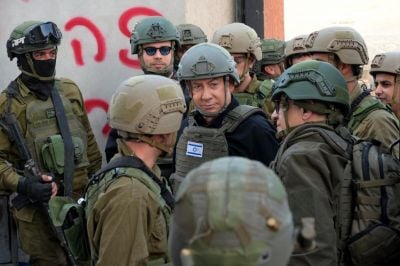
An attempted Israeli advance, supported by heavy artillery fire, was also reported near Naqoura in the eastern sector (Sour district), as the Israeli 36th Division continues “intense ground operations” aimed at “destroying Hezbollah infrastructure,” including searches of “military buildings” where weapons were discovered.
The Golani Brigade, part of the 36th Division, reportedly found rockets, rifles, and ammunition in a southern building. Colonel Adraee also stated that the 7th Brigade, one of the army’s three armored brigades, “eliminated more than 10 Hezbollah militants posing an immediate threat” in southern Lebanon.
Despite Israel’s so-called “advanced defense” deployment, Hezbollah has carried out rocket attacks on northern Israeli villages, killing one person in Misgav Am and causing material damage.
According to Israeli media, including Walla News and Maariv, Hezbollah reportedly bypassed Israeli troops at Reb el-Talatine to carry out these strikes.
Firestorm in the Nabatieh region, 4 killed
Despite adverse weather, which seemed to slow Israeli strikes overnight, bombardments continued across southern Lebanon throughout the day. Dawn strikes on Sawaneh and Sultanieh killed four people, according to the Health Ministry, while a drone strike targeting a vehicle at the Burj al-Moulouk, Khiam, and Kfar Kila junction injured three workers.
During the day, the Israeli army carried out a series of near-simultaneous raids, described as a “belt of fire,” in the Nabatieh region, hitting Kfar Tebnit, Zawtar Sharqi, Zawtar Gharbi, and Zebdin. The army claimed these strikes targeted “Hezbollah infrastructure.”
Elimination of al-Radwan commander and Hamas official
The Israeli army also announced on Sunday that it had killed Abou Khalil Bourji, identified as “commander of the al-Radwan special forces unit of Hezbollah,” along with two other militants, in a strike on Majdel Selm.
Bourji had led the special forces unit responsible for planning and carrying out operations against Israeli forces. Earlier in the week, the army said it had killed Walid Mohammad Dib, “a senior Hamas finance official” responsible for funding military activities in Lebanon, though it did not specify where Dib was eliminated.
Reporting by our regional correspondent, Muntasser Abdallah.

 8 p.m. recap: Israel again threatens Beirut’s south suburbs; 2 ships hit near Hormuz; Riyadh football matches canceled