


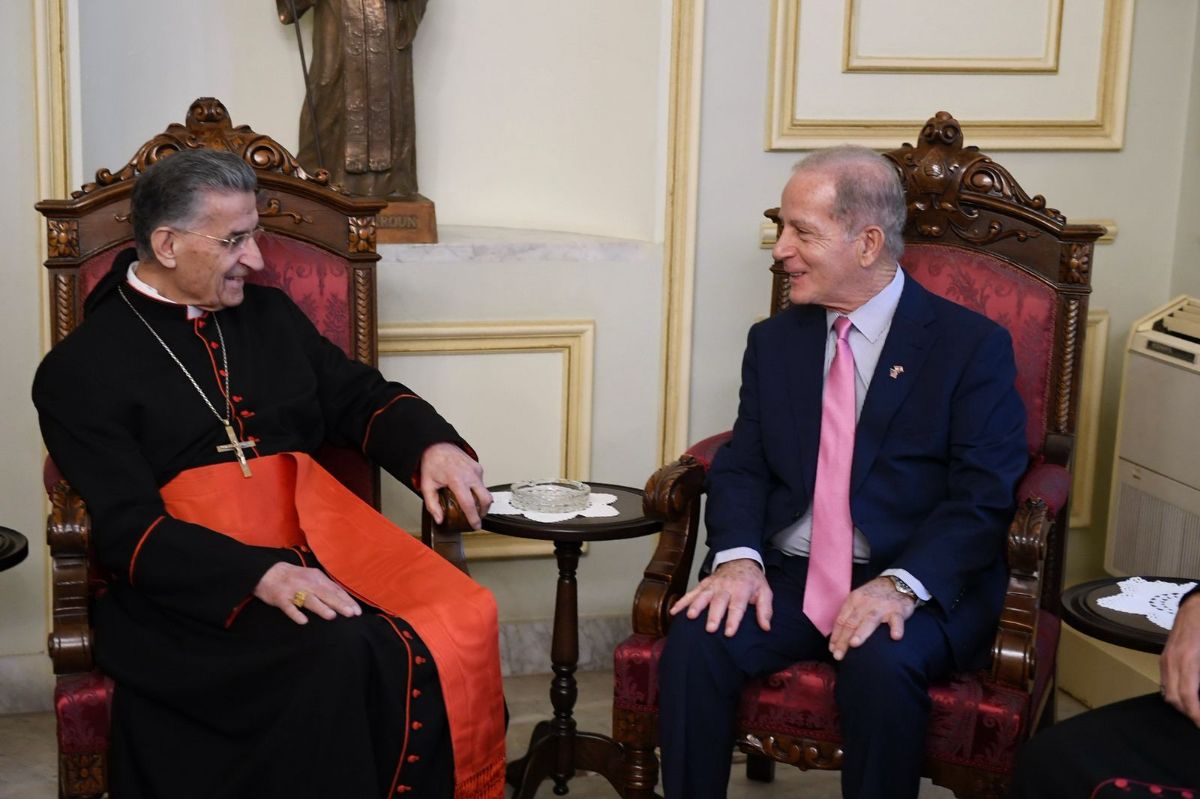
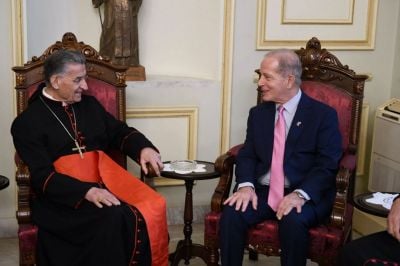
The U.S. ambassador to Lebanon, Michel Issa, meets with Maronite Patriarch Bechara al-Rai in Bkirki, on March 20, 2026. (Photo: NNA)






The United States ambassador to Lebanon, Michel Issa, said Friday from Bkirki, where he was welcomed by Maronite Patriarch Bechara al-Rai, that Washington "insists on peace prevailing in Lebanon" and is doing everything in its power to achieve it. Meanwhile, Hezbollah and Israel continue to clash, with Israel so far rejecting Beirut's offer for direct talks.
"The United States wants peace to prevail in Lebanon, for the country to be independent and for there to be no war, and personally, I am doing everything possible to reach that goal," the ambassador said. "I share the same concern as the patriarch: we want to end the war in Lebanon, and we are calling on all parties to make the decision that will help stop the war."
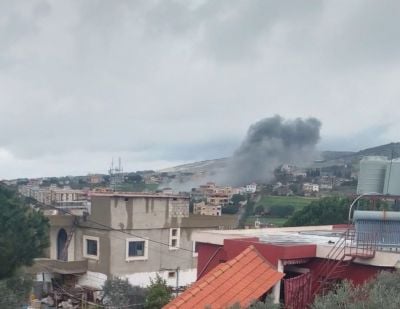
In this context, Issa praised "the decision of President Joseph Aoun to sit at the negotiating table with Israel to resolve the crisis," while stressing, "I believe the Israelis have decided not to stop the strikes on Lebanon, so the latter must decide whether it is able to meet with them nonetheless." "In my opinion, peace between Lebanon and Israel is not possible without talks, so I encourage the Lebanese side to consider the need to talk with the Israeli side to reach a solution," he added.
Ten days ago, Aoun accused Hezbollah of seeking to provoke the "collapse" of Lebanon on behalf of Iran and called for direct negotiations with Israel to end the war. On Thursday, he reaffirmed this position during a meeting at the Baabda Presidential Palace with French Foreign Minister Jean-Noel Barrot. The French foreign minister traveled to Israel on Friday, admitting that he saw no obvious end to the conflict in the short term, but said France and its allies would continue to seek a lasting solution.
Hezbollah opened a new front in the regional conflict on March 2 when it launched missiles at Israel following the killing of Iran’s supreme leader, Ali Khamenei, on the first day of U.S.-Israeli attacks against Iran. Israel has since carried out a massive bombing campaign across large swaths of Lebanese territory, including on the southern suburbs of Beirut, and is conducting ground incursions into the south of the country with troops and armored vehicles.
'The Lebanese Army must accomplish its mission'
After meeting with Rai, Issa also stated that "the Lebanese Army must accomplish the mission it has been given, and that is what we expect." He also indicated that it has the capacity to carry out its mission, "if it so decides." On March 2, the Cabinet asked the military institution to implement the plan for the monopoly of weapons "by all possible means" and "as quickly as possible."
The Lebanese government shares the goal of disarming Hezbollah but fears that direct action against the group could trigger clashes or even a renewed civil war. In recent weeks, a campaign against the army chief, General Rodolph Haykal, has called for his resignation over his refusal to forcibly disarm Hezbollah. The United States was reported to have pushed for his dismissal, a move immediately rejected by the authorities. After the meeting between Rai and Issa, Haykal traveled to Bkirki to himself meet with the patriarch, according to the state-run National News Agency (NNA).
"We asked the Lebanese Army to stay in the Christian villages in the South to protect them. So far the situation is satisfactory, but no one knows how things will develop," Issa said, adding that the United States has received a promise from Israel not to carry out strikes on the southern Christian border villages "provided no member of Hezbollah infiltrates those villages."
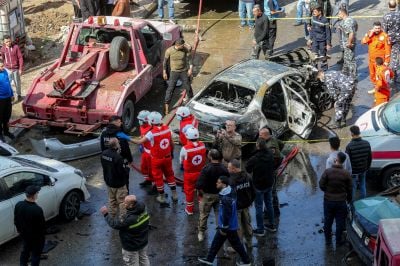
Israeli strikes killed several people in some Christian villages in the border area over the past week. Israel killed the parish priest of Qlaya in an artillery attack, while three workers from Rmeish were targeted by an Israeli drone. On Sunday, March 8, a man in his seventies from Alma al-Shaab, a village since totally evacuated, was also killed in a drone strike.
On the Israeli side, Foreign Minister Gideon Saar said after his meeting with the French foreign minister that "the Lebanese government and the Lebanese Army are taking no significant measures against Hezbollah, either militarily or in other areas." The Israeli minister said he had presented to his French counterpart "the scale of the attacks on Israel launched from Lebanese territory since March 2, especially from the area south of the Litani, which the Lebanese government and army boasted, only two and a half months ago, of controlling."
Saar also said he considered that "a complete de-legitimization of Hezbollah is essential in the face of this Iranian branch, which has been conducting military operations against Israel for decades and is gradually destroying Lebanon and its future."
 The 7 p.m. recap: Houthis advance, government announces counteroffensive; Iran raises stakes; Israeli shells hit close to journalists in south Lebanon
 2 Israeli soldiers injured in 'operational accident,' as army continues attacks in the South