



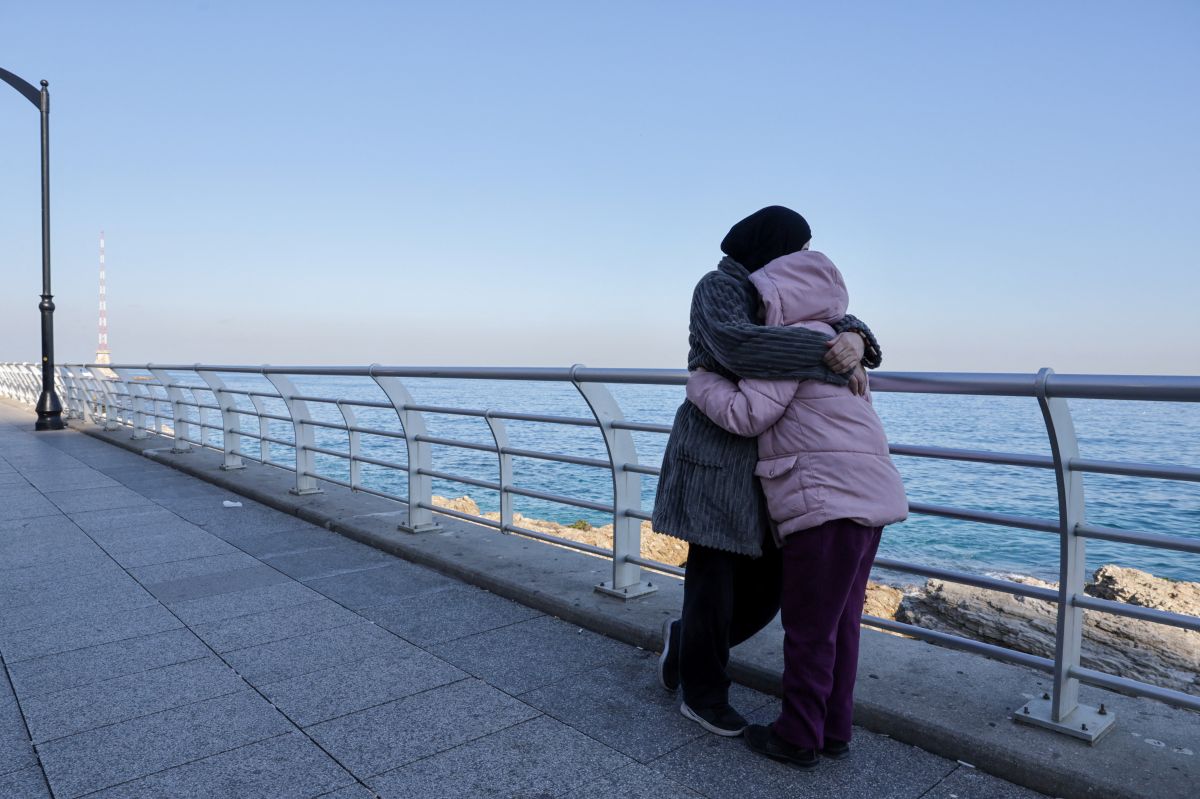
Displaced Lebanese mother holds her daughter as they shelter at Beirut's seaside following an escalation between Hezbollah and Israel amid the U.S.-Israel conflict with Iran, Lebanon, March 2, 2026. (Credit: Emilie Madi/ Reuters)






Lebanese students will stay home on Tuesday following Monday’s nationwide school closures ordered by Education Minister Rima Karameh. The order affected all public and private schools, as well as technical education centers, after overnight airstrikes targeted Beirut’s southern suburbs, southern Lebanon, and the Bekaa.
The strikes – carried out in retaliation for Hezbollah-launched rockets toward northern Israel – killed at least 31 people and displaced thousands. Hezbollah said it acted to “avenge the assassination on Saturday of Iran’s Supreme Leader Ali Khamenei.”
School principals and parents remain uncertain despite the minister’s announcement, calling for clearer guidance. “What should we do in the coming days? Can we operate school buses?” asked Tiba Geha, director of Louise Wegmann College.
Sister Nawal Akiki, director of Collèges des Saints-Cœurs in Kfar Dibian added, “We are still waiting for guidance from the authorities.” Another principal, speaking anonymously, said, “We still don’t know what to do. It’s very unsettling. In this situation, we need support from the state.”
Daily assessment
The Cabinet, which met in the morning, did not announce any specific measures for the education sector. Only after the meeting did the ministry confirm that the closure would continue Tuesday, “in light of the current security situation and out of concern for the safety of the educational community.” It added that a daily assessment would be conducted in coordination with the relevant authorities.
According to a source close to the ministry, decisions will be made “day by day.”
In Israel, the military also extended the closure of schools and workplaces until Wednesday evening, on the third day of the U.S.-Israeli war launched against Iran on Saturday.
For students, Monday felt like an unexpected holiday. “My daughter stayed home; she’s playing while I work online,” said the mother of a student at Collège Notre-Dame de Jamhour. “My children went to activities in Kfar Shima. Their mother, a teacher, is also off,” said Joseph, whose children attend Sagesse Brasilia. The same was true for Nemr’s children, who left the southern suburbs to take refuge with relatives in Beirut.
Schools, however, are already preparing for the possibility of a longer and wider conflict. Some are considering shifting to online learning or adapting their plans depending on their location. “If the authorities have not decided by tomorrow (Tuesday) and there is still no clarity, we are preparing a meeting to launch distance learning in Ain Najm starting Wednesday, since our students come from afar,” said Sister Nawal Akiki. She stressed that there is no question of losing the progress made during this advanced stage of the school year: “Students were already preparing for exams before the conflict broke out.” She added that for Kfar Dibian, which is far from the conflict zones, “a return to in-person classes could be considered.”
Universities closed
Nearly 53 villages in southern Lebanon were evacuated on Monday. The ministry said several public high schools, identified during the 2024 crisis, would be used to accommodate displaced families. Rima Karameh condemned “the aggression suffered by Lebanon” and expressed support for the displaced, noting that a list of public schools had been made available to the national emergency response plan to serve as shelters.
In a second statement, the minister announced – after coordinating with Prime Minister Nawaf Salam – the closure on Tuesday of all private higher education institutions as well as the Lebanese University. Decisions for the following days will be announced daily.
