






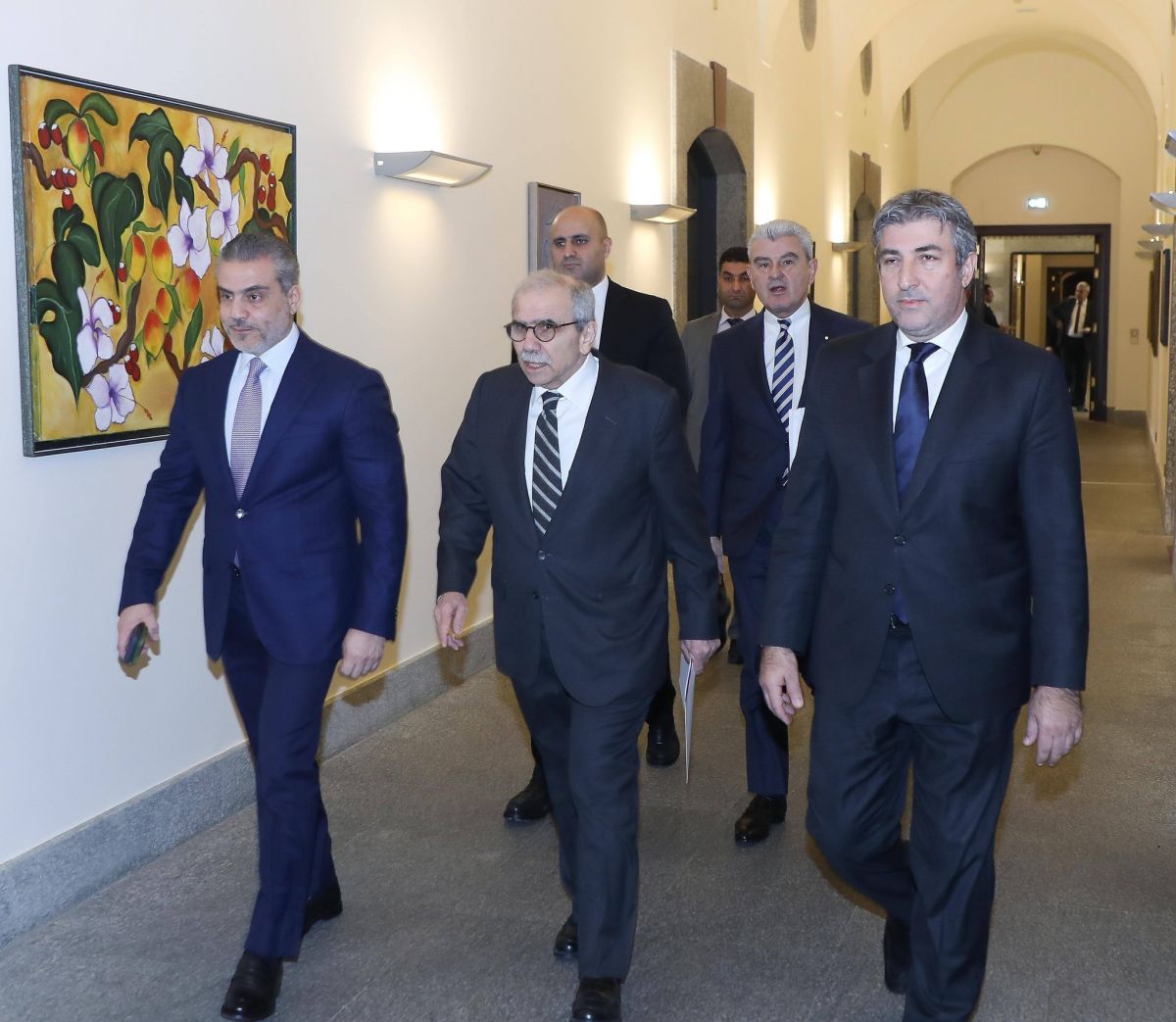
Prime Minister Nawaf Salam before the Cabinet, Feb. 26, 2026. (Credit: @grandserail/X)






Nawaf Salam's government dedicated hours on Thursday to exploring ways to boost state revenues, mainly to fund salary hikes for public employees. This came 10 days after the unveiling of tax measures that sparked dissatisfaction across sectors.
The ministers notably debated, during a Cabinet meeting at the Grand Serail, steps to fight tax and customs evasion, as well as to collect fines for the illegal use of maritime and river public properties and to recover revenues related to quarries.
Speaking at the end of the meeting, Information Minister Paul Morcos emphasized that during the Cabinet session, Salam underscored the need to combat tax and customs evasion, noting that files had been transferred to the judiciary and measures had been implemented against taxpayers who have not paid their dues.
Finance Minister Yassin Jaber previously mentioned that 200 companies have been referred to the public prosecutor’s office for tax fraud.
During the session, Jaber also presented the results of installing scanners at the country’s ports — two in Beirut and one in Tripoli — which enable every container entering or leaving the country to undergo strict inspection. This should speed up customs clearance and improve the traceability of goods.
These installations “have helped reduce customs evasion, and a large number of taxpayers and companies have rushed to fulfill their obligations before any measure could hinder their shipments,” according to the finance minister.
Jaber also emphasized that measures allowing taxpayers to file their returns online have simplified tax collection.
Environment Minister Tamara Elzein, for her part, highlighted the potential revenues from fees related to quarry exploitation.
'Protecting the Lebanese coast, not making money'
Public Works and Transport Minister Fayez Rassamny discussed the “comprehensive” study he is preparing on encroachments on maritime public properties, pledging to update his colleagues with “precise figures.” He noted “significant violations” along the heavily urbanized coast, “for which fines have not yet been collected.”
Regarding this issue, Nizar Saghieh, founder and executive director of the NGO Legal Agenda, believes the state would be wrong to rely too heavily on this to replenish the treasury.
He explained that in 2025, the total amount the state calculated for public maritime properties was only $21 million, and to reach the $80 million target set by Salam in one of his speeches, it would therefore be necessary "to multiply the required taxes by four."
Saghieh also fears that “the government may be tempted to approve all demands for coastal occupation and turn a blind eye to violations, to maximize revenue.” The point of this tax, however, is “to protect the coast, not to make money to pay civil servants.”
To specifically enable a salary increase for public employees, the government announced tax measures on Feb. 16, which provoked an outcry among labor and union circles.
Protests and strikes were planned to oppose these new taxes — which included a one-percentage-point increase in VAT and an additional 300,000 Lebanese liras (about $4) per 20-liter gallon of gasoline — but they were ultimately postponed indefinitely, following statements by authorities in recent days.
The president of the General Confederation of Lebanese Workers (CGTL), Bechara Asmar, especially welcomed a statement by Salam that he “does not insist” on increasing VAT, and by Jaber, who said that the government would not defend this decision before Parliament.
Social Development Minister Haneen Sayed announced on X, after the Cabinet meeting, that the government has approved the national strategy for people with disabilities. Developed by her Ministry with input from organizations of people with disabilities, she described it as a “genuine national turning point.”
“This strategy is not an additional document, but a political and executive commitment to make the state fairer, more equitable, and more responsible,” she said.
The government did not discuss organizing the parliamentary elections in May or their possible postponement, nor did it address the Israeli threats to attack civilian infrastructure, including Beirut's airport, if Hezbollah becomes involved in a potential armed conflict between the United States and Iran.

 8 p.m. recap: Israel again threatens Beirut’s south suburbs; 2 ships hit near Hormuz; Riyadh football matches canceled