






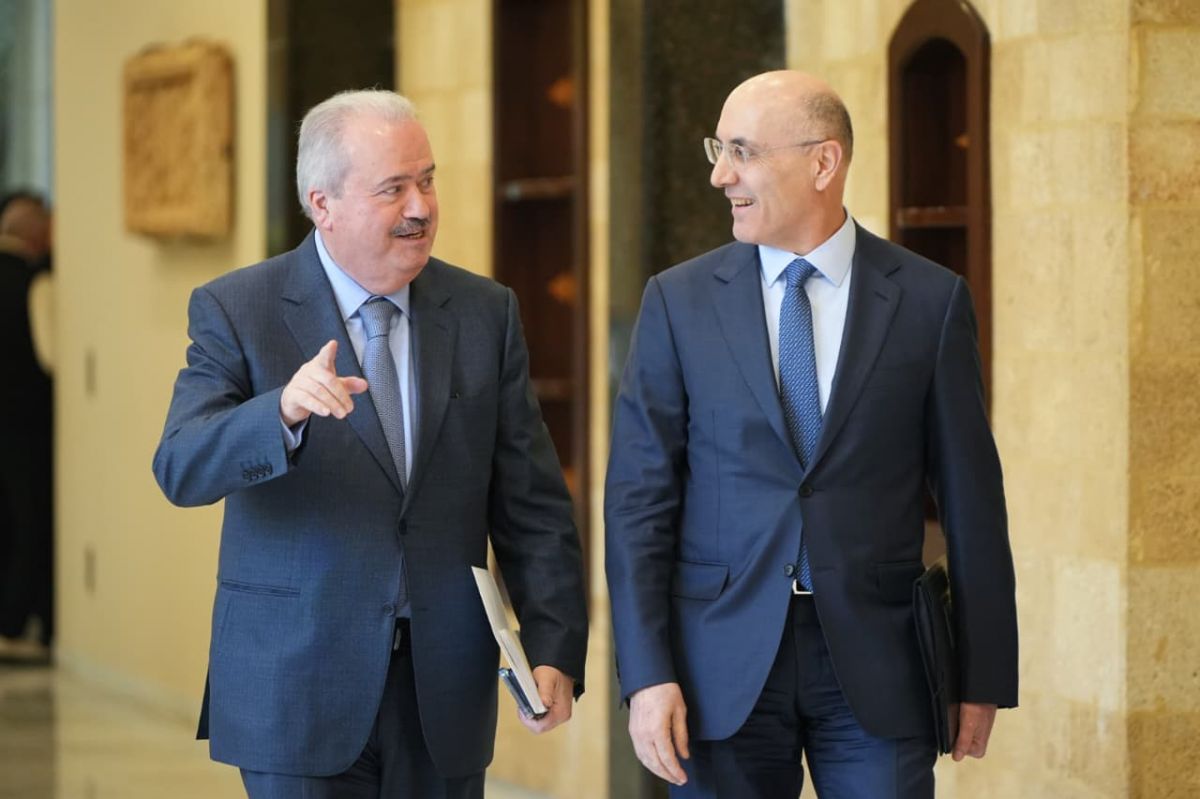
Ministers Ahmad Hajjar and Yassine Jaber upon their arrival in Baabda for a Cabinet meeting, on Feb. 16, 2026. (Credit: Mohammad Yassine/L’Orient-Le Jour)






BEIRUT — Interior Minister Ahmad Hajjar said Monday, ahead of a Cabinet session at the Baabda Presidential Palace, that the parliamentary elections are on track to take place "in accordance with the legislation in place, and nothing can stop it except a decision by Parliament.”
His remarks follow a non-binding opinion issued Saturday by the Legislation and Consultation Commission at the Justice Ministry stating that Lebanese expatriates may vote from abroad for all 128 MPs, not just the six seats allocated to the diaspora under the 2017 electoral law. The issue has fueled renewed political disagreement over expatriate voting.
“The goal is to hold the elections on time,” Hajjar said, noting that he had referred the commission’s opinion to the Cabinet’s General Secretariat for further action. “The opinion is not binding, but failing to implement it requires an official justification under the articles governing the Justice Ministry’s work.”
Addressing tensions over the diaspora vote, he said, “No one wants disagreement.”
Earlier Monday, Parliament Speaker Nabih Berri said on NBN television that the elections would be held on schedule, ruling out any technical delay or postponement. “The law is enforceable. There will be no postponement, neither technical nor otherwise,” he said, stressing there was “no possibility of obstructing the vote.”
On Sunday, Berri criticized what he described as “a plan aimed at preventing the legislative deadline from being respected.” In an interview with the pan-Arab newspaper Asharq Al-Awsat, he accused the advisory body of issuing its opinion “at the instructions of one party,” without naming it.
Gebran Bassil, head of the Free Patriotic Movement (FPM), also weighed in Monday, calling the commission’s opinion a “heresy.” He said his party was preparing to nominate candidates for the six seats allocated to expatriates, despite uncertainty over voting procedures. His position to call for the enforcement of the 2017 law is backed by Hezbollah and Berri's Amal Movement.
“All these discussions around the commission’s opinion are meaningless. The law is clear, deadlines have expired and the Free Patriotic Movement will submit its nominations from abroad,” Bassil wrote on X. He argued that it is up to the government to issue the implementing decrees authorizing candidacies from abroad, now that the election date has been formally set and Berri has rejected any amendment to the current law.
In a separate statement, the FPM said any failure by the executive to act would constitute “a flagrant failure of the government and administration.”
The dispute over expatriate voting procedures threatens preparations for parliamentary elections scheduled for May. Parliamentary blocs, led by the Lebanese Forces, favor amending the law to allow expatriates to vote for all 128 seats based on their district of origin.
Before the 2018 and 2022 elections, Parliament suspended Article 112, enabling expatriates to vote in their home districts instead of electing separate diaspora representatives.
The Legislation and Consultation Commission was asked last week to respond to two questions from Hajjar after he issued a circular stating that, in the absence of regulatory measures establishing the 16th constituency for expatriates, candidacies for the six diaspora seats could not be submitted. The resulting legal gap could prevent the roughly 144,000 registered expatriate voters from electing any representatives if no candidates are able to register.
Hajjar asked the commission whether registered expatriates may vote from abroad for the 128 MPs and whether they must travel to Lebanon to cast their ballots.