


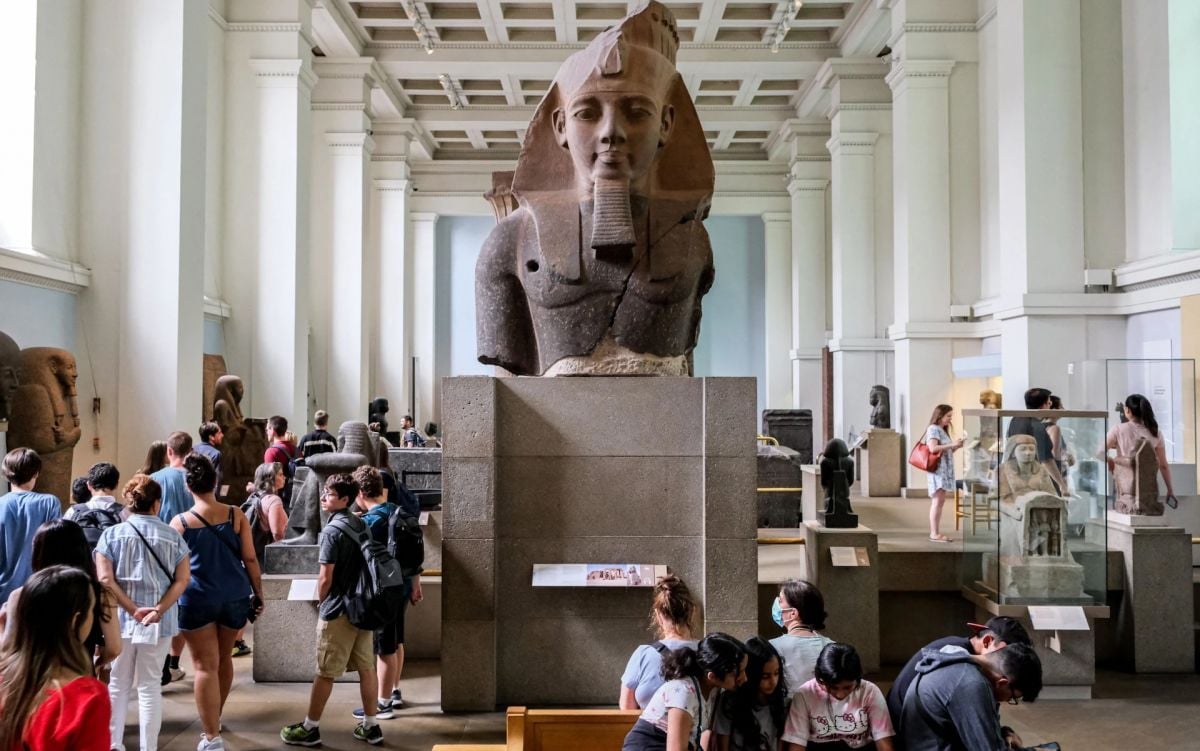
The gallery of Egyptian sculptures at the British Museum, where the labels have been revised. (Credit: AFP)






According to an investigation published by The Telegraph, the British Museum has removed the word “Palestine” from several panels dedicated to the ancient Near East following complaints that denounced “an anachronistic and politically charged usage.”
Maps and labels relating to ancient Egypt and the Phoenicians referred to the eastern Mediterranean coast as “Palestine.” Some peoples, including the Hyksos, were described as being “of Palestinian origin.”
The museum received protests claiming that the term was being applied “retroactively” to describe regions and civilizations that existed well before the word itself emerged.
Curators acknowledged that “Palestine was not a geographically relevant term for these ancient periods.”
The revisions followed a study of visitor feedback and concerns, particularly those expressed by the association UK Lawyers for Israel, which wrote to museum director Nicholas Cullinan.
In its letter, the organization argued that the retroactive use of the term “Palestine” “erases historical developments” and “creates a false impression of continuity,” even obscuring the kingdoms of Israel and Judah that emerged around 1000 B.C.
The association also claims that this terminology might suggest the existence of a continuous ancient region called “Palestine,” which would be historically inaccurate.
A land with many names
The Telegraph notes that the southern Levant has been known by many names over the centuries. One of the oldest is “Canaan,” mentioned as early as 1500 B.C. Egyptian inscriptions around 1200 B.C. mention a kingdom called “Israel,” while an Assyrian text mentions “Judah” a few centuries later.
The Greeks spoke of the land of the Phoenicians (now Lebanon), and the historian Herodotus is said to have been the first to use the term “Palestine” in the 5th century B.C. The word was later used to designate a province of the Roman and Byzantine empires, before the region became Arabized in the 7th century.
In the 19th century, “Palestine” became a relatively neutral geographical term for the southern Levant, a neutrality that the museum now considers lost.
According to The Telegraph, some references have already been revised: the phrase “of Palestinian origin” relating to the Hyksos has been replaced with “of Canaanite origin.” Other panels, including maps of the Egyptian New Kingdom referring to “dominion in Palestine,” are under review.
A British Museum spokesperson clarified that for maps depicting ancient cultural regions, the term “Canaan” is now favored for the southern Levant in the second millennium B.C. In contrast, contemporary maps use United Nations terminology (Gaza, West Bank, Israel, Jordan), and the term “Palestinian” is still used when referring to modern cultural or ethnographic identity.

 7 p.m. recap: Netanyahu seeks mastermind behind Flydubai incident; Washington sanctions 2 French nationals; Ben Gvir's 'I want to kill you' threat