






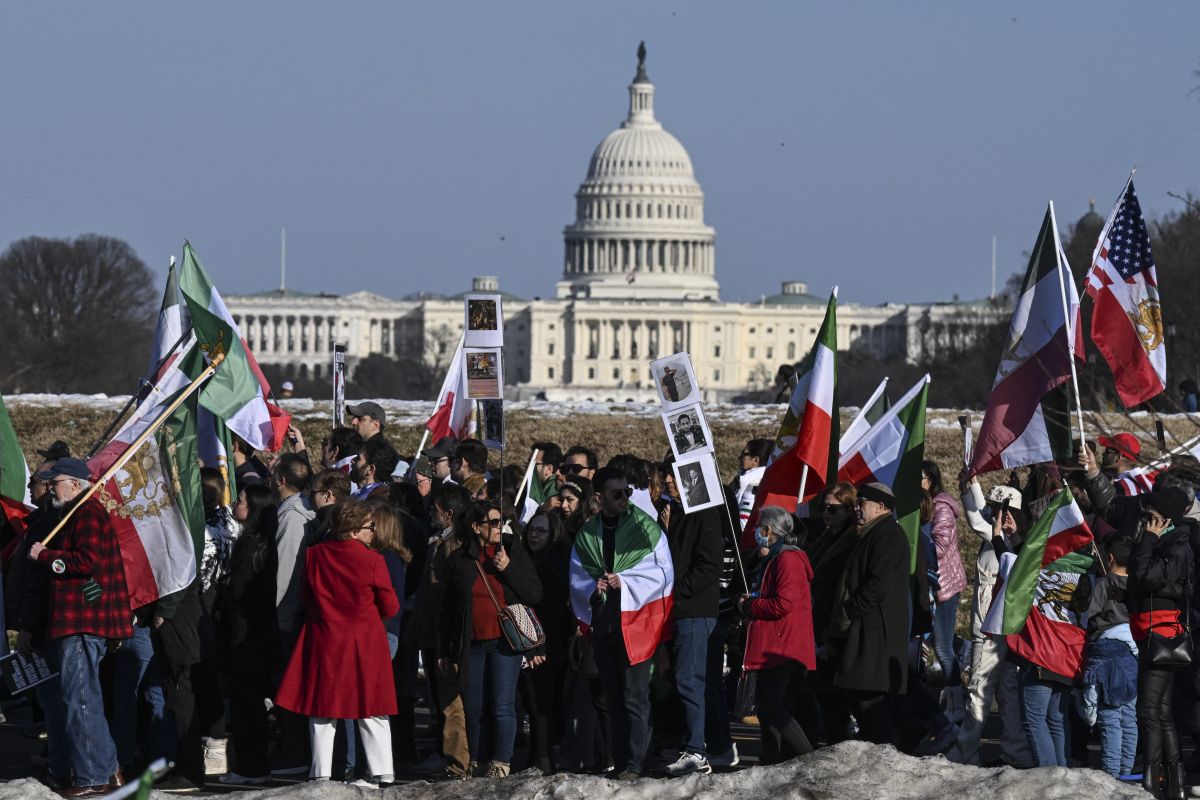
Protesters during a march in support of the Iranian people organized by members of the Iranian-American community in Washington, DC, on Feb. 14, 2026. (Credit: Roberto Schmidt /AFP)






Iran is seeking to reach a nuclear agreement with the United States that would deliver economic benefits to both sides, an Iranian diplomat reported Sunday, just days before a second round of talks between Tehran and Washington.
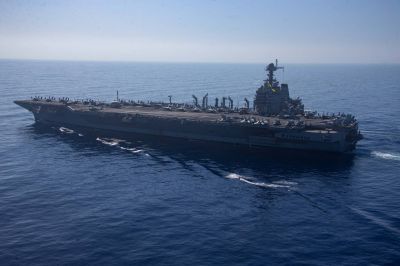
Iran and the U.S. resumed negotiations earlier this month to resolve their longstanding conflict over Tehran’s nuclear program and to avoid another military confrontation. The U.S. deployed a second aircraft carrier to the region and is preparing for the possibility of a prolonged military campaign if the talks fail, U.S. officials said.
U.S. Secretary of State Marco Rubio said during a news conference that President Donald Trump had made it clear that he would prioritize diplomacy and negotiate a settlement, but noted that this might not materialize. "No one has ever managed to reach an agreement with Iran, but we are going to try," he said.
Iran has threatened to strike American bases in the Middle East if U.S. forces attack, but on Sunday adopted a conciliatory tone. "To ensure the durability of an agreement, it is essential that the United States also benefit from sectors with high and rapid economic returns," said Hamid Ghanbari, deputy director for economic diplomacy at Iran’s Ministry of Foreign Affairs, according to the semi-official Iranian news agency Fars. "Common interests in oil and gas fields, joint fields, mining investments, and even aircraft purchases are included in the negotiations," he added, stating that the 2015 nuclear agreement with major powers did not guarantee U.S. economic interests.
In 2018, Donald Trump withdrew from the agreement, which had eased sanctions against Iran in exchange for restrictions on its nuclear program, and reimposed strict economic sanctions on Tehran.
U.S. envoys Steve Witkoff and Jared Kushner will meet with Iranian officials in Geneva on Tuesday, according to a source. This meeting was later confirmed Sunday to Reuters by a senior Iranian official. "Steve Witkoff and Jared Kushner will go onsite, I think they are traveling at the moment, to have important meetings and we will see how that goes," Mr. Rubio said, without providing further details.
While the talks leading to the 2015 nuclear deal were multilateral, the current negotiations are limited to Iran and the U.S., with Omani representatives serving as mediators for indirect contacts between the two countries.
Iranian Foreign Minister Abbas Araghchi left Tehran for Geneva to participate in the indirect nuclear negotiations with the U.S. and to meet the director of the International Atomic Energy Agency.
Possible compromises
Meanwhile, Iranian Deputy Foreign Minister Majid Takht-Ravanchi said in a BBC interview broadcast Sunday that Iran is ready to consider compromises to reach a nuclear agreement with the U.S., if Washington is willing to discuss lifting sanctions. He indicated that Iran was ready to discuss limitations to its nuclear program in exchange for the lifting of sanctions, but has repeatedly ruled out linking this issue to other matters, including missiles.
The head of the Iranian Atomic Agency said Monday that the country could agree to dilute its most enriched uranium in exchange for the lifting of all financial sanctions. Mr. Takht-Ravanchi used this example to illustrate Iran’s flexibility. The diplomat also reiterated his country’s position that Iran would not accept a total absence of uranium enrichment, which was a major obstacle to reaching an agreement last year, with the U.S. seeing enrichment on Iranian soil as a pathway to acquiring nuclear weapons.
Mr. Takht-Ravanchi also questioned the U.S. military buildup in the region, warning that a new war would be "traumatic, bad for everyone ... Everyone would suffer, especially those who initiated this aggression." He added: "If we perceive this as an existential threat, we will respond accordingly." Asked whether Iran would consider a U.S. campaign as a struggle for its survival, he replied: "It is not even wise to think about such a dangerous scenario, because the whole region would be plunged into chaos."
Iran has repeatedly stated that American military bases in the Middle East would be considered legitimate targets. During previous attacks, including against the al-Udeid military base in Qatar after the U.S. struck Iranian nuclear sites last June, Tehran avoided causing American casualties.


 8 p.m. recap: Israel again threatens Beirut’s south suburbs; 2 ships hit near Hormuz; Riyadh football matches canceled