





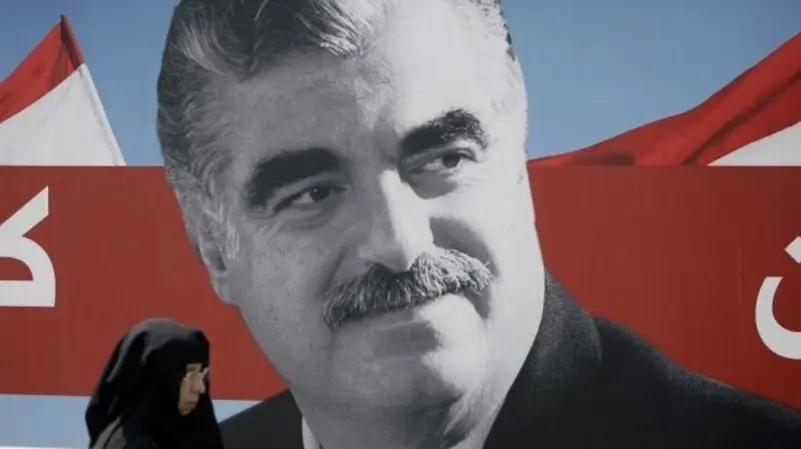
A woman walks in front of a portrait of former Prime Minister Rafik Hariri near his tomb in Beirut. (Credit: AFP archive photo)






Numerous senior officials, elected representatives and public figures paid tribute on Friday to former Prime Minister Rafik Hariri, on the eve of the 21st anniversary of his assassination on Feb. 14, 2005, in a bomb attack in downtown Beirut that killed 21 others and injured 226 people.
Arriving in Beirut on Thursday, his son Saad Hariri, also a former prime minister who has lived abroad for several years after withdrawing from Lebanese political life, held a series of meetings at the Center House, receiving among others the U.S. ambassador Michel Issa, the French ambassador Hervé Magro, the Russian ambassador Alexandre Rudakov and the U.N. special coordinator for Lebanon, Jeanine Hennis-Plasschaert.
Supporters paraded on motorcycles and in cars on certain streets of Beirut and Tripoli.
Responding to the commemoration of Rafic Hariri’s assassination, Parliament Speaker Nabih Berri said: “We mourn him as a statesman, a defender of unity and moderation. On the anniversary of his martyrdom, we are called to uphold these principles to preserve Lebanon, to which he devoted himself.”
Information Minister Paul Morcos wrote on X Friday that Hariri’s “martyrdom was not a fleeting event, but a pivotal moment in the nation’s history, when the will of the Lebanese to remain committed to justice and truth was tested.”
Vice President of the Supreme Shiite Council, Ali Khatib, added: “We mourn the loss of a man of Islamic and national unity, a statesman who fervently defended Lebanon and leveraged the strength of the resistance [Hezbollah] to achieve this goal. On this painful anniversary, we can only reiterate our deep sorrow for this immense national loss and our hope to see his aspiration of preserving Lebanon’s territorial, Islamic, and national unity realized.”
President Joseph Aoun was one of the first to speak in a message posted on the presidency's X account: "We feel the absence of a man who devoted his life to the project of the state, to the reconstruction of Lebanon and to strengthening its Arab and international presence," he said, adding that Rafik Hariri "believed in a Lebanon of state and institutions, in coexistence, and that true recovery begins with investing in people, education and the economy."
Former Prime Minister Tammam Salam also spoke on X, believing that Rafik Hariri's assassination had "marked a turning point in the history of our country and constitutes a message that state-building requires great sacrifices."
"Paying tribute to his memory means renewing our commitment to a strong and just state, governed by law, preserving its national unity, and placing the interest of Lebanon above all. May God protect Lebanon and its people," he wrote.
Former minister Wadih al-Khazen also spoke out. "More than ever, we reaffirm our attachment to the values embodied by the martyr: true patriotism, respect for democracy and the constant pursuit of unity and stability in Lebanon. We will not forget his great sacrifices and will continue to follow his path for a better Lebanon," he wrote in a statement published by the state-run National News Agency (NNA).
In the morning, Bahia Hariri also paid tribute to her late brother during the annual gathering organized with the Hariri family Association and their relatives from the Sharaf family, at her home in Saida, according to NNA.
"We are continuing the path of the martyred president with Saad Hariri and with all those who believe in 'Harirism' as a legacy and as human and national values. Our choice has been and will remain the project of building the state as Rafik Hariri wanted," she said.
Bahia Hariri, who then went to the Center House, welcomed the association's delegation there, thanking them for their constant support through all the difficult stages since Rafik Hariri’s assassination.
She stated: "We are continuing the path of the martyred president with Saad Hariri and with all those who believe in 'Harirism' as a legacy and as human and national values. Our choice has been and will remain the project of building the state as Rafik Hariri wanted."
An extended family member of the former prime minister, Amin Hariri, spoke on behalf of the delegation, declaring that "'Harirism' remains a trend symbolizing a solution, not a problem, regardless of the pressure in the political sphere," and that support for this trend goes beyond "electoral figures."
Another of Rafik Hariri’s sons, businessman Fahd Hariri, visited his father’s mausoleum in downtown Beirut to pay his respects and pray, according to a statement from NNA, which specified that he was on a business trip to Lebanon and had already departed.
Sunni MP for Tripoli (northern Lebanon) Ashraf Rifi estimated that those who killed the former prime minister "have paid the price for the crime of the century," adding that "his dream of a Lebanon as a beacon of development, modernity and leadership is not dead and will not die, while their project, that of a culture of death, destruction and blood, is coming to an end."
He also declared that "there will be no leniency towards the criminals and perpetrators until justice is served," rejecting any attempt at a settlement or political compromise regarding the assassination.
Geagea and Bassil
The leader of the Lebanese Forces (LF), Samir Geagea, for his part, called for unity in order to "achieve what remains of Rafik Hariri’s goals, in loyalty to his memory," estimating that a large part of the objectives for which he died have already been achieved.
According to him, "The camp of 'mumana'a' [the pro-Iranian axis] assassinated Rafik Hariri on the pretext that he was behind U.N. Security Council Resolution 1559, which called for the withdrawal of Assad’s army from Lebanon and the dismantling of all illegal armed organizations."
He added: "Today, we no longer see [Bashar] Assad, even in Syria, and we are on the verge of dissolving all illegal armed organizations and extending the authority of the state, through the Lebanese Army and the legitimate security forces, over the entire Lebanese territory."
The leader of the Free Patriotic Movement (FPM, Gebran Bassil, considered that in Lebanon "everyone has paid their dues, but the heaviest cost is physical assassination, not to mention the harshness of political assassination," emphasizing that "the great injustice lies in the fact that the truth remains unrevealed."
He also wished mercy to the soul of Rafik Hariri and his companions, as well as to all those who have been victims of assassinations, calling for the lesson to be learned that "dialogue and understanding are the only things that can save Lebanon."
In a message posted on the platform X, Prime Minister Nawaf Salam paid tribute to “a great man of Lebanon.” “Rafic Hariri, martyr of the nation, was driven by an enlightened vision and an unwavering determination to rebuild Lebanon after years of war, destruction, and occupation. He was also committed to consolidating civil peace, stability, and national unity through the implementation of the Taif Agreement,” he wrote. Mr. Salam also indicated that he had tasked the Minister of Social Affairs, Hanine Sayed, with representing him on Saturday at the ceremony that will take place at the tomb of the former Prime Minister in Beirut.
Saad Hariri also received Deputy Speaker of Parliament Elias Bou Saab at the Centre House. “Today, more than ever, we understand the magnitude of this loss and what Lebanon and all Lebanese have lost, from the south to the north, from the Bekaa to Beirut, and across Mount Lebanon,” Bou Saab said.
“If Prime Minister Rafik Hariri were among us today, we would have so much more hope for a different reality. His wisdom, intelligence, and determination to save Lebanon in difficult times were evident in the files he handled in the past, and he would certainly have handled them in the same way today. We could then have hoped for broader and more inclusive dialogue among the Lebanese…”
Israeli army drones flew at low altitude and intensively over several villages in the Zahrani area, located near the coast, our correspondent in south Lebanon reported.
Syrian Foreign Minister Assaad al-Shaibani met with his U.S. counterpart Marco Rubio on the sidelines of the Munich Security Conference, where they discussed the recent agreement with the Kurds, according to an official statement. The meeting addressed “the latest national and regional developments, while emphasizing Syria’s unity, sovereignty, and territorial integrity,” the Syrian Foreign Ministry said in a statement.
The United States expressed its support for “the recently concluded integration agreement with the Syrian Democratic Forces,” it added, referring to the SDF, predominantly Kurdish forces that played a key role in the fight against jihadists in Syria.
The ministry released photos of the meeting in Munich showing, alongside Shaibani, SDF commander Mazloum Abdi and Kurdish official Ilham Ahmed, who participated in the meeting.
