





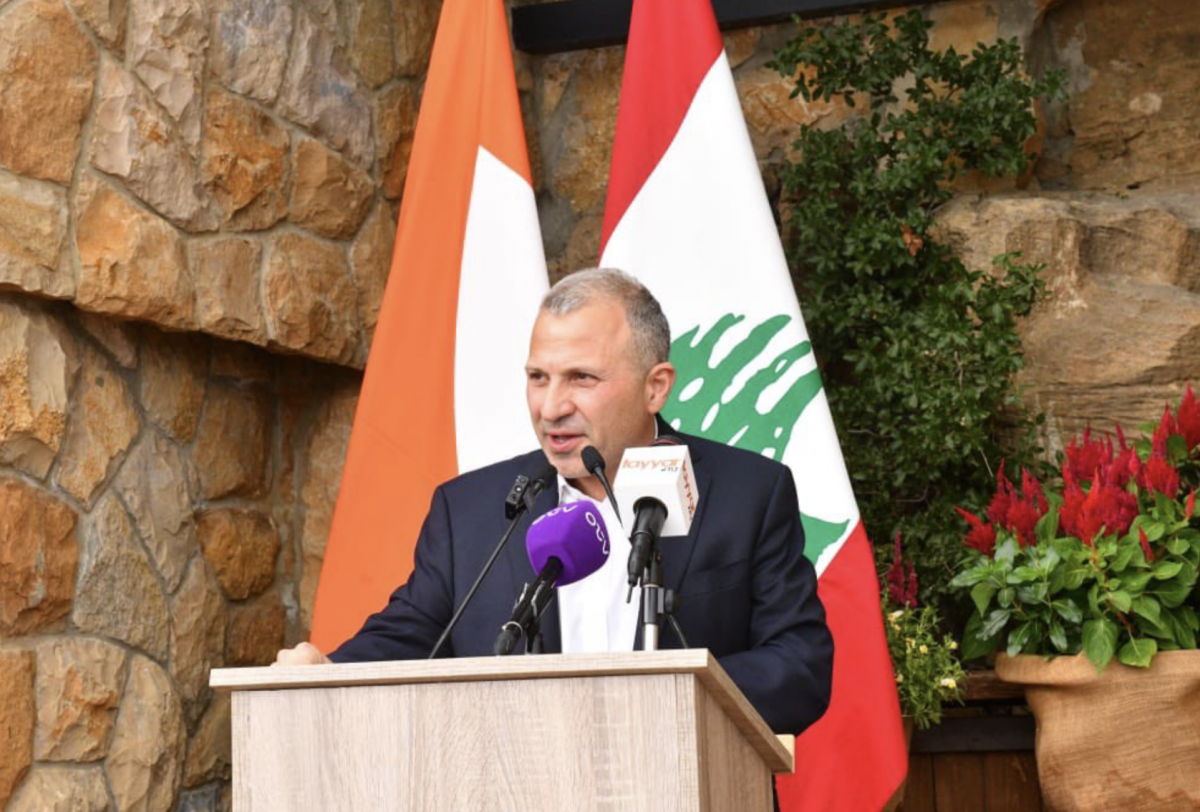
The leader of the Free Patriotic Movement, Gebran Bassil, in Ehmej (Jbeil district), on Oct. 5, 2025. (Credit: Photo taken from the FPM's X account)






BEIRUT — The head of the Free Patriotic Movement (FPM), Gebran Bassil, announced Wednesday at a press conference that he would "undertake legal steps" to ensure that the parliamentary elections, scheduled for May, take place under the current electoral law, including a suit against Foreign Minister Joe Rajji (Lebanese Forces).
The 2017 law stipulates that expatriates vote for six seats allocated to them, rather than for the 128 seats in the chamber. This option is seen as more favorable to his interests, while the issue of how expatriates will vote casts a shadow over the ballot, with Parliament divided on this issue and the specter of a possible postponement looming.
Bassil also said that the 144,000 Lebanese expatriates registered for the parliamentary elections did so "knowingly and agreeing to vote" according to the 2017 law.
'Preliminary appeal' against Joe Rajji
"We are required to adopt clear legal steps to protect a right enshrined by law and by the Constitution," the FPM leader declared, in the face of what he called a "problem that is not legal or administrative, but political." He then announced five measures.
The first is to "file a preliminary appeal against the Foreign Ministry": "This is not a formality, but a fundamental legal step that establishes the existence of an administrative malfunction, places the administration before its responsibilities, and gives it a final chance to correct course and apply the law as required," Bassil explained.
"The importance of the preliminary appeal lies in moving the debate from the realm of political polemic to that of legal responsibility, and in confirming that the problem does not lie in the text of the law but in the refusal to implement it," he added.
"The administration’s refusal to exercise its prerogatives is not neutrality but is in itself a legal violation, known in administrative law as ‘negative incompetence’: when the administration refrains from making the decision needed to enforce the law, it fails in its legal duty," he further asserted.
Bassil then outlined four other steps. "The second is to file an appeal against the decision regarding the submission of candidacies before the State Council, the third, to submit a question to the government over its failures to implement the law; the fourth, to send a letter to Parliament and seek a withdrawal of confidence, signed by ten MPs, against the foreign minister and the government ... the fifth, to call on anyone wishing to submit their candidacy from abroad to do so."
'Diaspora registered on the basis of the 2017 electoral law'
The leader of the main opposition bloc to the Salam government lashed out at the circular regarding the deadlines for submitting declarations of candidacy and lists, which states that "the opening of candidacy submissions for the six seats is ‘impossible as of today,’ due to the absence of the necessary legal and implementation texts."
"The real danger lies precisely in the phrase ‘as of today’ in the interior minister’s circular," Ahmad Hajjar, said. "Regulatory texts exist to implement the law, not to block it. The phrase ‘as of today’ means that the obstacle is circumstantial. If it is circumstantial, what, then, is the obstacle? And who is responsible for it?" he further asked.
Bassil maintained that "the mechanisms to implement [the 2017 law] exist, and two committees have each proposed an option — one in 2021 and the other in 2025 — that should be adopted," he insisted. The article regarding the six overseas MPs in the electoral law adopted in 2017 was not applied in the last two legislative polls in 2018 and 2022, as the text remains vague about the system for these six seats, with no concrete mechanism for implementation.
He also argued that "the Lebanese of the diaspora registered abroad on the basis of the current electoral law, knowingly and agreeing to vote from abroad for the six MPs who directly represent them in constituency no. 16."
"What do you tell them now, and how are you going to remove their names from the voter lists to make them vote inside the country?" he pressed. He called on "the 144,000 expatriates and others to rise up and submit their candidacies so as not to lose their rights. Are we living in a state or in a jungle?"
Bassil insisted again, asserting that "without the expatriates, the elections collapse and lose their legitimacy."
Lebanese expatriates registered between Oct. 2 and Nov. 20, 2025, while heated parliamentary debates took place regarding the modalities of expatriate voting.

 Evening recap: Netanyahu announces West Bank offensive; 7 killed in Jordan church shooting; tents burned in south Lebanon
 US strike on Iran this weekend? ‘Absolutely,’ says Barrack; ‘I have no idea,’ says Trump