






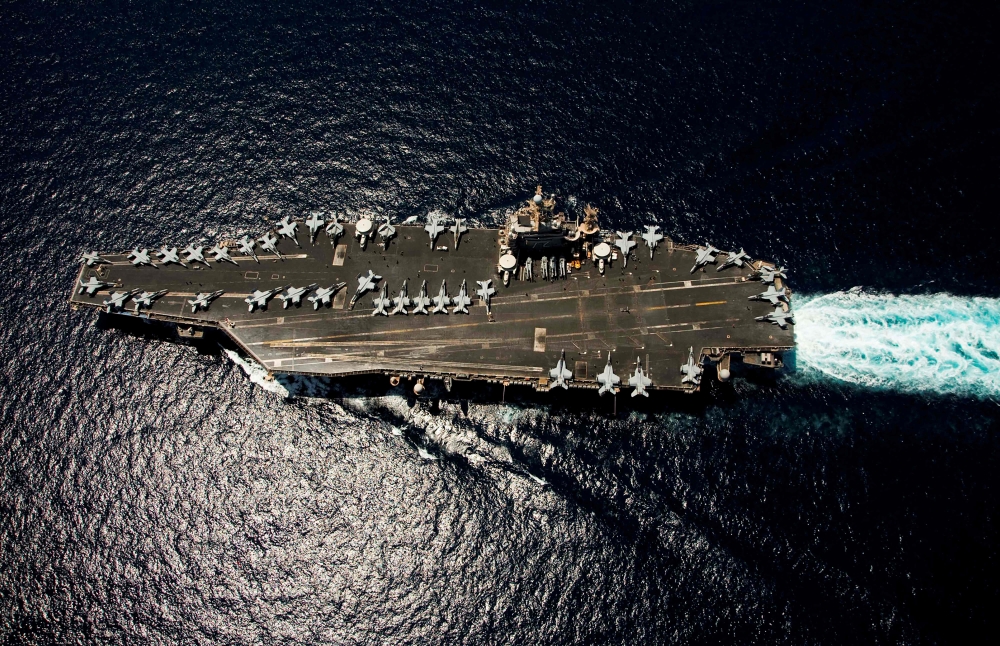
The aircraft carrier USS Abraham Lincoln, of the Nimitz class, crosses the Arabian Sea on April 5, 2012. (Credit: Karolina A. Martinez/US NAVY/AFP)






The likelihood that the United States will order its armada, led by the recently deployed USS Abraham Lincoln (CVN-72) carrier in the region, to conduct major strikes on Iran has been postponed for now to allow for negotiations. But according to the Wall Street Journal, such strikes are not imminent despite recent rhetoric from President Donald Trump, because Washington is first seeking to reinforce its air defenses in the Middle East and Gulf to protect Israel and allied Arab states in case of Iranian retaliation and the outbreak of a protracted conflict.
The WSJ reports, based on interviews with U.S. Defense officials, flight tracking data and satellite images, that the Pentagon is deploying an additional THAAD battery and Patriot systems to bases where American troops are stationed throughout the Middle East, including in Jordan, Kuwait, Bahrain, Saudi Arabia and Qatar.
Deployment of THAAD, a strong signal
The THAAD battery can intercept ballistic missiles above the atmosphere, while Patriots protect against lower-altitude, shorter-range threats, the American newspaper notes.
The deployment of THAAD is a strong signal that the United States is preparing for conflict, as it possesses only seven operational batteries, which are already stretched to the limit. Moving them is costly, according to Seth Jones, a former Pentagon official contacted by the WSJ. Each THAAD battery can hold 48 interceptors and requires about 100 soldiers for reloading, data analysis, maintenance and continuous firing, the paper details.
Satellite images show that an additional Patriot has been installed at the al-Udeid base in Qatar last week, the paper reports. A coordination cell has also been set up at this base to strengthen air defense and missile defense cooperation with U.S. partners in the Gulf. Three squadrons of F-15E are also deployed in Jordan and could play a role in intercepting Iranian drones, according to the WSJ.
"The issue of air defense is key — how much equipment we have to ensure that our troops and facilities in the region are protected against any form of Iranian retaliation," summarized Suzanne Maloney, a former State Department official on Iranian policy under the Bush and Obama administrations.
Officials interviewed added that, at this time, Washington could order limited strikes on Iran if the president called for an attack today, but that the kind of decisive strike Donald Trump has asked the military to prepare for would likely trigger a proportional Iranian response, which would overwhelm current U.S. air defense capabilities. The WSJ counts eight destroyers capable of intercepting Iranian missiles and drones, including two near the Strait of Hormuz, three in the northern Arabian Sea, one near Israel in the Red Sea, and two in the eastern Mediterranean.
The WSJ adds that Iran is preparing by reinforcing its regional proxies.
During the war launched by Israel against Iran that lasted 12 days in June, U.S. defenses intervened to intercept some of the missiles fired by Tehran at Israeli territory, which was struck several times – some of the Iranian missiles launched were visible from Lebanon.
The THAADs played a key role, especially when Israel's Arrow interceptors were depleted, the WSJ adds. However, the U.S. used up its munitions at a very fast rate, firing more than 150 missiles — about a quarter of all the interceptors ever purchased by the Pentagon.
