


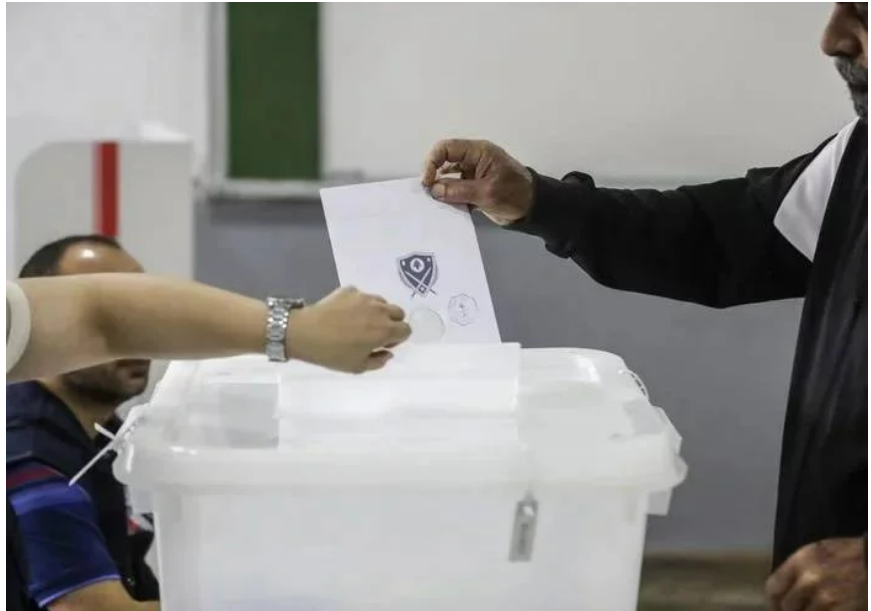
A Lebanese citizen votes during the 2018 parliamentary elections. (Credit: Joseph Eid/AFP)






BEIRUT — The decree convening the electoral college for the 2026 parliamentary elections, signed Thursday by Interior Minister Ahmad Hajjar, was published in the Official Gazette on Friday.
The process is proceeding within the legally required deadlines, but the outcome of the vote remains uncertain and could be postponed at least until the summer.
Under the decree, Lebanese residents will vote on May 10, 2026, while the diaspora will vote a week earlier: May 1 for residents of certain Arab countries and May 3 for the rest of expatriates. Civil servants working during the elections will vote on May 5.
Lebanese citizens living in Saudi Arabia, Qatar, Kuwait, Iran, Oman, Bahrain, and Egypt will vote on Friday, May 1, except in the United Arab Emirates, where voting will take place on Sunday, May 3.
Elections will also be held on May 3 in countries including France, Canada, the United States, Germany, Australia, Ivory Coast, the United Kingdom, Ireland, Sweden, Belgium, Switzerland, Nigeria, Italy, Brazil, Gabon, Ghana, Congo, Venezuela, Spain, the Netherlands, Cyprus, Benin, Senegal, Romania, Angola, Togo, Zambia, Sierra Leone, Denmark, Mexico, Luxembourg, Greece, Russia, Turkey, Austria, Liberia, Guinea, Ireland, South Africa, Cameroon, and Burkina Faso.
The Directorate General of Civil Status announced that preliminary electoral lists for 2026–2027 are available in accordance with Articles 2, 33, and 34 of Law No. 44 of June 17, 2017. Voters residing in Lebanon and abroad are invited to review the lists on the official website (www.dgcs.gov.lb) starting February 1, 2026, and submit any corrections by March 1, 2026.
Copies of the lists have also been sent to municipalities, mukhtars, governorate and district centers, and the Ministry of Foreign Affairs and Emigrants to ensure broad dissemination and facilitate final review. Voters may also consult copies at governorate and district centers, municipal offices, mukhtar offices, and Lebanese embassies and consulates abroad.
The civil status authority emphasized that “anyone affected must submit a request between Feb. 1 and March 1, 2026, to correct any errors in their registration, whether a deletion, a name error, or any other issue.”
Preliminary electoral lists are also available on CDs for each electoral district. Copies can be obtained for 1,000,000 Lebanese pounds through fiscal stamp or official receipt.
The issue of diaspora voting continues to divide Parliament, raising concerns that the elections could be postponed to the summer.
Led by the Lebanese Forces, parties supporting an amendment to the electoral law advocate that expatriates be allowed to vote for all 128 parliamentary seats, as in the previous two elections, rather than just six additional seats reserved for the diaspora under the 2017 law.
The latter option is supported by the Shiite bloc (Amal-Hezbollah), led by Parliament Speaker Nabih Berri.
On Wednesday, during debates on the 2026 state budget, MP Adib Abdel Massih said, “It is clear that the elections will not take place on the scheduled date,” and announced plans to propose a law to postpone the elections by one year to avoid “continuing to lie to the Lebanese people.”
The article was updated on Friday, Jan. 30, following the publication of the decree.