






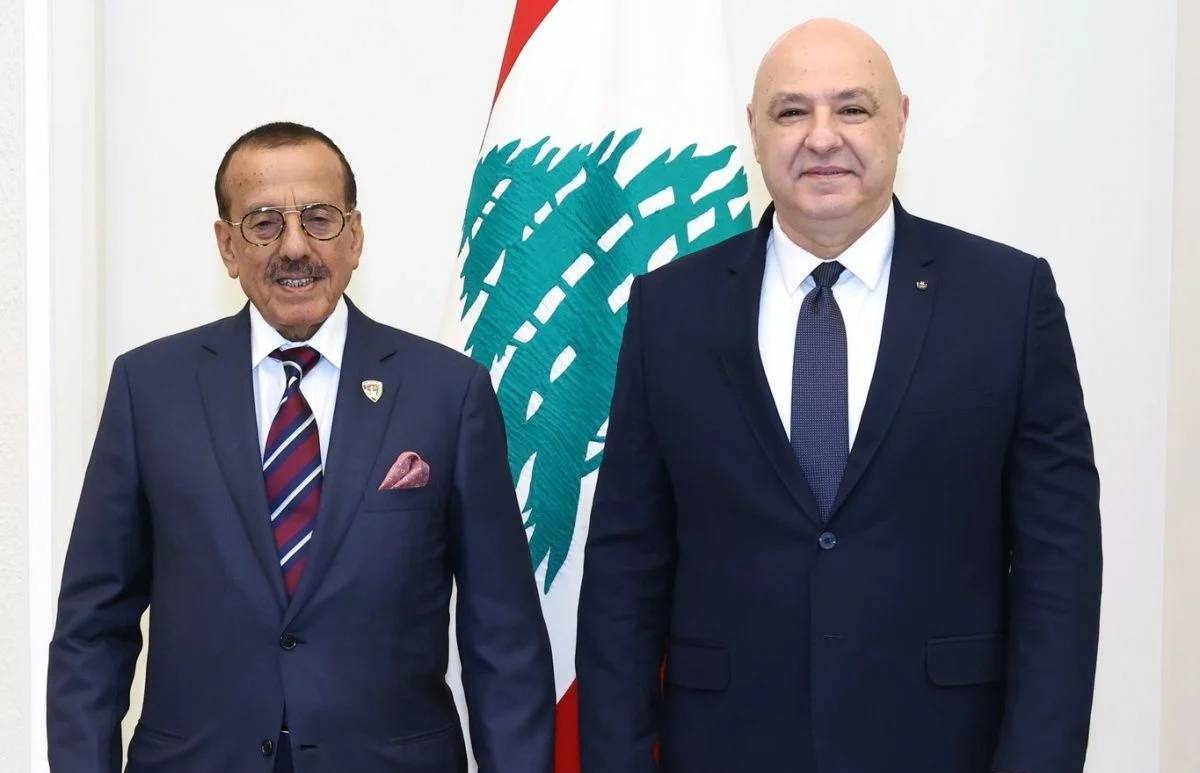
Emirati businessman Khalaf Ahmad al-Habtoor next to Lebanese President Joseph Aoun. (Credit: Photo taken from the Lebanese presidency's X account, Sept. 11, 2025.)






BEIRUT — Emirati conglomerate Habtoor Group, led by Khalaf al-Habtoor, has threatened legal action against the Lebanese government and the central bank over more than $1.7 billion in investment losses, according to a statement cited by Reuters and local media.
Specifically, the group stated that its "investments have suffered severe and lasting damages as a direct result of measures and restrictions imposed by the Lebanese authorities and the BDL, which prevented it from freely accessing and transferring funds legally deposited in Lebanese banks," referring to the blocking of billions of dollars in deposits during the crisis that erupted in 2019 and continues to this day.
"These measures, compounded by the prolonged political, economic, financial, and social crises facing the Republic of Lebanon, as well as Lebanon's failure to provide a stable and secure environment for operations and investment, have resulted in significant and ongoing damages and losses to the group's assets and property in Lebanon, exceeding a value of $1.7 billion," the statement said.
The group, which said it had "exhausted all reasonable and good faith efforts to resolve this dispute amicably, including through official communications with the relevant authorities, to no avail," declared that "there is no other alternative" but to "pursue all necessary legal proceedings to protect and assert its rights under international agreements and existing legal frameworks."
However, it says it remains open to constructive solutions that would restore its rights, while warning that it "cannot and will not continue to absorb additional losses resulting from prolonged inaction, negligence, and systemic failure."
The offices of Lebanese Prime Minister Nawaf Salam and the Banque du Liban did not immediately respond to Reuters' requests for comment.
The Habtoor Group has invested in Lebanon for years in various sectors, including hospitality, retail, and real estate. It even built an amusement park in Baabda, which is now closed.
Habtoor, founder and chairman of the group, is known for his critical statements against Hezbollah. He has increased his public statements since the election of President Joseph Aoun in January 2025, either to rally enthusiasm over Lebanese leaders' renewed willingness to pursue long-awaited reforms since 2019, or to denounce, among other things, the grip of the Iran-backed Shiite party over the country's governance.
A few days before the funeral in February 2025 of former Hezbollah Secretary General Hassan Nasrallah, who was killed in an Israeli raid in the southern suburbs of Beirut in September 2024, the billionaire warned of "the end of Lebanon" if there were any official representation at the event.
In January 2025, Habtoor announced he had made the "painful" decision to cancel all investment projects in Lebanon and sell all his real estate assets in the country due to the challenges facing the state. But in September of the same year, he announced his return to Lebanon, promising a new wave of investment.
