






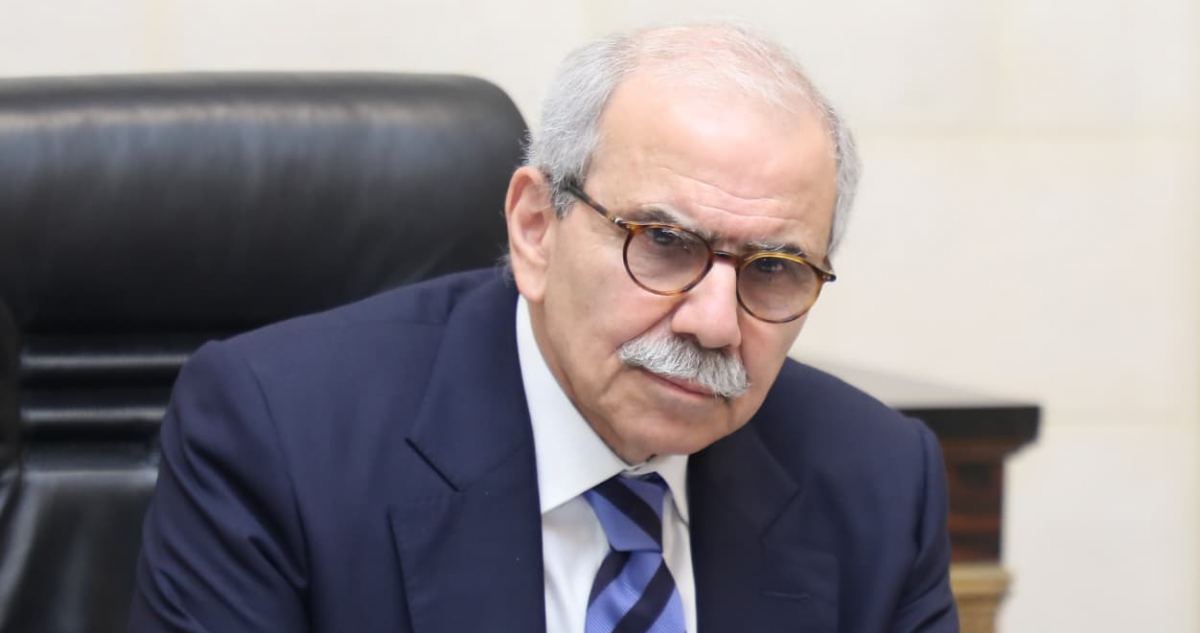
Prime Minister Nawaf Salam. (Credit: NNA) Prime Minister Nawaf Salam. Photo ANI






Speaking from the Lebanese Embassy in Paris on Saturday, Prime Minister Nawaf Salam addressed key national issues, notably the Lebanese state’s monopoly on weapons and the need for economic reforms.
“If security is not ensured in Lebanon, there will be no investments, and if reform of the banking sector does not take place, there will also be no investments,” he said.
The prime minister had been received the previous day at the Élysée Palace by French President Emmanuel Macron for an hour-long meeting focused on the fragile cease-fire between Israel and Hezbollah, the disarmament of the group, and preparations for the international conference in support of the Lebanese Armed Forces, scheduled for March 5 in Paris.
When Salam spoke of security and banking reform, he was referring both to the recent war between Israel and Hezbollah — which has continued despite the Nov. 27, 2024 cease-fire through ongoing strikes and targeted attacks on Lebanese territory — and to the unprecedented economic and financial crisis that has gripped Lebanon since 2019. As for investments, Lebanon needs them more than ever given the scale of the economic collapse and the necessity of rebuilding large swaths of the country.
The prime minister nevertheless affirmed that “Lebanon has entered a new phase of negotiations with the International Monetary Fund,” describing these talks as a gateway to renewed investment.
On the issue of the state’s monopoly over weapons, a mission assigned to the Lebanese Army by the government last August, Salam confirmed that “the first stage of the plan was in itself a historic achievement.” He stressed that “this objective will not be abandoned. We are committed to implementing this plan, just as we are committed to the Taif Agreement,” which ended the 1975–1990 civil war and serves as a constitutional framework.
“There is no difference between north of the Litani and south of the Litani, as the law must apply everywhere,” he added. “Our job is not to please Israel, but to satisfy our people and improve our situation. We cannot claim that we have avoided war while engaging in a unilateral war of attrition. We must continue our efforts to end the hostilities.”
Following Hezbollah’s weakening in its latest confrontation with Israel and amid international pressure, particularly from the United States, the issue of illegal weapons has resurfaced. The Salam government tasked the Lebanese army with implementing militia disarmament. The army submitted its report in early January on the completion of the first phase, covering areas south of the Litani River, including zones closest to the Israeli border. The second phase is expected to begin in February.
Hezbollah, for its part, continues to reject full disarmament, arguing that the cease-fire agreement applies only south of the Litani, a claim denied by Lebanese authorities.
Role of the cease-fire monitoring mechanism
In Paris, Salam was also questioned about the role of the cease-fire monitoring committee, known as the Mechanism, which was established after the conflict and sponsored by France and the United States. The body is reportedly facing difficulties due to alleged differences between its two sponsors, raising concerns about its future.
“The role of the Mechanism is not over, and we remain committed to it. When it becomes necessary to strengthen the presence of civilians within it, we will do so,” the prime minister said. In early December, President Joseph Aoun appointed former ambassador Simon Karam to join the committee, which had previously been composed solely of military officials.
He added: “We do not intend to confront the United States, which is an essential partner in this committee. And that country has never said it sought to sideline France from this body.”
Asked about the international conference in support of the Lebanese Armed Forces planned in Paris, Salam concluded: “I cannot guarantee its success, but we are mobilizing all efforts to support the army and to expand the circle of countries that may contribute.”

 1 p.m. recap: Hezbollah offers extensive aid package for the displaced; ICRC warns of 'disaster' in Middle East; explosive device found in the Bekaa