






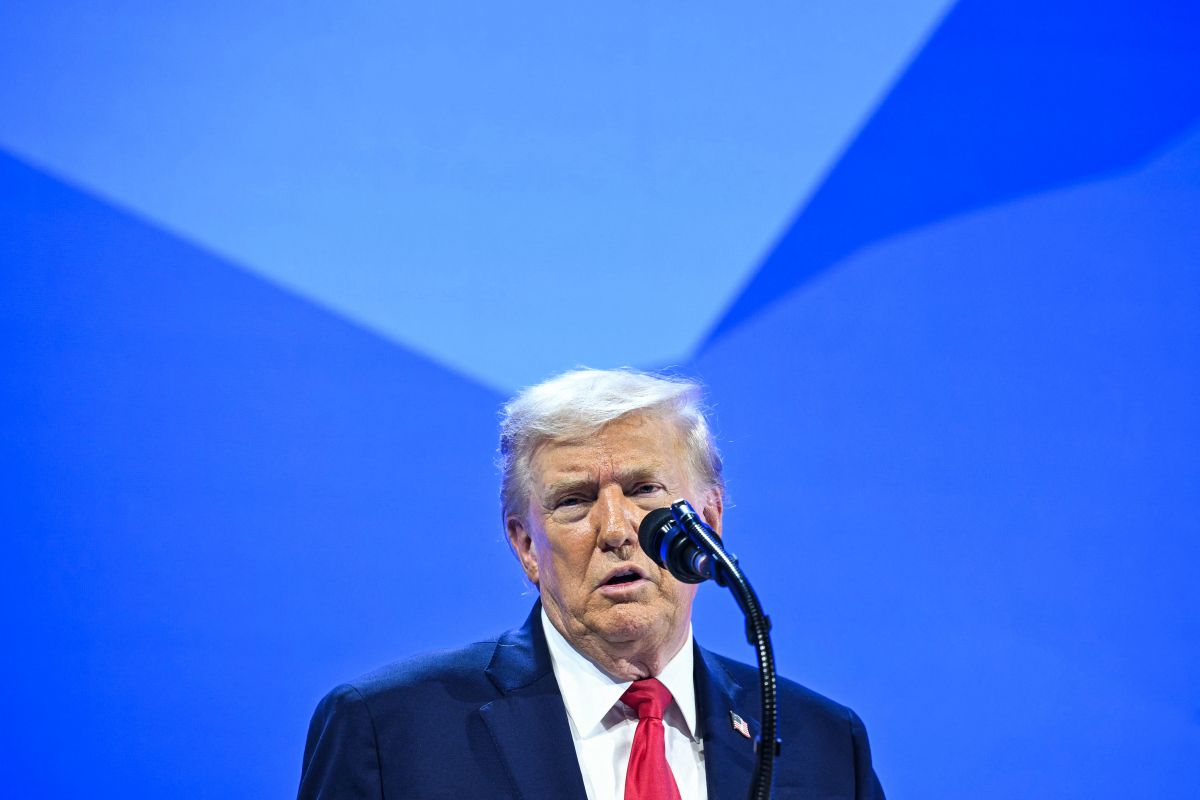
The American president, Donald Trump, delivers a special address at the annual meeting of the World Economic Forum (WEF) in Davos, on Jan. 21, 2026. (Credit: Mandel Ngan/AFP)






BEIRUT — U.S. President Donald Trump mentioned Hezbollah on Wednesday on the sidelines of the Davos Economic Forum, repeating that it is a “problem,” while once again remaining evasive, as Lebanon continues to fear a major Israeli offensive on the country.
“There’s a problem with Hezbollah, and we’ll see what happens there” he said in response to a question about the future of the Gaza Strip.
The remark echoes a statement he made at the end of December, after meeting with Israeli Prime Minister Benjamin Netanyahu. “Hezbollah has behaved badly, so we’ll see what happens,” he had said at the time.
The Lebanese Army says it has completed the disarmament of Hezbollah south of the Litani River, Hezbollah still refuses to hand over its weapons north of this area, where the army must draw up a plan.
The Israeli army for its part continues to occupy at least five positions in southern Lebanon, and to bomb southern Lebanon and the Bekaa on a daily basis, citing Hezbollah’s refusal to disarm.
Particularly destructive strikes took place Wednesday evening.

Hamas was 'born with a weapon in their hand'
Before discussing Hezbollah, the U.S. president addressed the disarmament of Hamas, which is stipulated by the cease-fire agreement in the Gaza Strip that came into effect on Oct. 10, 2025.
“I think we have peace in the Middle East. There are still some little situations like Hamas, and Hamas has agreed to give up their weapons. You know, they were born with a weapon in their hand, so it’s not easy. We’re going to know over the next two or three days, certainly overthe next three weeks, whether they do it or not. If they don’t do it they’ll be blown away very quickly,” Trump said.
“There are these little flames, but now there is peace in the Middle East,” he added, stating that Iran “is no longer the bully of the Middle East” after American strikes against nuclear installations in June 2025, during the twelve-day war between Israel and Iran.
“Saudi Arabia, the Emirates, and Qatar, as well as other countries, would have never signed anything if there had been that ‘dark cloud’: an Iran with nuclear weapons. If we hadn’t neutralized them, they would have acquired nuclear weapons within two months,” Trump continued.
The Gulf countries he cited did not sign the Gaza peace agreement, except Qatar, engaged as a key mediator in the negotiations and guarantor between Israel and Hamas.
They are, to varying degrees, involved in negotiations on the future of the Gaza Strip, where an international stabilization force is due to be deployed as part of the cease-fire agreement.
Iran saw a vast protest movement in January, during which 3,117 people were killed, according to Iranian state television on Wednesday.
According to the Norway-based NGO Iran Human Rights (IHR), whose figures are cited by the U.N., at least 3,428 protesters were killed, but the toll could likely exceed 20,000 deaths.
The U.S. president did not intervene on behalf of the protesters, despite his threats, notably under pressure from Gulf countries and, to some extent, Israel.
