


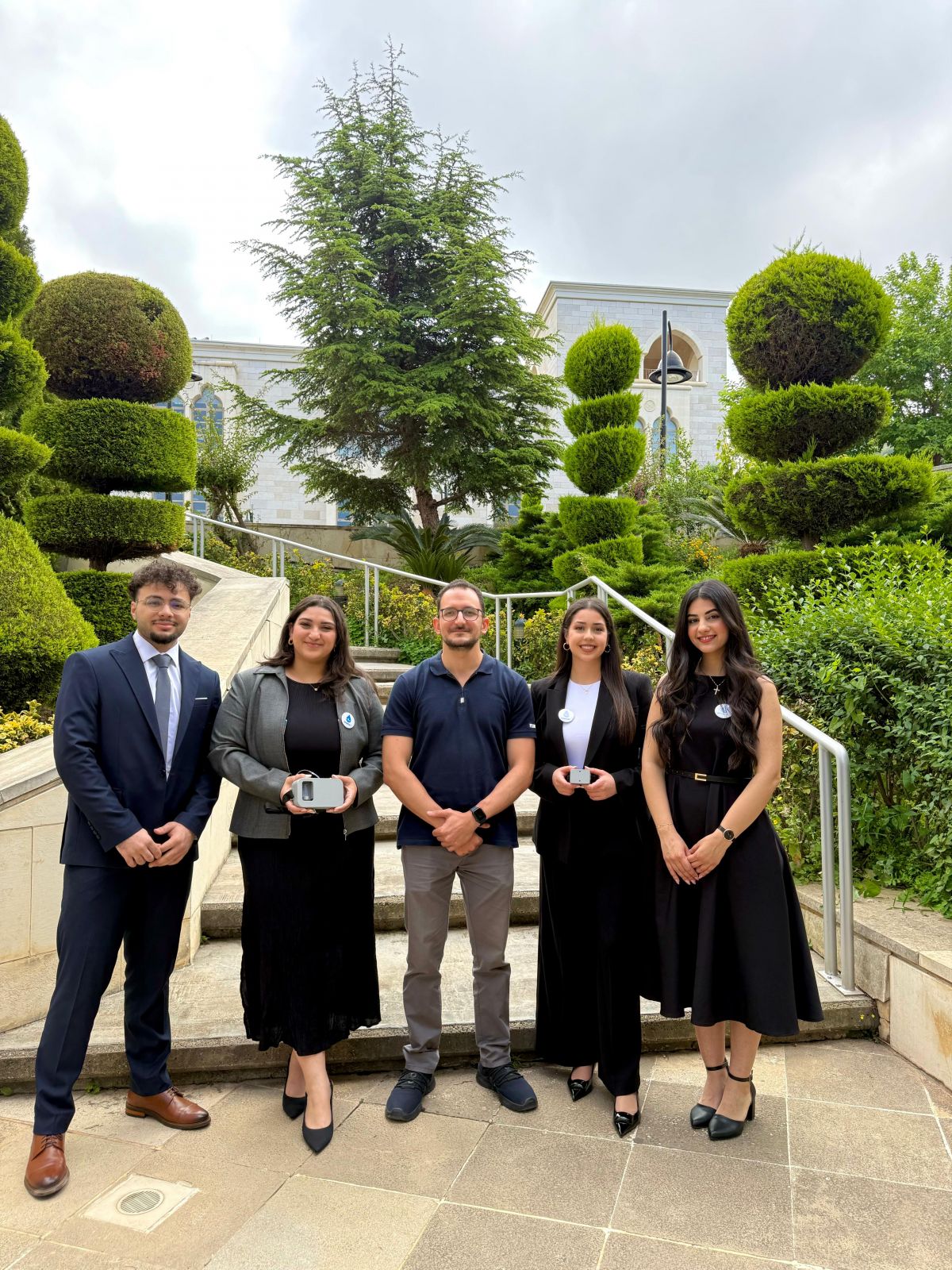
AUT CREATE 25 winners. (Credit: C.E.)






DiaBEAT, created by Valerie Naufal and Elissa Diab, computer engineering students, along with Taline Saad and Hassan Tfaily, who studied electrical and mechatronics engineering — all at the Lebanese American University (LAU) — is a diabetes management system that combines a wristband sensor, an automated insulin pump worn on the belt and a mobile application connected to the device.
Behind its seemingly simple exterior, DiaBEAT relies on a complex mechanism that enables precise glucose measurements and delivers personalized insulin doses. "DiaBEAT offers a complete diabetes management ecosystem. It combines noninvasive optical data and machine learning to accurately estimate glucose levels," says Naufal, 22.
"DiaBEAT stands out because it is neither just a gadget nor a limited prototype. It is an integrated system inspired by the real logic of diabetes management: measurement, interpretation and action," says Noel Maalouf, an assistant professor at LAU and the team’s supervisor.
A closed-loop system inspired by the pancreas
The system’s wristband sensor allows for continuous monitoring of blood glucose levels using near-infrared light, without the need for finger pricks, says Saad, 22, a recent graduate. The approach ensures both measurement accuracy and user comfort, Naufal adds.
The mobile application enables users to track trends, view real-time data, receive alerts and obtain personalized insulin recommendations, helping users better manage their disease, according to Naufal. Data collected through the app make it possible to calculate appropriate insulin doses based on glucose levels, meals and daily activities, Saad says. These doses are then delivered by an automated pump worn on the belt.
"This ecosystem was designed to mimic the functioning of the human pancreas, which naturally performs all these steps," Naufal explains. "The result of this closed-loop system is that patients are freed from the constraints of constant measurements, monitoring, calculations and injections."
The main objective of DiaBEAT, Saad says, is to offer "precise, painless and personalized diabetes management while improving patients’ quality of life."
Medical precision and quality of life
Developed as a graduation project, DiaBEAT was inspired in part by Diab’s personal experience. The 22-year-old graduate recounts the challenges faced by her cousin, who has lived with type 1 diabetes since birth.
"Growing up, I witnessed the pain of frequent finger-prick tests, the constant insulin and carbohydrate calculations, and the constraints that prevented him from fully enjoying his childhood," she says. Diab also recalls the constant anxiety caused by sudden hypo- or hyperglycemic episodes triggered by stress or daily activities.
"This reality pushed us to think about how technology could ease this burden and address the needs of more than 300 million diabetic patients worldwide," she says. "The goal of DiaBEAT was to rethink diabetes care by placing both medical accuracy and quality of life at the core of the solution."
Addressing the limits of existing methods
The team designed DiaBEAT to address shortcomings in existing diabetes management tools. Traditional finger-prick glucose testing, Diab says, remains insufficient due to constant glucose fluctuations. Continuous glucose monitoring systems worn as patches, meanwhile, are often invasive, uncomfortable and expensive.
DiaBEAT distinguishes itself through a simpler, painless monitoring approach that encourages regular use, Diab says, leading to better glycemic control, fewer complications and an overall improvement in patients’ quality of life.
Maalouf notes that the team placed strong emphasis on user experience and practicality while maintaining engineering rigor. The students aimed to reduce the pain and inconvenience of finger pricks while prioritizing precision in insulin delivery. The pump delivers roughly one drop per second, a rate that allows for safer and more predictable control, he says.
Affordability was another key consideration. "Many commercial continuous glucose monitoring solutions remain expensive and not widely available," Maalouf says. "DiaBEAT was designed from the start with cost constraints in mind. Even at the prototype stage, this approach ties technological choices to issues of access and equity, not just performance."
Recognition and international exposure
DiaBEAT won first prize at AUT CREATE 25 in September, a milestone for the project. According to Maalouf, the combination of system integration, user-centered design, testing phases and attention to realistic constraints often distinguishes promising student projects from those with real-world potential.
The national innovation competition is supported by the German Federal Ministry of Education and Research and organized by the American University of Technology in collaboration with Hochschule Bonn-Rhein-Sieg University of Applied Sciences, the IEEE Lebanon Section, ZAKA (Beirut AI) and DX Talks.
As part of the prize, the team spent a week in late November at Hochschule Bonn-Rhein-Sieg in Germany, where they participated in intensive workshops on entrepreneurship, sustainability and innovation, as well as collaborative sessions with academics and industry partners.
"One of the highlights was visiting DIGITALHUB.DE in Bonn, where we discovered Germany’s dynamic startup ecosystem," Diab says. "This helped us refine the project’s design and strategy. When we returned to Lebanon, we continued improving DiaBEAT through individualized coaching sessions."
Participation in AUT CREATE 25 and the LIRA 18 competition, organized by Industrial Research Achievements Lebanon, helped shape the team’s trajectory. "This project transformed my vision, shifting it from a purely technical challenge to a real responsibility in the health sector," Naufal says.
With a minor in management, she adds that the experience gave her an entrepreneurial perspective and helped her develop an approach better aligned with patient needs and technological limitations. "Above all, it taught me that as an engineer, it is my social responsibility to connect technology, innovation and real-world problems to contribute to a better world," she says.
Clinical trials ahead
As a multidisciplinary team, the students developed DiaBEAT by combining complementary skills across hardware design, software development and data management. Projects like DiaBEAT, Maalouf says, push students beyond theoretical engineering toward true systems thinking — an approach that reflects both industry expectations and research requirements at the intersection of electronics, computer science and health care.
The next step is to strengthen the system’s scientific and clinical foundations, according to Naufal. The team plans to improve model accuracy using broader and more diverse datasets through intensive testing and continuous feedback.
Once optimal accuracy is achieved, the students aim to integrate DiaBEAT into clinical trials, particularly in LAU laboratories, in collaboration with health professionals in Lebanon. This phase, Naufal says, will allow the team to gather direct patient feedback and further refine the device, especially in terms of comfort.
The team is also seeking partnerships and funding to support continued research and technological development.


 1 p.m. recap: Salam in Nabatieh; up to 10,000 more US troops heading to Middle East