






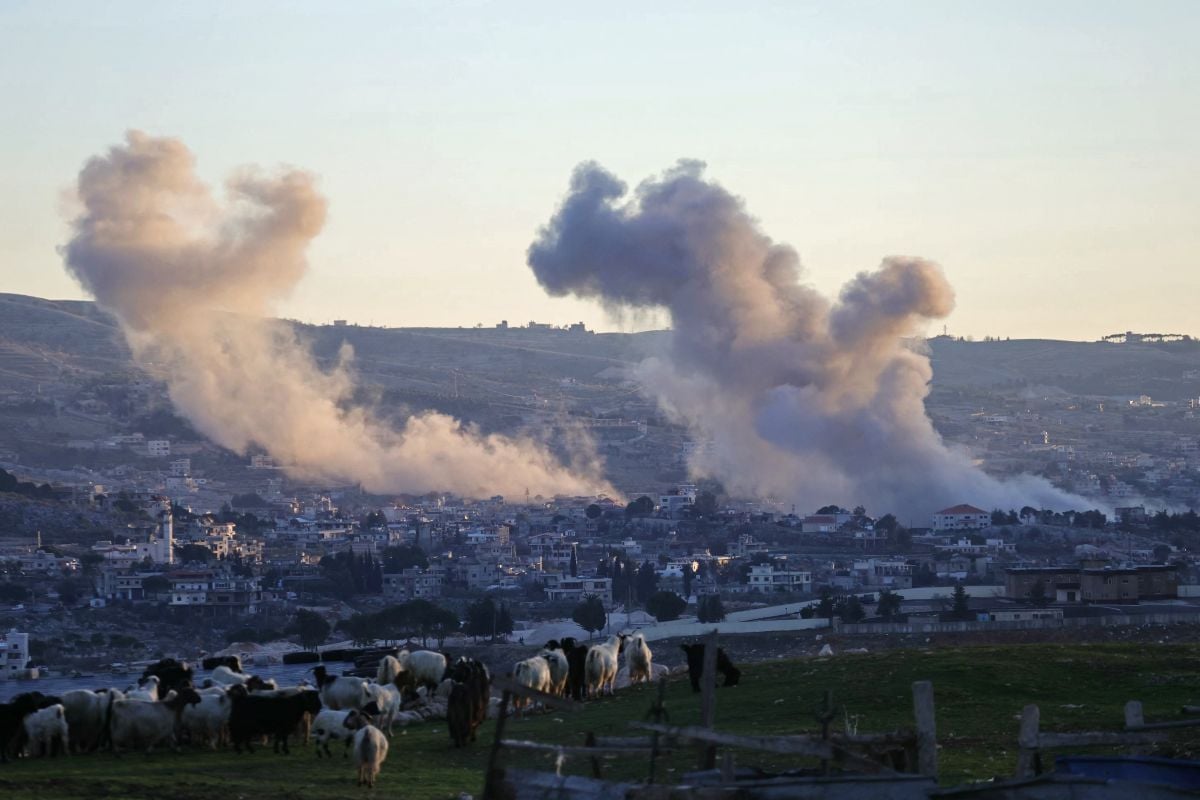
Smoke rises from the site of an Israeli airstrike that targeted the village of Sohmor, in southern Lebanon on Jan. 15, 2026. (Credt: Rabih Daher/AFP)






SOUTH LEBANON/BEKAA — The Israeli army carried out two successive series of strikes on Thursday afternoon in West Bekaa, in Sohmor and then Mashghara, hitting four locations that it had previously called on residents to evacuate.
No injuries were reported. This is the third time this month that the Israeli army has issued evacuation warnings before bombing an area, as Israel insists on the rapid disarmament of Hezbollah throughout Lebanon.
A little later, a series of Israeli strikes targeted the heights of Hermel, more specifically the Ras al-Assi area, according to our correspondent in the region. Unlike the previous strikes in the Bekaa, no evacuation warning was issued.
The Israeli air force first bombed and completely destroyed two buildings in Sohmor, located more than one kilometer apart, more than an hour after issuing evacuation notices. One of the buildings contained several apartments, our regional correspondent reported, while a public school located near the other building sustained significant damage.
In a post on X, the Israeli army’s Arabic-language spokesperson Avichay Adraee claimed that the buildings housed “Hezbollah military infrastructure.”
He accompanied his message with two maps marking the buildings in red and urged residents to stay at least 300 meters away. Shortly before the strikes, residents appealed to the Lebanese Army to intervene to prevent the bombing.
In December, three cases of inspections by the Lebanese Army in the South, at locations threatened by Israel, had succeeded in preventing bombardments. These inspections were carried out within the framework of the cease-fire monitoring committee, known as the “Mechanism,” which includes Israeli and Lebanese military and civilian representatives.
The Israeli army stated that the strikes in Sohmor targeted Hezbollah, which it accuses of “repeated violations” of the cease-fire agreement that came into effect in November 2024. Shortly afterward, evacuation warnings were issued for two buildings in Mashghara, which were also bombed more than an hour later.
In the evening, the Israeli army claimed it had carried out strikes against Hezbollah infrastructure, including “several weapons depots … in several areas of southern Lebanon,” in a statement published in Hebrew on X. It also highlighted that it had taken “numerous measures to reduce the risk of harm to civilians.”
Education Minister Rima Karameh condemned “the Israeli bombardment of a building near the public school in Sohmor, which hosts hundreds of students, as well as another building near a school in Mashghara.” \
She called on “the international community and influential countries to put an end to these attacks that spare neither schools nor residential buildings,” urging them to “exert strong pressure to stop the aggression and threat, and to protect school buildings from military operations.”
Israeli incursions in the Marjayoun district
On the same day, an Israeli helicopter dropped a stun grenade on the al-Massareb neighborhood in the town of Adaisseh (Marjayoun district), while soldiers from the Lebanese Army and UNIFIL were inspecting two homes.
According to our correspondent in the South, an Israeli unit had infiltrated the area at dawn to blow them up.
On Wednesday night, Israeli soldiers also entered Kfar Kila (Marjayoun) to demolish a building damaged during the last war with Hezbollah. An Israeli helicopter also dropped a stun grenade on the outskirts of the old quarter of Aita al-Shaab (Bint Jbeil district).
On Wednesday evening, an Israeli drone struck a house in the Hamoussieh area, on the outskirts of Blida and just steps away from the village of Aitaroun (Bint Jbeil). The attack destroyed an internet relay installed on the roof, causing a loss of connectivity in the village.
Despite the truce officially in effect since Nov. 27, 2024, the Israeli army continues to bombard southern Lebanon and the Bekaa, claiming to target Hezbollah’s movements and attempts to rebuild its military capabilities.
Hezbollah, although agreed to disarm south of the Litani River, refuses to hand over its weapons elsewhere in the country, as stipulated in the truce agreement and U.N. Security Council Resolution 1701 (2006). The Israeli army also continues to occupy positions on Lebanese territory and regularly conducts incursions north of the Blue Line.
Reporting by our regional correspondents, Sarah Abdallah in the Bekaa and Muntasser Abdallah in southern Lebanon.

 8 p.m. recap: Israel again threatens Beirut’s south suburbs; 2 ships hit near Hormuz; Riyadh football matches canceled