






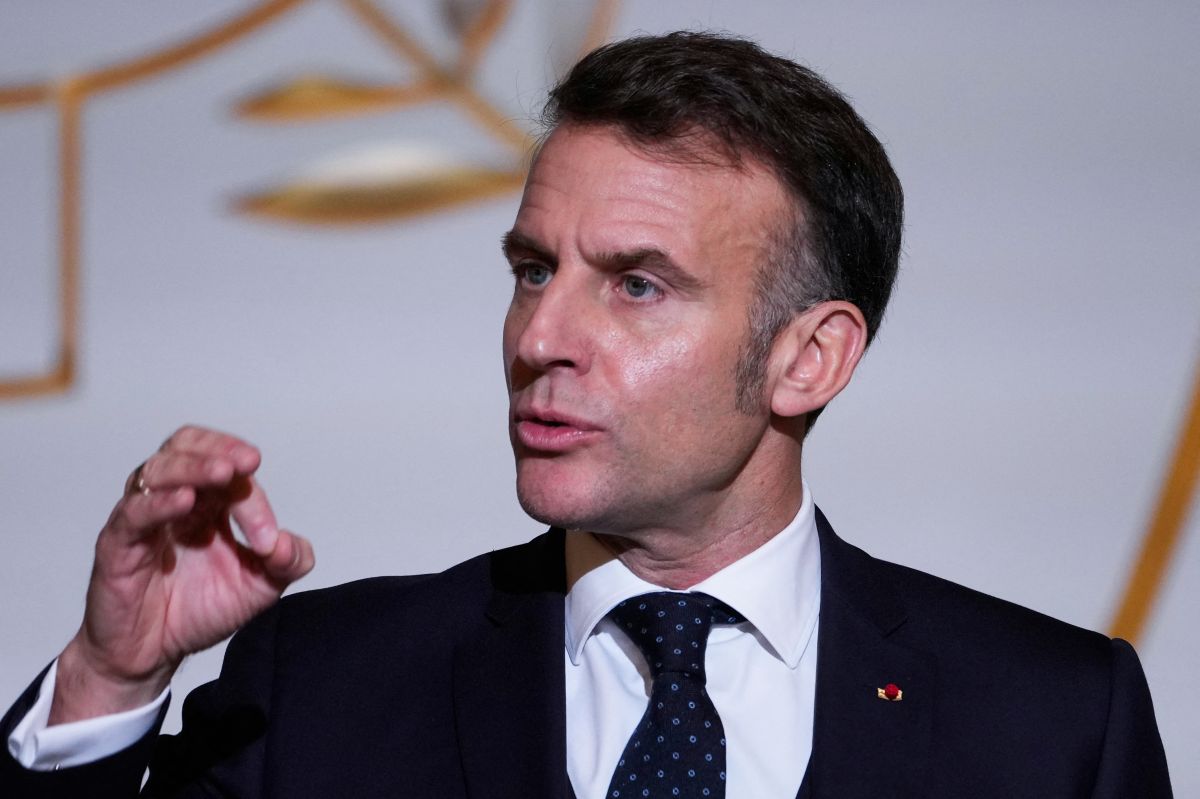
French President Emmanuel Macron delivers a speech to French ambassadors during the Ambassadors’ Conference at the Élysée Palace in Paris, on Jan. 8, 2026. (Credit: Michel Euler/AFP)






After months of statements and news reports that he would host two conferences in support of the Lebanese Army and Lebanon's economic recovery by the end of 2025, which ultimately did not happen, French President Emmanuel Macron assured on Thursday that France remains committed to Lebanon.
Macron called for "building a new partnership around the Mediterranean" and emphasized "the strength" of France's policy in Lebanon, "where we will continue by organizing conferences for the Lebanese armed forces and for Lebanon's economic recovery."
A conference to support Lebanon and its army is set to be held in February under the sponsorship of France, the United States, and Saudi Arabia.
The special envoy of the Élysée for Lebanon, Jean-Yves Le Drian, made several trips to Beirut in 2025 to assist and encourage Lebanon to move forward with the reforms demanded by the international community and, above all, with the disarmament of Hezbollah.

The French president also discussed the role of UNIFIL, the United Nations Interim Force in Lebanon, and "peacekeeping structures," calling for new initiatives to be proposed in this regard.
"A few months ago, we defended UNIFIL, which plays a key role in Lebanon, but we clearly see fatigue and maybe even a crisis affecting major peacekeeping operations," Macron said.
"This moment should be an opportunity for us, the French and Europeans, to propose new instruments, to work again with regional organizations on new peacekeeping structures, and to become operators of new initiatives," he said.
'New colonialism and new imperialism'
Macron also denounced "new colonialism and new imperialism" in international relations, specifically targeting the foreign policy of U.S. President Donald Trump, which he said "is gradually turning away" from some allies and "flouting international rules."
The French president advocated for what he called an "effective multilateralism" in response to this "disrupted world."
"We reject new colonialism and new imperialism," but "we also reject vassalization and defeatism," he said.
"We are evolving in a world of great powers with a real temptation to carve up the world," he added. This was a reference notably to Washington's move to capture Venezuelan President Nicolas Maduro and to repeated claims by the American president regarding Greenland.
While he criticized both China and its "increasingly uninhibited commercial aggression" and Russia as a "destabilizing power" in Ukraine, it was his comments about the United States that were most striking.
The U.S. is a power that "is gradually turning away from some of its allies and flouting the international rules it was still promoting recently," Macron lamented, also mentioning an increasingly present "neocolonial aggression."
A year ago, the head of state railed against a "reactionary international" supported by billionaire Elon Musk but had defended the need for France and Europe to "know how to cooperate" with Trump.
This year, he went further in his criticism of Trumpist diplomacy, though he did not advocate breaking ties with the world's leading power. He urged his diplomats not to settle for being "the commentators" on "what everyone else does," "the spectators of what is unraveling."
"Quite the opposite! We are not here to comment, we're here to act!" he hammered.
As France has just taken over the presidency of the G7, which also brings together the United States, Germany, Italy, the United Kingdom, Japan, and Canada, he reaffirmed his desire to make it an opportunity to combat "global imbalances" in a "cooperative" way, particularly with China.
He also warned that the G7 must not become "an anti-BRICS club," referring to the other bloc of major emerging countries such as Brazil, Russia, India, or China. On the contrary, he said he wants the G7 summit in June at Evian (French Alps) to be the occasion to "finally" attempt "together" with the emerging countries "this reform of global governance" and the United Nations, which has become a real never-ending issue.
