






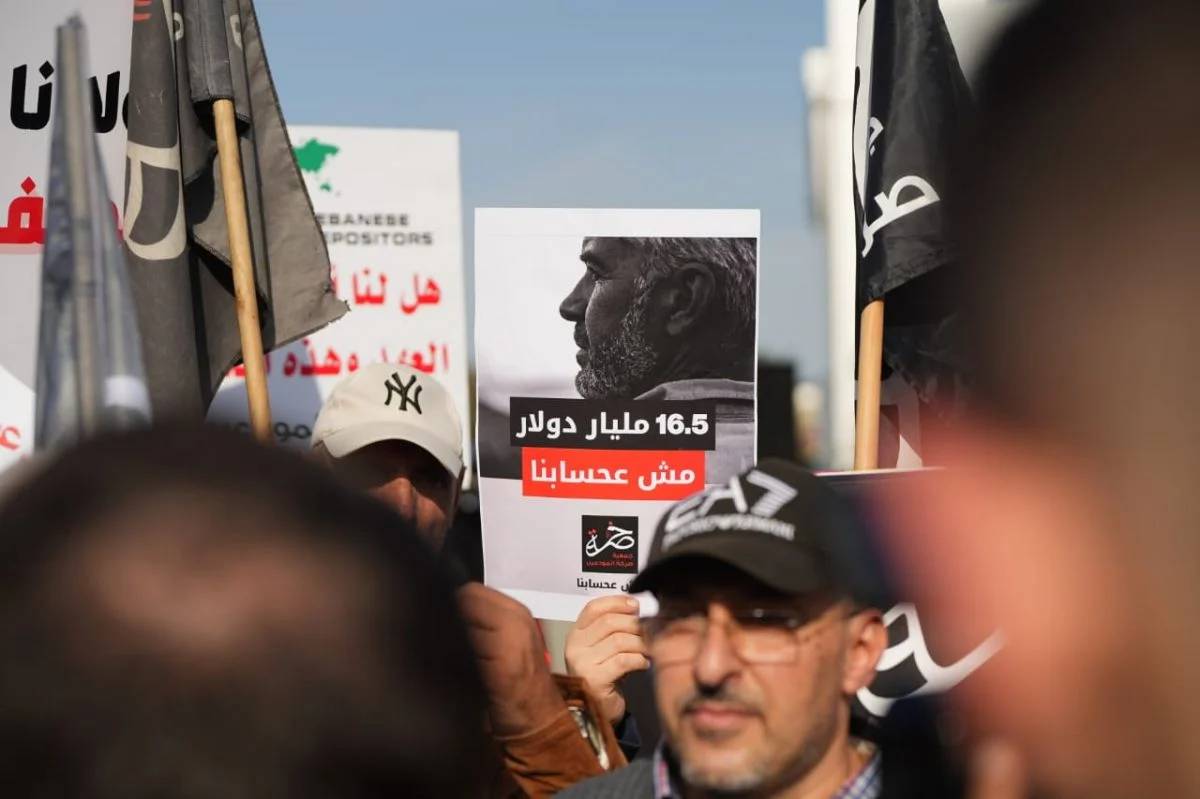
Depositors protesting at Baabda Presidential Palace before the Cabinet meeting, on Dec. 22, 2025. (Credit: Philippe Hage Boutros/L'Orient-Le Jour)






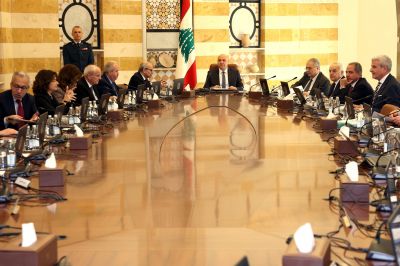
BEIRUT — Meeting since Friday morning at the Grand Serail, Cabinet approved the financial gap draft law, tackling the return of deposits, after reviewing provisions that were still pending, according to several local media outlets.
The bill, which will be sent to Parliament, was adopted by a majority vote, with 13 ministers in favor and 9 against out of a total of 22, according to LBCI. Culture Minister Ghassan Salameh was absent, while Foreign Minister Joe Rajji left the meeting before the vote.
The vote came at the end of a third Cabinet meeting convened to pass the bill, which is part of a package of key reforms after six years of dire economic crisis.
According to LBCI, no changes were made to the provisions of concern to depositors, notably the classification of deposits into four categories — starting with small deposits below $100,000 — or the repayment period for deposits under $100,000, set at four years.
At the previous meeting, the minimum monthly repayment to depositors had been set at $1,500.
Earlier this week, Prime Minister Nawaf Salam said he wanted the bill adopted without prolonging debate.
Several ministers noted what they described as a growing convergence between Salam and President Joseph Aoun, which they linked to the announced position of the Lebanese Forces, who intended to vote against the bill.

The government began reviewing the draft law on Monday, aiming to pass it before the end of the year. After several hours of discussion, ministers had reached Article 4 of the 16-article bill.
Described by Salam as “broadly in line with IMF requirements,” the text provides for losses to be distributed among the state, Banque du Liban, commercial banks and depositors, whose number was estimated at nearly one million before the unprecedented economic collapse of 2019.
Lack of clarity in figures
For his part, Justice Minister Adel Nassar (Kataeb-affiliated) announced in a statement that he voted against the bill.
He justified his position with several reasons: the need for a criminal audit into the causes of the financial crisis, encompassing the state, the Central Bank of Lebanon, and the banks, both before and after the Oct. 17, 2019 uprising; the lack of clarity in the figures and mechanisms for reimbursing sums owed to depositors; as well as other technical and legal considerations, notably the risk of legal challenges to the law.
The minister nevertheless insisted on "the need to adopt this law as soon as possible."
Information Minister Paul Morcos stated that he "had reservations about the bill."
According to him, the text must "better protect the rights of depositors and contribute to the recovery of the banking sector."
Like his colleague at the Justice Ministry, he pointed to "the lack of clarity in the figures."
For his part, MP Ghassan Hasbani, of the Lebanese Forces (LF) parliamentary bloc, indicated that ministers affiliated with his bloc voted against the bill, which he ironically described as a "deepening of the financial gap."
According to him, the bill "does not return deposits to depositors, does not satisfy the International Monetary Fund [IMF], and exonerates those responsible for the loss of bank deposits."
Although close to the president, who wanted to expedite the law's passage, Telecommunications Minister Charles Hage did not approve the bill.
"There is no disagreement on the need to determine the financial hole, but it is not possible to endorse financial promises without realistic data," he explained in a statement released by his Ministry.
He deemed it “imperative to extend the review of the draft legislation by a few days in order to improve it and support it with the necessary figures and studies,” specifically calling for the development of “reliable data to accurately determine the extent of the shortfall or the assets, and the capacity to provide the financial coverage stipulated in the draft legislation.”
The minister further lamented that “medium and large deposits remain without a real solution” and that the text does “not seriously consider depositors in Lebanese pounds.”
Industry Minister Joe Issa al-Khoury, who is close to the Lebanese Forces (LF), said he had "tried to amend certain articles" without success during an evening interview with the local channel MTV.
He asserted that he had "sought to emphasize accountability and responsibility for everything that has happened in the past." He explained that the reservations stemmed from the fact that "the law on the financial loophole is not based on any fundamental figures and contains numerous shortcomings."
Salam received the support of his Deputy Prime Minister, Tarek Mitri. "Few words, but they say the essentials, putting things in their proper place ... and striving to dispel misunderstandings among some, fueled by past disappointments and by what others have propagated, persisting in unrealistic and often contradictory demands," Mitri wrote on his account.
Describing a law whose primary objective is to "do justice to depositors" and second to "restore financial order," the deputy prime minister also praised "the best possible compromise after six years of procrastination, obstruction, and disorder," adding that "any further delay in adopting a realistic and fair law would only exacerbate the confusion, paralysis, and instability, to the detriment of citizens' interests."
