


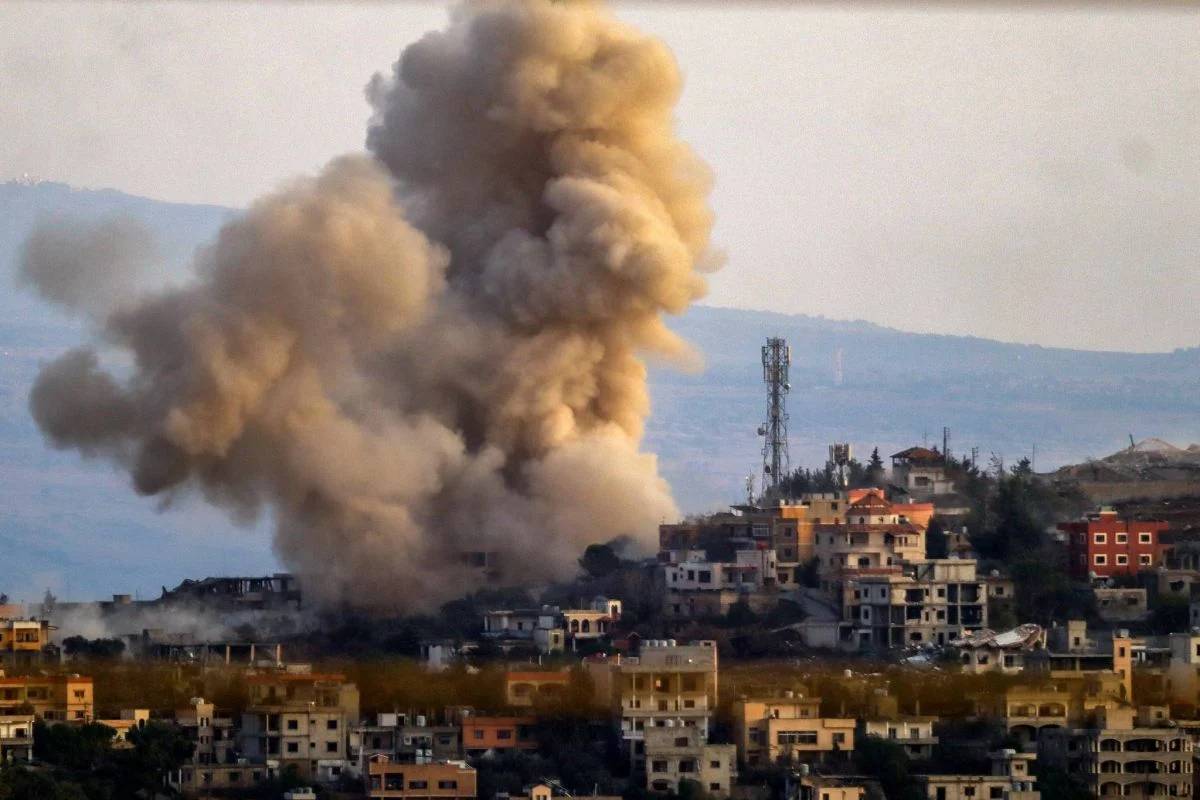
Thick smoke rises after explosions in Khiam, southern Lebanon, on Nov. 21, 2024. (Credit: AFP)






The Our Lady of the Presentation Greek Catholic Church in Khiam, southern Lebanon, was demolished this week due to the damage it sustained during the recent war between Hezbollah and Israel, as well as the damage suffered in 2006.
This demolition paves the way for the future reconstruction of the building, our southern Lebanon correspondent reports. However, images of the destruction shared online have sparked strong reactions.
The decision to demolish was made through an agreement among the Catholic archdiocese, the South Lebanon Council, and the municipality of Khiam. The building was deemed "at risk of collapse" and its rehabilitation considered "impossible," as confirmed by different sources to L'Orient-Le Jour.
An employee at the South Lebanon Council's Marjayoun office stated that a council engineer conducted an inspection and prepared a report concluding that demolition was "necessary."
This was then "approved by the Greek Catholic archdiocese," without specifying a possible reconstruction date. The same source stressed, however, that the South Lebanon Council itself "did not give the demolition order, as legal proceedings must first be initiated for this purpose."
Restored by Qatar after the 2006 war
A municipal official from Khiam explained that the municipality "is only responsible for implementing decisions made" and assured that "the demolition is not done haphazardly: the stones will be kept on site and in principle reused."
He remained vague, however, regarding the authority that gave the demolition order. In a statement published Thursday, the Greek Catholic archdiocese explained that the church had already been hit by Israeli shelling during the summer 2006 war, before being restored, "as much as possible," by Qatar after the conflict, but "without consolidation of its structure."
Built in the 1960s, the structure is founded on a slab without pillars or columns, with its roof supported by two beams resting on stone walls, according to the archdiocese.
These beams were damaged during the recent conflict, causing the entire southern part of the church to collapse. The eastern side also cracked, as did part of the northern wall, and the whole church was severely damaged.
The South Lebanon Council's report concluded that "restoration of the church was impossible," as it "risked collapsing in the event of renewed shelling or even the slightest earthquake."
It is therefore recommended "the demolition of the ruins and complete reconstruction of the building, in the interest of public safety."
Christmas Mass at the Maronite church
As the holiday season approaches, a Christmas Mass is scheduled at the town's Maronite church, according to our correspondent.
The municipality has undertaken cleanup works around the religious buildings, removing debris left by the most recent war. Khiam has four churches and two mosques.
Currently, only four or five Christian families remain permanently in the town, out of about 1,200 families of all faiths. Before the recent conflict, 32 Christian families lived there.
Nearly 1,000 Christian families are registered in Khiam, but some return only on weekends or religious holidays, according to Khiam mukhtar Ali Khreis.

During the last war (October 2023 - November 2024), the village was at the heart of intense fighting between Hezbollah and the Israeli army for several weeks.
The Israeli army launched its ground offensive in southern Lebanon on Sept. 30, 2024, and deployed in several border towns.
Among the five positions still occupied by Israeli soldiers is Tallet al-Hamames, south of Khiam, the easternmost and farthest from the border, about 1.5 km as the crow flies. Amid ground incursions, house demolitions, drone strikes and machine-gun fire, Khiam continues to suffer from Israeli cease-fire violations.
 The 7 p.m. recap: Houthis advance, government announces counteroffensive; Iran raises stakes; Israeli shells hit close to journalists in south Lebanon
 2 Israeli soldiers injured in 'operational accident,' as army continues attacks in the South
This article presents a biased narrative that relies entirely on the demolisher’s viewpoint to frame a deliberate choice as a technical necessity. By presenting the unverified claim that restoration was "impossible" as an absolute fact, it uses an engineering fallacy to bypass independent oversight. Furthermore, the authorities employ a "bureaucratic shell game" to avoid accountability; by splitting the decision between the Council’s report, the Archdiocese’s approval, and the Municipality’s implementation, they ensure no single entity is held legally or morally liable for the permanent destru
20 December 2025 14:09