


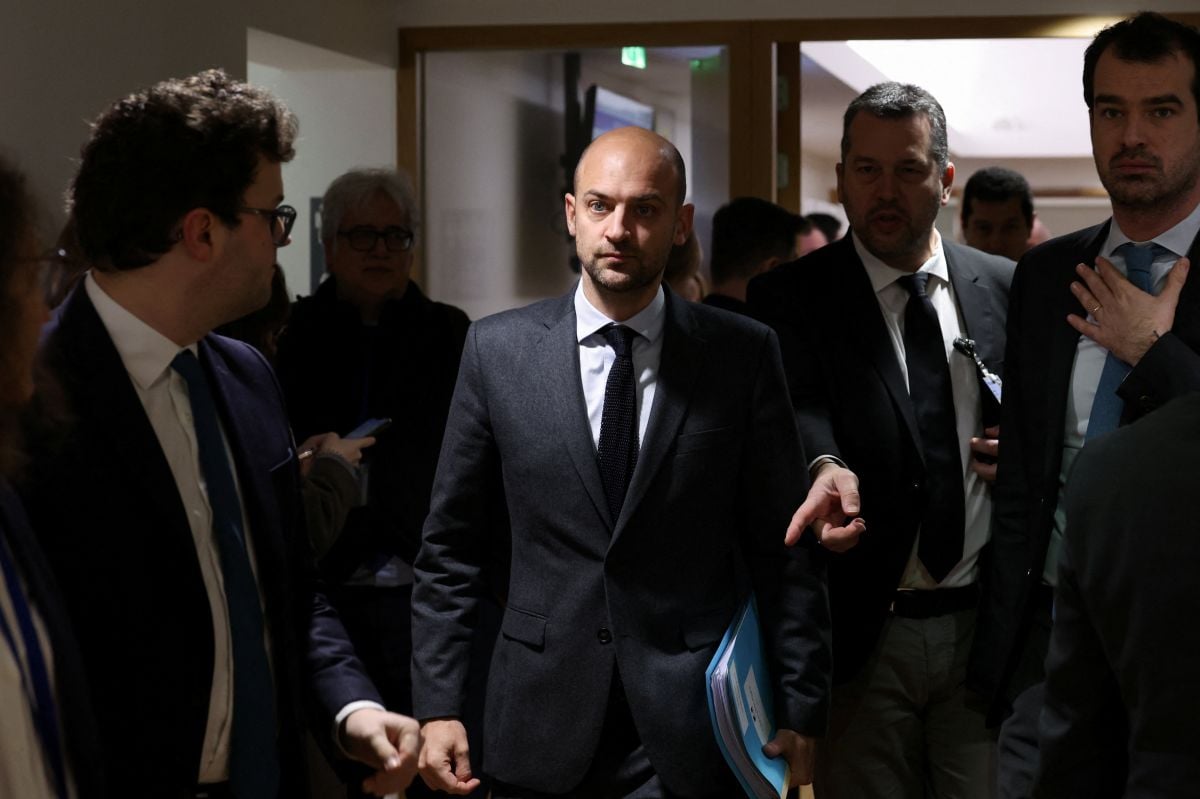
French Foreign Minister Jean-Noel Barrot arrives to attend an EU Foreign Affairs Council round table in Brussels, Belgium Dec. 15, 2025. (Credit: Omar Havana/Reuters)






French Foreign Minister Jean-Noël Barrot said Monday that a "second mechanism" for monitoring Hezbollah's disarmament in Lebanon is being developed "to prevent escalation."
"We are working on setting up a second mechanism that will be dedicated to monitoring Hezbollah's disarmament, a key element to avoid escalation and ensure a credible path toward a full guarantee of Lebanon's sovereignty," he said at a press briefing following a meeting of the Lebanon-European Union Partnership Council, attended by his Lebanese counterpart Joe Rajji, among others.
Barrot also welcomed recent talks held in Naqoura, southern Lebanon, between Lebanese civilian negotiator Simon Karam and an Israeli representative during the most recent meeting — in early December — of the cease-fire monitoring committee between Israel and Hezbollah, also called the "mechanism."
"Our joint efforts with the United States and Saudi Arabia continue and just a few days ago led to the first dialogue in 40 years between Lebanese and Israeli civilians within the monitoring mechanism for the cease-fire that we designed last year," he added.
The French minister's comments came at the conclusion of the first meeting in eight years of the Lebanon-EU Partnership Council. Several senior European diplomats took part in the discussions, including EU foreign policy chief Kaja Kallas.
"Support for the [Lebanese] Army is not an act of charity but a strategic investment in stability," Rajji said at the meeting, emphasizing his hope that "the European Union will continue its support for the military institution."
"Lebanon, in 2025, has entered a decisive phase of state restoration. The historic government decision made on Aug. 5, which reserves the monopoly on weapons to the state through its legitimate security forces, represents a pivotal step in this process," the Lebanese minister said, according to comments reported by the state-run National News Agency (NNA).
He added that "the Lebanese Army is implementing this decision, reflecting the will of the overwhelming majority of Lebanese, who oppose the logic of a 'state within a state,' starting with the south of the Litani River."
He continued: "The first phase is supposed to be completed by the end of the year, while full implementation across all Lebanese territory should be finalized by the end of 2026."
On Sunday, an unprecedented intervention by the Lebanese army in southern Lebanon to search a house in Yanouh (Sour district) led to the cancellation of an airstrike targeting that residence, announced just moments earlier by the Israeli army spokesperson.
The process of Hezbollah's disarmament, led by the Lebanese Army south of the Litani, is expected to conclude by the end of 2025. The next monthly report by the army's commander-in-chief, General Rodolph Haykal, to the Cabinet is scheduled for Jan. 5.