


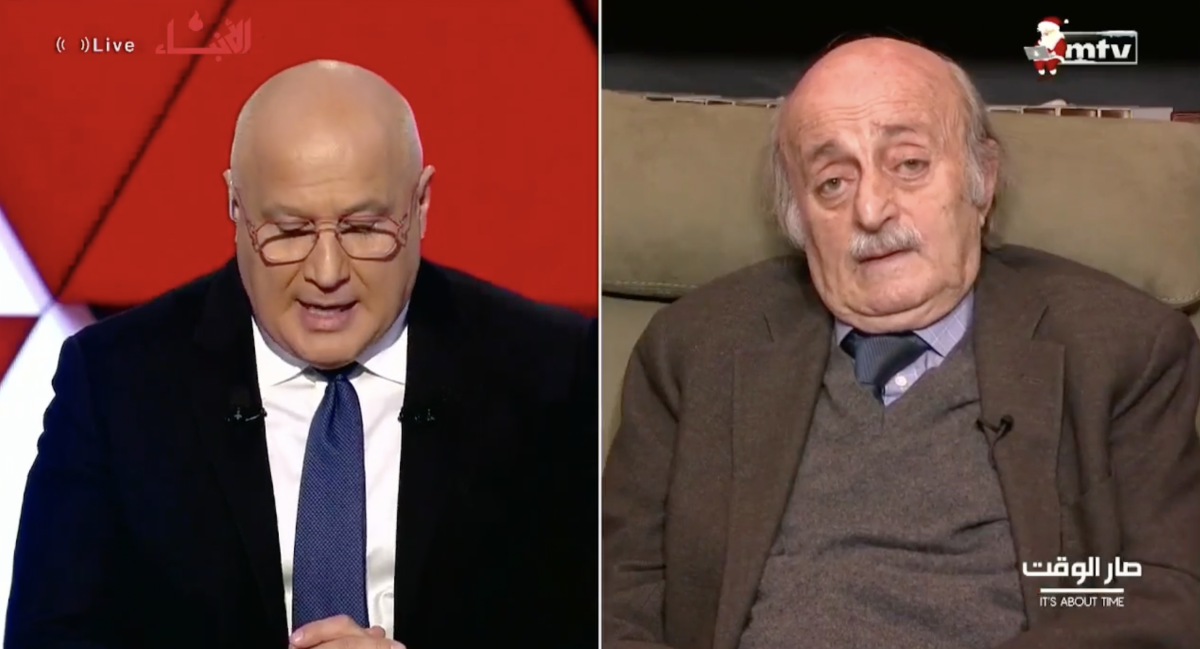
The presenter Marcel Ghanem (left) interviews Druze leader Walid Joumblatt (right) on the show “Sar al-Wa'et” on the MTV channel, Thursday, Dec. 11, 2025. (Screenshot of the show broadcast by the media outlet al-Anbaa)






Druze leader Walid Joumblatt said he "supports" holding a "popular referendum" on whether Lebanon should join the Abraham Accords, while expressing doubt about Israel’s genuine desire for "peace," during Thursday night’s weekly show "Sar al-Wa'et" ("It's Time" in Arabic) on MTV.
The former head of the Progressive Socialist Party (PSP) also called on Hezbollah to "no longer be a tool in the hands of Iran," making his appeal to the party’s secretary-general, Naim Qassem.
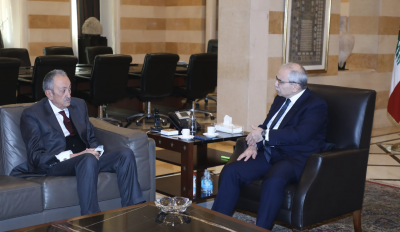
Asked about the "desire of the Lebanese to live in peace," in light of direct negotiations launched in early December between Lebanon and Israel — currently limited to the meetings of the November 2024 cease-fire monitoring commission (known as the "mechanism") — Joumblatt said he "supports holding a popular referendum on Lebanon’s accession to the Abraham Accords."
The Abraham Accords are a series of agreements signed in 2020 that established diplomatic normalization between Israel and several Arab states.
The Druze chief, who has always always been vocal about his commitment to the Palestinian cause, reiterated his support for the "2002 Arab Peace Initiative," which calls, in exchange for normalized relations with Arab countries, for Israel to withdraw from all occupied territories — including the Palestinian territories of the West Bank and Gaza and the Syrian Golan Heights — and for the creation of a Palestinian state within the internationally-recognized 1967 borders, on lands which Israel continues to occupy through military force and settlement expansion.
He continued: "Is the principle of peace present among the Israelis, who occupy part of southern Lebanon [at least five positions, editor’s note] and continue to expand, with or without excuses?"
"We do not accept negotiations to take place under fire. We negotiate under the banner of [Israeli] withdrawal and the cease-fire,” asserted Walid Joumblatt after meeting with Parliament Speaker Nabih Berri in Ain al-Tineh late last week.
Asked about Israeli incursions into Lebanon and Syria, he said: "I do not resign myself to the Israeli era: it is a state without borders [in its use of force, politically and geographically], that wants everything. Consider me as being under occupation, but I do not accept surrender."
Hezbollah must 'no longer be a tool in the hands of Iran'
Joumblatt also addressed a message to Hezbollah secretary-general Naim Qassem, hoping he "will understand that Iran cannot use Lebanon or a part of the Lebanese Shiite population to improve its negotiations [with the United States] around the Iranian nuclear program or anything else."
"But at the same time, I oppose the comments of the American ambassador [Michel Issa], who says we have to negotiate and endure the strikes, and the words of [U.S. envoy Morgan] Ortagus about an economic zone in the South. These statements are unacceptable," he added.
On Wednesday, Ambassador Issa said that "just because negotiations have begun does not mean Israel will stop its operations."
Joumblatt also said, "We will not forget the Hezbollah martyrs who fell defending Lebanon," but wished for "a debate within the 'party' and for them to agree no longer to be a tool in the hands of Iran." Referring to the figure of "90 percent of Hezbollah's heavy strategic weaponry destroyed," he asked: "So why do the Israelis still insist on striking Lebanon? And do they want the displacement of the entire Shiite community?"

Asked about the future of the Sweida province, a Druze-majority area in Syria whose influential Druze sheikh Hikmat al-Hijri has called for independence and Israeli "protection," Joumblatt said that "someone has decided to take over Suweida to make it an independent state with the support of Israel."
"Let's see how far this state will take the region’s Druze. It's a suicidal project in my opinion, because it harms all the interests of the region's Arab Muslim Druze," he said, before mentioning an "existential battle" for the Druze.
Last July, Sweida witnessed intercommunal violence between Druze factions on one side and Bedouin tribes and government forces on the other, which left more than 2,000 dead, according to the Syrian Observatory for Human Rights (SOHR).
Regarding the Lebanese parliamentary elections scheduled for May 2026, while thorny questions about expatriate voting cast doubt on their timing, Joumblatt said: "It is said that elections are supposed to take place in the spring, but I have heard that, since Ramadan falls during that period, they may be postponed until July." The Muslum fasting month of Ramadan will run from mid-February to mid-March 2026.

 1 p.m. recap: Salam in Nabatieh; up to 10,000 more US troops heading to Middle East