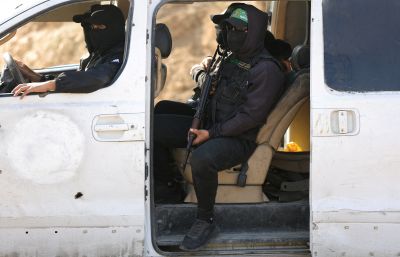
Hamas militants sit inside a vehicle as they escort members of the Red Cross towards an area within the so-called "yellow line" to which Israeli troops withdrew under the cease-fire, as Hamas says it continues to search for the bodies of deceased hostages. Gaza City, Nov. 20, 2025. (Credit: Dawoud Abu Alkas/Reuters)






Top Hamas leader Khaled Meshaal told Al Jazeera on Wednesday that the group is open to a weapons "freeze," but rejects the demand for disarmament put forward in the U.S.-sponsored plan for Gaza.
"The idea of total disarmament is unacceptable to the resistance [Hamas]. What is being proposed is a freeze, or storage [of weapons]... to provide guarantees against any military escalation from Gaza with the Israeli occupation," said Meshaal in an interview aired Wednesday.
"This is the idea we're discussing with the mediators, and I believe that with pragmatic American thinking... such a vision could be agreed upon with the U.S. administration," he said.
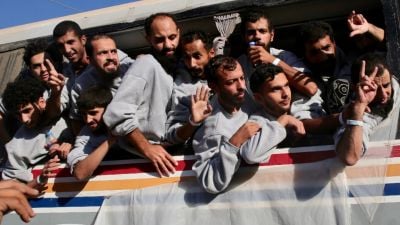
The U.S.-sponsored cease-fire deal, in effect since Oct. 10, brought to a halt Israel's relentless two-year war on Gaza which began in October 2023.
The agreement is composed of three phases. Israeli Prime Minister Benjamin Netanyahu recently indicated that it was ready to enter the second phase.
Under that phase Israeli troops would further withdraw from their positions in Gaza and be replaced by an international stabilization force (ISF), while Hamas would lay down its weapons.
Netanyahu is expected to meet with U.S. President Donald Trump in the U.S. later this month to discuss moving ahead with the Gaza plan.
Hamas has indicated it would not agree to giving up its arsenal altogether, citing the idea that "disarmament for a Palestinian means stripping away his very soul." Meshaal added that the goal could be achieved another way.
In the first phase of the deal Palestinian groups committed to releasing the remaining 48 living and dead captives held in the territory. All of the hostages have so far been released except for one body.
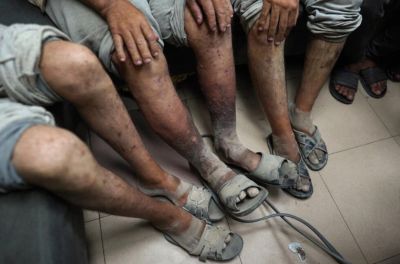
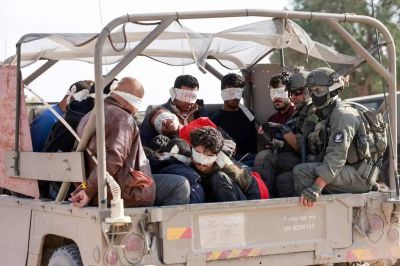
In exchange, Israel has released nearly 2,000 Palestinian prisoners in its custody and returned the bodies of hundreds of dead Palestinians, many of whom show signs of torture.
"Prisoners from Gaza have had their legs amputated due to the effects of shackles, they defecate in diapers and are continuously restrained, which violates medical ethics and the law," a doctor at an Israeli army camp wrote in a letter to Haaretz in April 2024.
As for the international peacekeeping force, Meshaal said the group was open to its deployment along Gaza's border with Israel, but would not agree to it operating inside the Palestinian territory, calling such a plan tantamount to "occupation."
"We have no objection to international forces or international stabilization forces being deployed along the border, such as UNIFIL," he said, referring to the U.N. peacekeeping force deployed in southern Lebanon near the border with Israel.
"They would separate Gaza from the occupation," he added, referring to Israel.
"As for the presence of international forces inside Gaza, in Palestinian culture and consciousness that means an occupying force."
Mediators as well as Arab and Islamic nations, he said, could act as "guarantors" that there would be no escalation originating from inside Gaza.
"The danger comes from the Zionist entity, not from Gaza," he added, referring to Israel.