


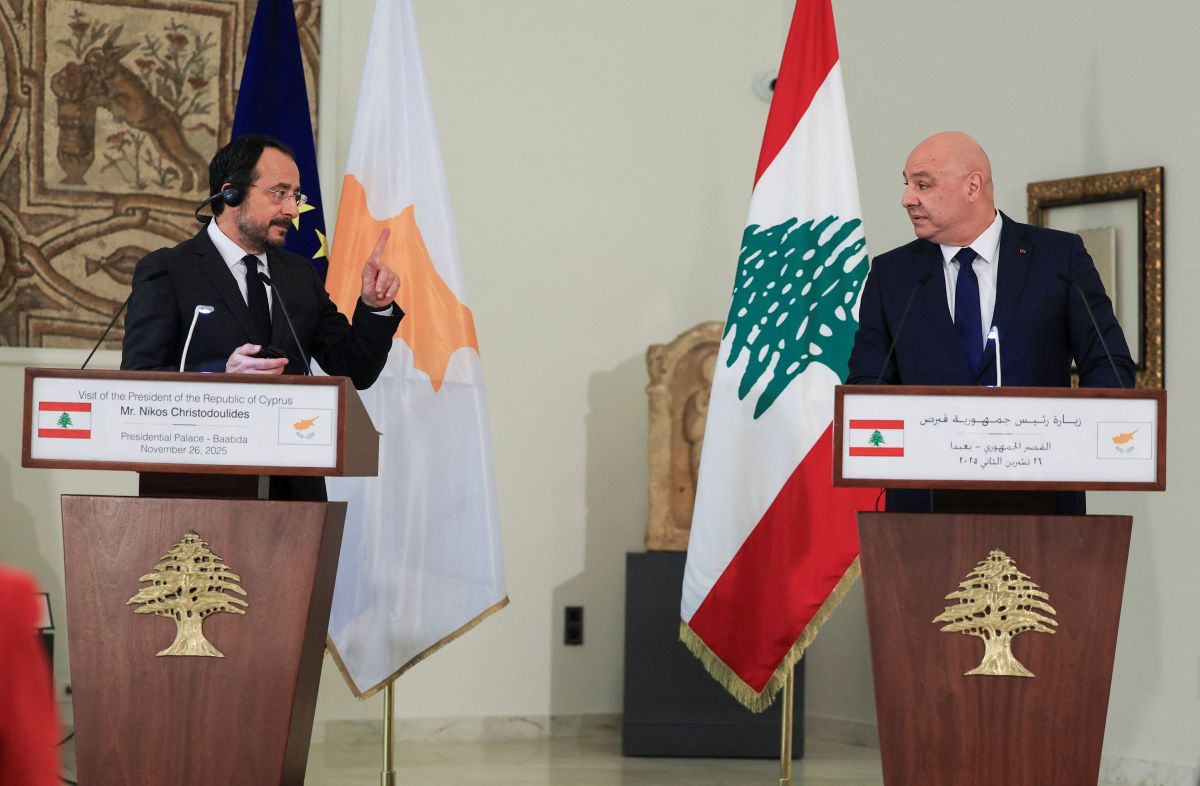
Cypriot President Nikos Christodoulides and Lebanese President Joseph Aoun attend a press conference after the signing of the maritime delimitation agreement at the Baabda Presidential Palace near Beirut. (Credit: Anwar Amro/AFP)






Several MPs, including Amal Movement MP Ali Hassan Khalil and opposition MP Melhem Khalaf confronted the government over the agreement signed with Cyprus on the maritime border, arguing that bypassing Parliament constitutes a violation of the Constitution.
In a post on X, Khalil wrote that he "submitted a question to the government regarding the violation of the Constitution in concluding the maritime border delimitation treaty with the Republic of Cyprus before obtaining the approval of the Parliament, in accordance with the provisions of Article 52 of the Constitution," Khalil said in his post.
Article 52 of the Lebanese constitution states that the president negotiates international treaties in coordination with the prime minister. These treaties are not considered ratified except after the agreement of the government.
They are to be made known to the Parliament whenever the national interest and security of the state permit. However, treaties involving the finances of the state, commercial treaties, and other general treaties that cannot be renounced every year are not considered ratified until they have been approved by Parliament.
Khalil joined to the question, and his post on X, a copy of a letter submitted by Parliament Speaker Nabih Berri, addressed to Prime Minister Nawaf Salam urging him to reply to Khalil's request.
On Wednesday, Khalaf submitted a similar question, signed by 24 MPs, asking the government to “clarify the reasons that led to concluding the agreement without going through Parliament, despite its sovereign nature and its impact on Lebanon’s maritime borders and economic rights,” the state-run National News Agency (NNA) reported.
The other MPs who signed the question, alongside Khalaf, represent a range of political currents and affiliations: Najat Aoun Saliba, Oussama Saad, Jamil al-Sayyed, Salim Sayegh, Hussein Hajj Hassan, Michel Moawad, Paula Yacoubian, Cesar Abi Khalil, Salim Aoun, Achraf Rifi, Sagih Attieh, Mohammad Khawaja, Halima Kaakour, Cynthia Zarazir, Ibrahim Mneimneh, Bilal Hashimi, Yassine Yassine, Waddah Sadek, Marc Daou, Michel Doueihy, Elias Jaradeh, Adib Abdel Massih, and Firas Hamdan.
In November, Lebanon and Cyprus signed a long-awaited maritime border delimitation agreement, ending nearly two decades of stalemate. The negotiations had been on hold since 2007 until last July, when Aoun and his Cypriot counterpart pledged to resume talks at a bilateral summit in Nicosia.
Resolving its maritime border disputes with Cyprus, Israel and Syria is crucial for Lebanon to attract foreign investment in offshore energy exploration.
While some parties consider the agreement a diplomatic success, others believe Lebanon could have secured a larger area, as Beirut adopted the “median line theory” as the delimitation method, a solution seen as fair by the government-formed committee but criticized by some camps who point to Lebanon's short coastline compared to an island like Cyprus. According to them, Lebanon could have claimed between 2,600 and 5,000 additional square kilometers.
A ministerial source told L'Orient Today in November that, before its adoption by the Cabinet on Oct. 24, the agreement had been submitted to the Committee for Legislation and Consultation, which depends on the Justice Ministry for review.
The latter "confirmed the legality of its adoption by the executive without necessarily passing through Parliament." This legal point was confirmed by a judicial source. "Unlike a significant loan from another state or a tax exemption decision, the maritime border delimitation agreement does not involve state finances. That is a misreading of Article 52," adds the judicial source.
Therefore, the signature of the agreement falls "within the prerogative of the executive, in accordance with the separation of powers." The agreement, which still has to be officially ratified by the relevant minister(s) after the issuance of a decree, can enter into force "upon the exchange of ratification instruments" between the two countries, as provided in Article 5 of the bilateral text.
In October 2022, Lebanon and Israel had finalized a U.S.-brokered maritime border deal, ending a long-standing territorial dispute over lucrative offshore gas fields in the Eastern Mediterranean, establishing Line 23 as the boundary, granting Israel the Karish field, and Lebanon the Qana field (with Israeli royalties for a portion).
The maritime border deal, facilitated by U.S. mediator Amos Hochstein, involved former Lebanese President Michel Aoun and former Prime Minister Najib Mikati, but did not go through Parliament for approval.

 7 p.m. recap: Netanyahu seeks mastermind behind Flydubai incident; Washington sanctions 2 French nationals; Ben Gvir's 'I want to kill you' threat