






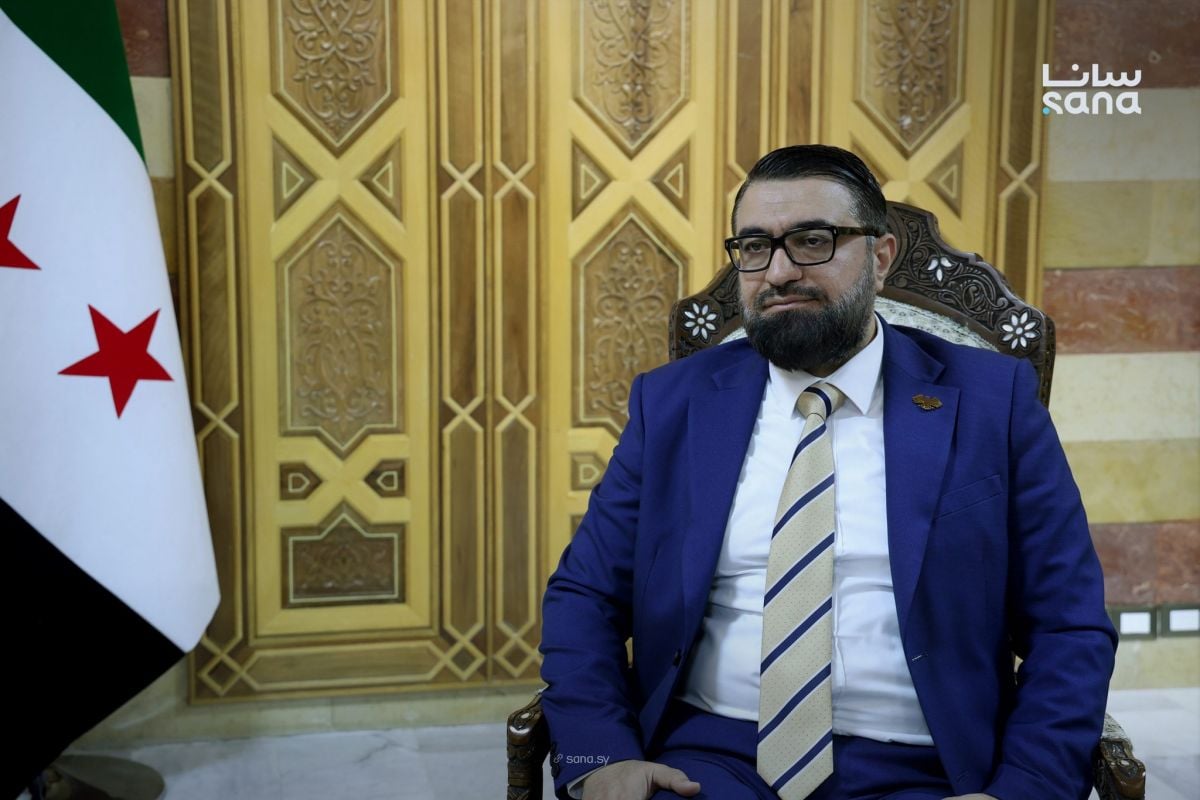
The Syrian Minister of Justice, Mazhar Abdel-Rahmane al-Oueis. (Credit: SANA)






BEIRUT — Syria has no Lebanese detainees remaining in its prisons, and contacts with Beirut over Syrians held in Lebanon are “continuing positively,” Syrian Justice Minister Mazhar Abdel-Rahman al-Wais said Tuesday in an interview with Saudi channel al-Arabiya, according to Lebanon's state-run National News Agency (NNA) and several local media outlets.
The remarks come ahead of a scheduled visit by a Lebanese judicial delegation to Damascus on Wednesday to discuss a draft agreement for the transfer of Syrian detainees and convicts held in Lebanese prisons, al-Markaziya agency reported. On Saturday, Lebanese Prime Minister Nawaf Salam met Syrian President Ahmad al-Sharaa on the sidelines of the Doha Diplomatic Forum, referring to “the opening of a new chapter” in bilateral relations. Earlier, on Nov. 20, Deputy Prime Minister Tarek Mitri also met with the Syrian president to address sensitive issues between the two countries.
In recent months, Syrian and Lebanese officials have held multiple meetings to advance key files, particularly the repatriation of Syrian detainees in Lebanon. Lebanese Interior Minister Ahmad Hajjar said in August that 2,400 Syrians are held in Lebanese prisons, accounting for roughly 30 percent of the total detainee population.
Syrian detainees in Lebanon fall into three categories: those convicted of misdemeanors, those convicted of serious crimes and those awaiting trial. Syria has demanded their full return so they can serve sentences or face trial on its territory.

Wais also addressed the March violence along Syria’s coastal region, an Alawite stronghold. The Alawite community, a branch of Shiism from which former President Bashar al-Assad hails, has been targeted since Assad’s regime collapsed and an Islamist coalition rose to power in Damascus in December 2024. The coastal attacks left at least 1,426 dead, mostly civilians, according to a national investigative commission, while the Syrian Observatory for Human Rights reported nearly 1,700 fatalities, predominantly Alawites.

“The Syrian authorities have facilitated the work of the international commission concerning the events on the coast,” the Syrian minister said, adding that public trials have taken place and “extensive investigations are underway against many perpetrators of war crimes.” He emphasized, “We do not want rushed or selective justice; the transitional justice process is not aimed at any particular group.”
Despite pledges to protect minorities, Syria — still fractured after 14 years of civil war — faces major security challenges, including intercommunal violence in regions with Druze and Alawite majorities.
Wais stressed the independence of the Syrian judiciary, saying it “does not allow any interference in its work” and is “determined to prosecute anyone who commits violations against a Syrian citizen.” He added that “President Ahmad al-Sharaa is the main guarantor of judicial independence” and confirmed that an investigative process is underway to organize public trials.
Referring to clashes on Nov. 23 between armed members of the Sunni Bani Khalid tribe and Alawite neighborhoods in Homs — a city long mired in security crises — Wais said authorities “acted firmly in response to the incidents in Homs to preserve civil peace.” He announced the arrest of dozens accused of inciting sectarian tensions, warning that “anyone who promotes sectarian discourse is liable to prosecution.”
The minister also noted that “around 250,000 Syrians are missing between 2011 and 2024” and said Damascus is coordinating with the National Authority for Missing Persons.

