


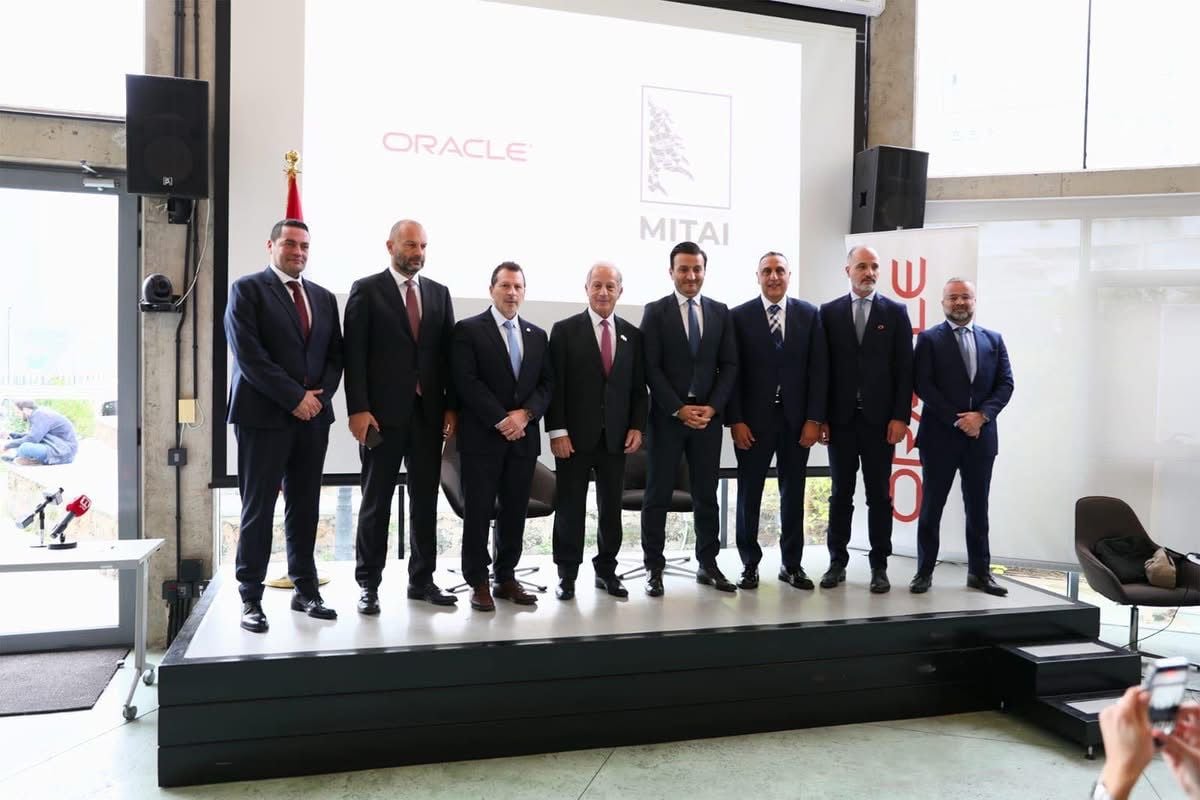
The Minister of State for Information Technology and Artificial Intelligence, Kamal Shehadi (third from the left), and the U.S. ambassador to Lebanon, Michel Issa (to his left), on Monday during the signing of the partnership with Oracle, on Dec. 9, 2025. (Credit: Released by the U.S. Embassy in Lebanon)






The Minister of State for Information Technology and Artificial Intelligence and Displaced Persons, Kamal Shehadi, on Tuesday defended the memorandum he signed the previous day with the American company Oracle to train 50,000 Lebanese in artificial intelligence (AI), assuring that it did not provide for "any data exchange or access to any information from the Lebanese public sector."
In this statement, relayed by the state-run National News Agency, the senior official was responding to the pro-Hezbollah daily Al-Akhbar, which, in an article published the same day, claimed that the Lebanese state had, through this agreement, "handed over public sector data to the company … which has long cooperated with the Israeli state in military and security fields."
In fact, the American company, founded in 1977, does have a subsidiary in Israel and claims several projects, including data storage centers in Jerusalem.
But Oracle also maintained offices in downtown Beirut, which were closed several years ago, according to two sources, including a local reseller of its solutions used in payment terminals or integrated business management.
No violation of boycott law
Contacted, Shehadi assured that the memorandum was signed with the American company and did not violate the Lebanese boycott law of 1955, while the country suffers daily strikes from the Israeli army, more than a year after the cease-fire it reached with Hezbollah to end 13 months of clashes and then all-out war.
"The partnership signed with Oracle does not in any way include a data exchange or access to any information from the Lebanese public sector and is strictly limited to a large-scale program aiming to train 50,000 Lebanese from both the public and private sectors in skills related to AI and resource planning [Enterprise Resource Planning and Government Resource Planning, according to the English terminology, which refer to software for automating, centralizing, and monitoring resources]," the minister insisted in his statement.
"It opens new opportunities for Lebanese people, offers them additional job prospects, and aims to transform Lebanon from a mere consumer of technologies to a producer and innovator, by developing a local skills base capable of driving future national projects," he added.
Agreement welcomed by Michel Issa
The U.S. Embassy in Lebanon, now represented by a diplomat of Lebanese origin, Michel Issa, welcomed the signing of this memorandum in a statement published on social media.
According to information confirmed by the minister, the program is set to start being implemented in "a few months," to allow time to finalize the selection process for the 50,000 beneficiaries, who will come from the public and private sectors. The company will provide the training, and several universities — including AUB, LAU and USJ— will help select potential candidates.
The training program will provide practical skills in programming, cloud and AI. According to LBCI, this partnership marks the first official agreement between a major American company and a Lebanese public institution in more than 20 years.

 1 p.m. recap: Salam in Nabatieh; up to 10,000 more US troops heading to Middle East