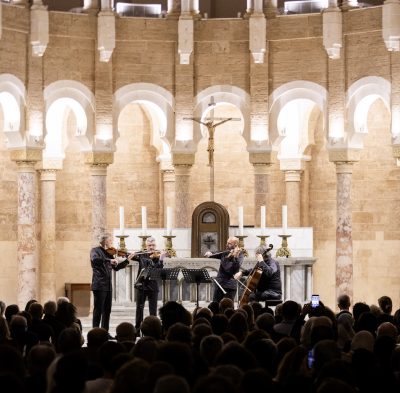


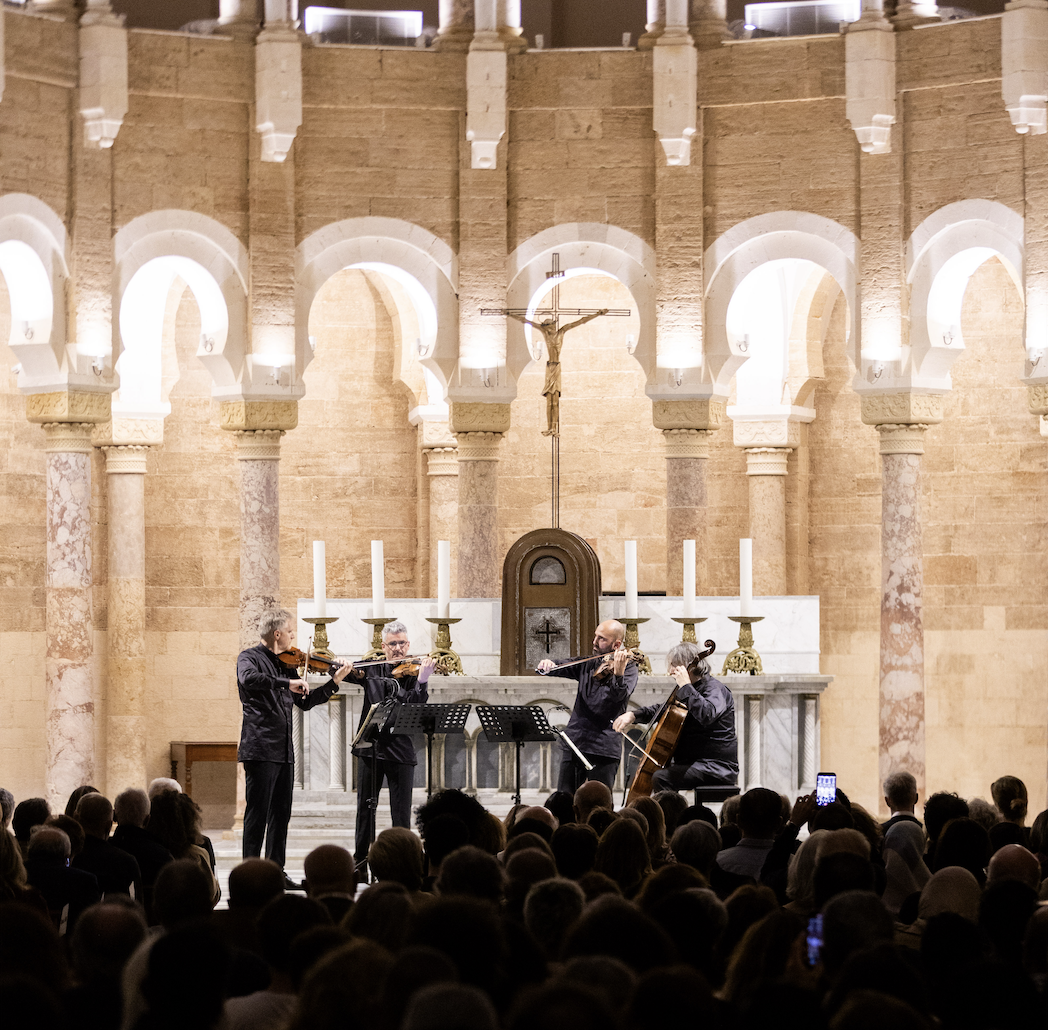
The Quartetto di Cremona lights up Saint-Joseph Church: a highlight of the 2025 edition of Beirut Chants. (Photo: Ihab Fayad/Beirut Chants)






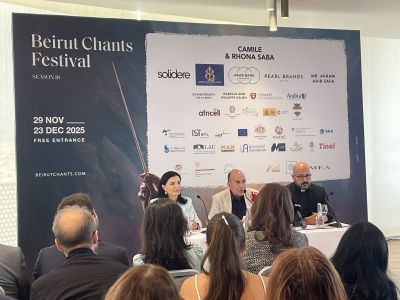
The concert by Quartetto di Cremona, organized by the Italian Cultural Institute, took place on Dec. 2 in the legendary setting of the Saint Joseph Church in Monot, as part of the 18th edition of Beirut Chants, which runs until Dec. 23 at several heritage venues across the capital.
The Quartet (Cristiano Gualco, violin; Paolo Andreoli, violin; Simone Gramaglia, viola; Giovanni Scaglione, cello) embodied, in keeping with a tradition of rigor and expressive density and in a spirit of timelessness and musical verticality, this search for a universal language — no longer religious, but purely musical — where the counterpoint of memory joins the modernity of interpretation.
In 1747 or 1748, Bach began composing the Credo of his Mass in B minor — harpsichord? organ? piano? chamber orchestra? string quartet? — while perhaps not his last piece of work, nevertheless arguably one of the boldest testaments to his musical prowess.
He bequeaths the sum of his musical knowledge in the form of a cyclical work containing, on a single theme, all possible forms of counterpoint. Already in 1742, he had written the Goldberg Variations — another synthesis of the same kind —, the Canonic Variations and the Musical Offering.
There is nothing more beautiful than the loyalties of old men who cling to their message, refusing the changing world around them and, by the same token, freeing themselves from half-measures, compromises and concessions to the public and to the world. It is this loyalty to who they truly are that in one final and luminous definition of themselves, suddenly deliver everything at once.
Monet laboring over water lilies when Picasso is already on the scene. Corneille writing Psyché at seventy and realizing that the truth of his heart lies less in heroism than in tenderness.
Botticelli, as his friend Leonardo softens outlines and blurs the drawing, tightens his pencil, thickens the lines, suppresses space and thins the air. Thus is born a Gothic painting, far beyond the gentle dream of a platonic vision: a broken and fierce, pathetic Botticelli; finally, himself.
So it is with Bach. Music, ever so quietly, is moving toward Haydn; Stamitz is preparing the way; Johann Christian, his own son, is learning the path that will lead him toward Mozart; Telemann has understood and dips his pen in a lighter ink.
And Bach, almost blind, all ties with the world severed, begins The Art of Fugue. Denying his era, he asserts his right to anachronism, and there he is, plunging into music. He signs it and falls silent. There is no need for an ending: "Contrapunctus ad infinitum."
Music to read or to play? On two staves or four? For the harpsichord or in orchestra? Finished or unfinished? Everything is a question. That is the mark of inexhaustible works.
The style is both flexible and erudite; the phrasing is of unparalleled accuracy; the clarity is perfect; an aura of infinite poetry. Phrasing is supple, the style lively and refined, a sense of color and clarity of discourse: the work sings and breathes.
The work, often cited as forbidding, intellectual and speculative, with their incomparable sound becomes a choral work throbbing with a vibrant life, with bursts that also make it a work of luminous faith.
From the very first fortissimo chord of Schubert’s String Quartet No. 14 in D minor, D. 810, you know something great is about to happen.
The tragic lyricism of Death and the Maiden finds its true resonance in them, with a first movement tense in its ardent revolt, accentuated by the heart-wrenching tenderness of the second movement, with variations layered in a masterful dramatic progression; then a scherzo of bold vigor, preceding the dizzying, horribly grating exhilaration of the conclusive dance macabre, here taken as a whirling dash into the abyss.
The ensemble playing is of impressive homogeneity and accuracy, individual passion and enthusiasm subsumed within the higher unity, rare beauty and plenitude of sound. The attacks (in the first and third movements) are life itself.
The sound vibrates and lives: luminous, grating, and unruly matter. The rhythms are accentuated with total freedom and inventiveness: the punctuation of the Andante lied becomes almost wavering. Cristiano Gualco’s violin soars, chirping in the stratosphere, its repeated notes bold as a bird’s. Even the piano or pianissimo nuances have something pressing and resolute about them here.
The tone is modern, sometimes aggressive in its sound, sharp, passionate, yet with the greatest care given to melodic continuity. The phrasing is warm... but absolutely classical. Two or three times, a slight portamento upward suggests that song underlies this music and gives it its timbre.
As an encore, a beautiful transcription of the theme from Gabriel, Ennio Morricone's music for Roland Joffe's film The Mission: chamber music that is fascinating, passionate, alive, irresistible and comforting.