


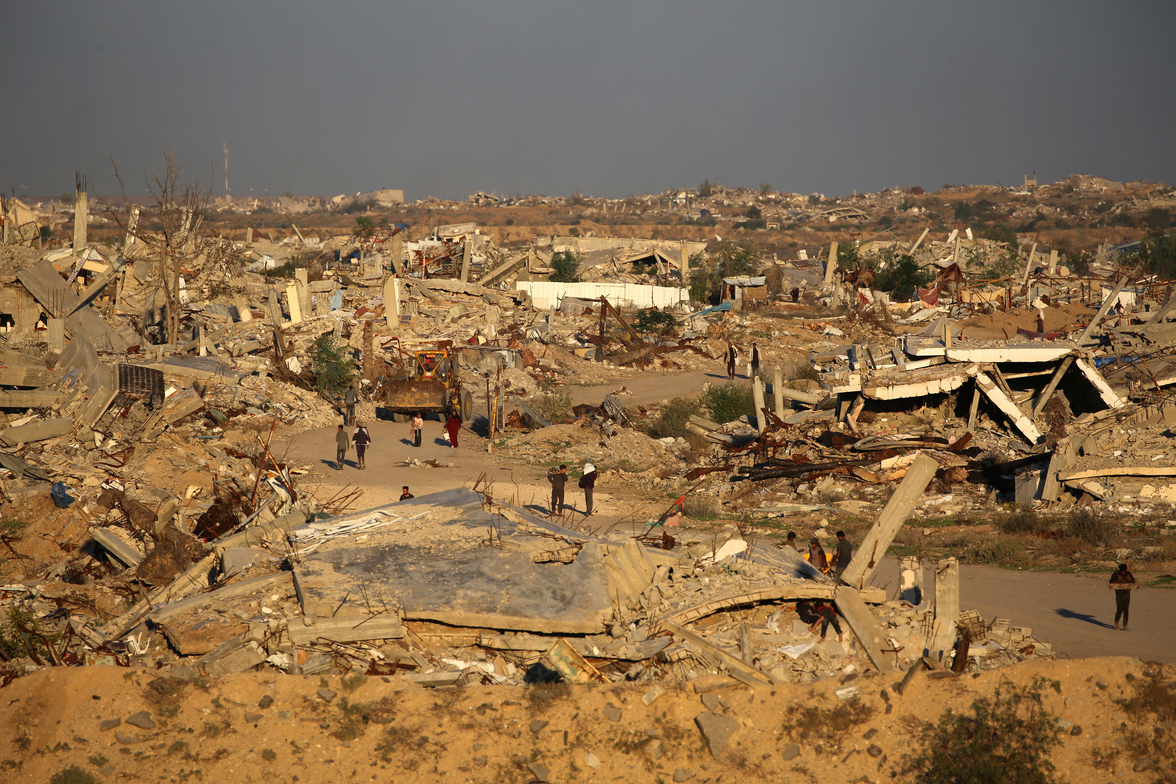
People walk amid the rubble of destroyed buildings in the Nuseirat camp for displaced Palestinians, in the central Gaza Strip on Dec. 2, 2025. (Credit: Eyad Baba/AFP)






An estimated 200-300 Hamas fighters trapped within the Israeli-occupied areas of Gaza and stranded for weeks underground have escaped across the so-called "Yellow Line," according to a report from The National published Wednesday.
This number is the same shared by Hamas and Israeli officials alike in recent weeks of the total number of fighters believed to have been cut off from the rest of their party's armed wing, unable to communicate with the outside world and, possibly, even unaware that a cease-fire had been brokered.
Last week, Hamas released a statement appealing to international actors to pressure Israel into allowing its fighters to return after Israel had announced that in the week prior, it had killed 20 fighters "attempting to flee" from the tunnels.
Sources briefed on the fighters' eventual escape told the National that, in some cases, local Israeli-backed militiamen were bribed to look the other way or to guide fighters who emerged from their hiding places into the Hamas-controlled parts of Gaza.
Others, the sources explained, were freed following repair work on tunnels that had collapsed in under bombardment, allowing the fighters to come out in Khan Younis, on the Hamas side of the Yellow Line.
The fighters were believed to have been spread across three different tunnel formations in Rafah.
"We don't know whether there are still any living fighters inside the tunnels," said one of the sources. "But we believe the overwhelming majority of those stranded are now either dead inside the tunnels, or free."
'Intense clashes' in Rafah
According to reports in both Israeli and Palestinian media, the Israeli army bombarded Rafah on Wednesday afternoon with airstrikes and artillery shelling, in an escalation of what has been non-stop Israeli violations of the cease-fire since it came into effect two months ago.
Some reports referred to "intense clashes" and indicated that Hamas fighters emerged from tunnels within Israeli-occupied areas and engaged Israeli soldiers in combat before retreating back into the tunnels.
Later in the evening, the Israeli army announced that four Israeli soldiers had been wounded, one seriously, in an "operation" carried out in eastern Rafah, during which, it said, its forces encountered several fighters who emerged from a “subterranean structure in the area.”
According to The National's sources, elite fighters from the Hamas Khan Younis Brigade were among the Hamas fighters stuck over the Yellow Line. They were running out of water, food and ammunition, but were adamant they would never surrender, the sources said.
Neither Hamas nor the Israeli army has commented on the report.
Amnesty for disarmament
In early November, U.S. envoy Steve Witkoff said that the condition of these dozens of Hamas fighters trapped inside Israeli-controlled areas could serve as a "test" for both parties in the cease-fire and help mediators advance the truce into its second phase, which Israel and the U.S. are hoping will include Hamas' disarmament.
“We hope this serves as a test and could be expanded later to other areas of Gaza,” an American source told Axios also in early November, followed by the launching by the Trump administration of talks to open a secure crossing for 24 hours during which Hamas fighters would be granted safe passage in exchange for handing over their weapons.
However, Israel remained staunchly opposed and, while the cease-fire's first phase nears its conclusion, progress toward the second stage appears to remain stalled.
 Israeli army carries out demolition at Jabal Amel School in Houla as strikes continue