


Thank you for following our live news coverage of the pope's visit to Lebanon
Thank you for following our live coverage of the pope's second day in Lebanon, in which he visited Annaya and Harissa, participated in interfaith meetings at Beirut's Martyrs' Square, and spoke to young people at Bkirki.
Amongst crowds of people lining the streets to catch a glimpse of him, meetings with various religious figures from different sects, and an impassioned speech to the youth of the country, one takeaway line from day two of the pope's visit is: "Your homeland, Lebanon, will flourish again, beautiful and strong like the cedar tree."
We look forward to seeing you tomorrow, Tuesday, for the continuation of Pope Leo XIV's historic trip to Lebanon.
Tomorrow, the pontiff will continue his busy schedule. Starting at 8:30 a.m., he will visit the Sisters of the Cross psychiatric hospital in Jal al-Dib, north of Beirut, to meet with medical staff and patients.
At 9:30 a.m., he will participate in a silent prayer at the site of the Aug. 4, 2020, Beirut Port explosion before celebrating a large communal mass on the capital's seafront at 10:30 a.m.
The visit will conclude with a farewell ceremony at Beirut airport at 12:45 p.m., before his scheduled departure from Lebanon at 1:15 p.m.
Pope joins members of the clergy for a photo op
The pope greets the crowd and then makes his way to the courtyard of the Bkirki Maronite Patriarchate for a photo op with the clergy present.
'The true renewal that a young heart desires begins with everyday gestures'
"God, who is love, builds solid and fruitful relationships on mutual trust... Think of the many young people who, like you, have not allowed themselves to be discouraged by injustices or bad examples, even those within the Church," says the pope.
"As young people, you find it easier to build relationships with others, even those from different cultural and religious backgrounds," he continues.
"The true renewal that a young heart desires begins with everyday gestures: welcoming those who are close and those who are far away, reaching out to friends and refugees alike, and forgiving enemies: a difficult but necessary task."
"Let us look at the many admirable examples set by the saints. Think of Pier Giorgio Frassati and Carlo Acutis, two young people canonized in this jubilee year," he says.
"Think also of the many Lebanese saints. What singular beauty there is in the life of Saint Rafqa, who endured years of suffering with strength and gentleness. How many acts of compassion were performed by Blessed Jacques Haddad, in the service of those whom everyone had forgotten. What a powerful light emanates from the darkness into which Saint Charbel chose to withdraw, he who has become one of the symbols of Lebanon throughout the world. His eyes are always depicted as closed, as if to veil an infinitely greater mystery. Through the eyes of Saint Charbel, closed so as to see God better, we continue to perceive God's light more clearly.
"Dear young people, may divine light also illuminate your eyes, and may the incense of prayer blossom there. In a world of distractions and vanities, take time each day to close your eyes and look only at God," says the pope.
'Your homeland, Lebanon, will flourish again, beautiful and vigorous like the cedar'
"Dear young people, live in the light of the Gospel, and you will be blessed in the eyes of the Lord. Your homeland, Lebanon, will flourish again, beautiful and vigorous like the cedar, symbol of the unity and fertility of the people. You know well that the strength of the cedar lies in its roots, which often have the same span as its branches," says the pope.
"The many good things we see today in Lebanese society are the fruit of the humble, discreet and sincere work of so many people of good will, many good roots that seek not to produce just one branch of the Lebanese cedar, but the whole tree in all its beauty," he continues.
'Peace is not authentic when it is the product of partisan interests'
"May the good roots of those who devote themselves to serving society without personal gain, and who generously commit themselves to justice, a common project for a future of peace and development, spring forth: may they be the source of hope awaited by the country."
The pope continues, "Peace is not authentic when it is the product of partisan interests. It is only real when I do to others what I would like them to do to me."
Pope Leo XIV echoes the words of John Paul II, saying, "There is no peace without justice, nor justice without forgiveness." "This is profoundly true. Forgiveness leads to justice, which is the foundation of peace," he affirms.
"It is true that we live in an age where personal relationships are fragile and consumed like objects. Even among young people, personal interests can sometimes take precedence over trust... Such attitudes transform even beautiful realities such as friendship and love into superficial things, confusing them with selfish satisfaction. If the ego is at the center of a friendship or love relationship, it cannot bear fruit," he says.
"Friendship is authentic when it puts 'you' before 'me,'" says the pope. A respectful and welcoming view of others allows us to build a broader 'us,' open to society as a whole and to all of humanity. Love is authentic, and can last forever, only when it reflects the eternal splendor of God."
'The true opposition to evil is not evil, but love'
"You have a gift that we adults often seem to have lost," says Pope Leo XIV. "You have hope, you have time. You have more time to dream, to plan, and to do good."
"You are the present, and the future is already taking shape in your hands. You have the enthusiasm necessary to change the course of history," he continues.
The true opposition to evil is not evil, but love, a love capable of healing its own wounds while caring for the wounds of others."
"Blessed are the meek, for they shall inherit the earth. Blessed are the peacemakers, for they shall be called children of God," says the pope.
'In all these conflicts, many of us can recognize our own experiences, good or bad'
The pope greets the young people who spoke earlier.
"Their stories bear witness to courage in the midst of suffering. They speak of hope in the face of disappointment and of inner peace, even in times of war," he says.
"They are like bright stars in the night sky, offering us a glimpse of the first rays of dawn."
"In all these conflicts, many of us can recognize our own experiences, good or bad," he continues. "Lebanon's history is woven with moments of glory, but it is also marked by deep wounds that are slow to heal."
"These wounds have causes that transcend national borders and are intertwined with very complex social and political dynamics," he adds.
"Dear young people, you may regret inheriting a world torn apart by wars and disfigured by social injustice. Yet there is hope, and that hope lies within you."
'I extend a special greeting to the young people from Syria and Iraq'
"The enthusiasm we feel in our hearts expresses God's loving closeness, which unites us as brothers and sisters to share our faith in him and our communion with one another," says the pope.
"I thank you all for your warm welcome ... I extend a special greeting to the young people from Syria and Iraq, as well as to the Lebanese who have returned to their country from abroad. We are all gathered here to listen to one another and to ask the Lord to inspire our future decisions."
Pope Leo XIV commences his speech with 'peace be upon you'
The pope commences his speech: "Al-Salam 'Aalaykom."
"Peace be upon you," he continues in English.
'Our dreams have been buried,' says a young man in front of the pope
A young man speaks up. "Since the beginning of the crisis, a voice inside me has been telling me to leave the country, like so many Lebanese," he confides.
"I know that nothing is guaranteed here. I worked hard, and overnight, we lost everything: our dreams were buried, and I was back to square one."
"I had many opportunities elsewhere," he continues. "My relatives encouraged me to leave. But nothing convinced me. I decided to stay because, deep in my heart, I believe that difficulties are not there to destroy us, but to teach us resilience."
"How can I leave when my country is suffering? When God is at work on this earth? I am convinced that my desire to stay draws its strength from a responsibility: that of taking care of my brothers and sisters," the young man continues. Pope Leo XIV, we stayed because we have faith.
Faith that God will not abandon us, that life will go on despite everything. No country can survive without its youth. And Lebanon still deserves our dreams."
Young people re-enact scenes of recent pain and suffering
While a sound and light show is projected onto the exterior walls of the patriarchal headquarters, young people re-enact some of the painful events of the past few years: the economic crisis of 2019, the Covid pandemic, the Beirut Port explosion, and last year's war with Israel.
Rai begins his address to Pope Leo XIV
Maronite Patriarch Bechara al-Rai takes the floor to welcome the pope to Lebanon, "a country small in size but great in its mission."
"Welcome to Lebanon," he says. "Today Lebanon welcomes you and offers you its purest gift: tears transformed into pearls of hope."
"In your footsteps, we hear the echo of Christ walking on our roads ... whispering: 'Do not be afraid,'" he continues.
"You are contemplating a youth that is seeking a future here in Lebanon."
"Our young people want to build a new Lebanon where faith is a strength and pluralism is a source of wealth," he added.
"The youth of Lebanon love you and await you with ardent hearts, eager to hear words of hope from you amid the trying times they are going through."
"Thank you for looking upon us not with sorrow but with confidence. Your words will be a light for us. Thank you for your presence and your blessing," he concluded.
The pope meets with young people at Bkirki
During the meeting with the pope in Bkirki, young people offered him symbolic gifts: a handful of soil, symbolizing the refusal of exile; wheat seeds, reminiscent of the silos in the port of Beirut; a sculpture representing hands in prayer; and, of course, a Lebanese cedar sapling.
The pope arrives at Bkirki
The pope has arrived at Bkirki, greeted by a crowd waving Lebanese and Vatican flags.
First Lady and large crowds of people gather at Bkirki
Thousands of people have gathered in Bkirki, site of the Maronite Patriarchate headquarters where the pontiff is scheduled to meet with young people.
First Lady Neemat Aoun has also arrived there.
In a nod to the reference in his speech, Pope Leo XIV plants an olive tree
Surrounded by the Patriarch of Antioch and All the East of the Greek Orthodox Church, Jean X Yazigi, and the Druze Sheikh Akl, Sami Abi al-Mona, the pope planted a young olive tree handed to him by two children, while the choir sang the Psalm of Creation.
Pope Leo XIV makes his concluding remarks at Martyr's Square
"Dear brothers and sisters, every year on March 25, you gather to venerate Mary, Our Lady of Lebanon, honored in her sanctuary at Harissa, which is adorned with an impressive statue of the Virgin with outstretched arms, embracing all the Lebanese people," recalled the pontiff.
"May this loving and maternal embrace of the Virgin Mary, Mother of Jesus and Queen of Peace, guide each of you, so that in your homeland, throughout the Middle East and throughout the world, the gift of reconciliation and peaceful coexistence may spring forth 'like the living waters that flow from Lebanon,' bringing hope and unity to all ," he concluded.
'While Lebanon is renowned for its majestic cedars, the olive tree is also a pillar of its heritage'
"While Lebanon is renowned for its majestic cedars, the olive tree is also a pillar of its heritage: the olive tree not only embellishes this space where we are gathered today, but is also revered in the sacred texts of Christianity, Judaism and Islam, where it is considered a timeless symbol of reconciliation and peace," he said.
"Its long life and remarkable ability to flourish even in the most difficult environments symbolize endurance and hope, reflecting the unwavering commitment necessary to foster peaceful coexistence," added the pope as he blessed an olive tree at the end of his speech.
"Just as the roots of cedars and olive trees sink deep and spread widely into the earth, the Lebanese people are scattered throughout the world, but united by the enduring strength and timeless heritage of your homeland," said Leo XIV.
"Your presence here and throughout the world enriches it with your millennia-old heritage, but it also manifests a vocation."
"In an increasingly interconnected world," the pope called on the Lebanese "to be artisans of peace: to confront intolerance, overcome violence and banish exclusion, lighting the way to justice and harmony for all through the witness of your faith."
'Our common humanity and our belief in a God of love and mercy unite us,' says Pope Leo XIV
"At a time when coexistence may seem like a distant dream, the Lebanese people, despite embracing different religions, forcefully remind us that fear, mistrust and prejudice do not have the last word, and that unity, reconciliation and peace are possible," the pope said.
"It is a mission that has remained unchanged throughout the history of this beloved land: to bear witness to the enduring truth that Christians, Muslims, Druze and so many others can live together and build a country united by respect and dialogue," he added.
The Pope takes the floor
"For many years, and particularly in recent times, the eyes of the world have been fixed on the Middle East, the cradle of the Abrahamic religions, observing the laborious journey and the relentless quest for the precious gift of peace. Faced with such complex and persistent conflicts, humanity sometimes looks at the Middle East with a sense of apprehension and discouragement. Yet, in the midst of these struggles, we can feel hope and encouragement when we focus on what unites us: our common humanity and our belief in a God of love and mercy," said the pontiff during his speech at Martyrs' Square.
Syriac Orthodox Patriarch Ignatius Ephrem welcomes the pope 'to this holy land of Lebanon'
"I welcome you on behalf of the See of Antioch ... and on behalf of all Eastern Christians who have borne witness to Christ since the dawn of Christianity. This is despite the trials and persecutions they have endured over the centuries, to the point that their numbers have been dramatically reduced and their presence in the land of their ancestors is now threatened," he continued.
"In recent years, our countries have been victims of extremist terrorist campaigns, bloody wars, and the persistent aggression of a relentless Israeli enemy, causing the exodus of many inhabitants," he added.
At the same time, these existential challenges have strengthened cooperation between the various Churches of the Middle East, giving rise to what your predecessor, Pope Francis, called 'the ecumenism of blood.'"
"Your apostolic visit comes at a sensitive moment in the history of this region, at a time of profound turmoil and change," he continued, expressing his hope that your visit would lead "to stability, justice, and peace, which our region has not known for a very long time."
"The peoples of this land aspire to a peace based on justice, guaranteeing the dignity and freedom of every human being, within the framework of a state where the rule of law prevails and where equal rights and duties are ensured," the patriarch added. Christians and Muslims have lived on this blessed land for centuries, sharing their sufferings and their hopes, and aspiring to continue a common life based on the experience of their ancestors. While dialogue between representatives of religions is important, the concrete experience of living together remains the cornerstone that consolidates it."
"The East is not a border drawn on a map: it is a life to be shared, a memory to be preserved, a fabric of human relations woven over centuries between Muslims and Christians, said the patriarch. Here, we have learned that living together is not a slogan, but a dialogue of life based on sincere encounter, mutual respect, and collective responsibility towards human beings."
Sheikh Ali al-Khatib to Pope Leo XIV: 'We are not weapon enthusiasts'
In his speech delivered during the ecumenical meeting at Martyrs' Square, the vice president of the Supreme Shiite Council (CSC), Sheikh Ali al-Khatib, told the pontiff that "we are happy, on this occasion, to welcome you to Lebanon on behalf of the Supreme Shiite Islamic Council and the Shiite community, and we appreciate your visit to our country and your positions during this difficult period that Lebanon is going through."
He added that "we welcome your visit in these circumstances, and the Holy See has always considered Lebanon as a message. We all hope that your visit will help strengthen the faltering national unity of this country ravaged by ongoing Israeli aggression."
He concluded: "We are not lovers of weapons, and we place the cause of Lebanon in your hands, in the hope that the world will help our country to emerge from this situation."
Mufti Derian welcomes the pope: 'Lebanon, a country of coexistence and diversity'
"It is with great joy that we welcome Pope Leo XIV on his visit to Lebanon, a country of coexistence and religious diversity, a source of wealth and enrichment for humanity, where citizenship is the very foundation of equal rights and duties, without any discrimination," said the Grand Mufti Abdel-Latif Derian, during his meeting with the pope at Martyrs' Square.
"In Lebanon, we constantly reaffirm our national principles during our spiritual summits. We respect religious freedoms and human rights, the pillars of coexistence in our diverse and multiple societies, and we do not interfere in the specificities of each. Our Constitution protects the right of communities to practice their religious laws," he continued.
He also added that "Islam is a path of faith in one God, stretching from Adam to Noah, from Abraham to Moses and Jesus, and ending with Muhammad," while recalling that "the Charter of Medina, on which the first form of state in Islam was based, stipulates that believers and other components of Medinan society, in all its diversity, form with Muslims 'one community.'"
He added that "on these foundations of faith, [he] welcomes Pope Leo XIV, wishing him success in steering the Christian ship, for the good of humanity, in the spirit embodied in the Document on Human Fraternity signed between the Sheikh of al-Azhar, Ahmed al-Tayeb, and Pope Francis.
The mufti concluded by saying that "Lebanon is the land of this message; it is its bearer and its architect. That is why we consider ourselves the custodians — religiously, morally, and nationally — of this mission, so that security and peace may reign in the world, and love may prevail among all nations and peoples."
Patriarch of Antioch: Welcome to Lebanon, land of coexistence
In his speech delivered during the ecumenical gathering at Martyrs' Square, Patriarch John X of Antioch and All the East welcomed Pope Leo XIV.
"Welcome to this land where the cross of Christ has taken root. Welcome to Lebanon, this unique country that breathes both Christian and Muslim environments, this country of coexistence and components that unite to form Lebanon," he said.
Patriarch of Syrian Catholics speaks with the pope
The Patriarch of Syrian Catholics, Mar Ignatius III Younan, during his meeting with Pope Leo XIV in Martyrs' Square: "The purpose of today's visit is to build peace and stability in the region, particularly in Lebanon, which is small on the map but great in its message, its role and its Islamic-Christian mosaic."
The interfaith meeting has begun in Martyrs' Square
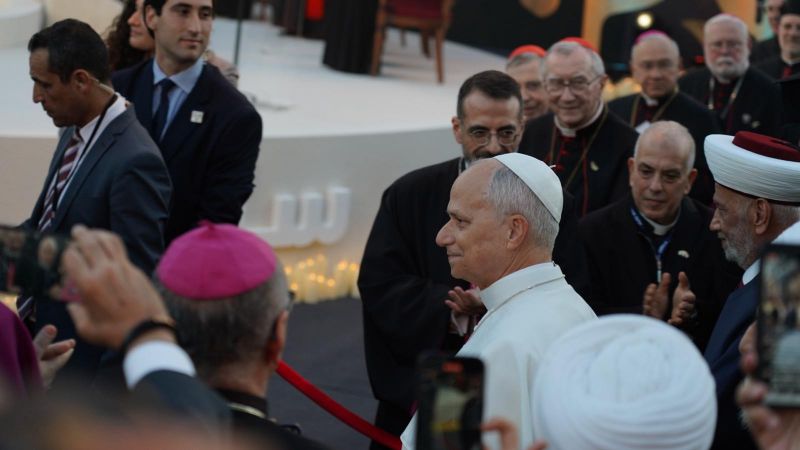
(Credit: Téa Ziadeh/ L'Orient Today)
The meeting between Pope Leo and representatives of Lebanon's various religious communities has just begun in Beirut. Army helicopters are continuously circling Martyrs' Square.
Once the pope had passed the crowds gathered along the road leading to the square, the hundreds who cheered him on quickly dispersed, heading to restaurants and cafes in the nearby Saifi Village.
"I can't believe I saw this angel made man," Dany Haroun exclaimed, still ecstatic, to our reporter Ghadir Hamadi.
Aboard the popemobile, Leo XIV arrives at Martyrs' Square, waving to the cheering crowd from inside the vehicle's glass box.
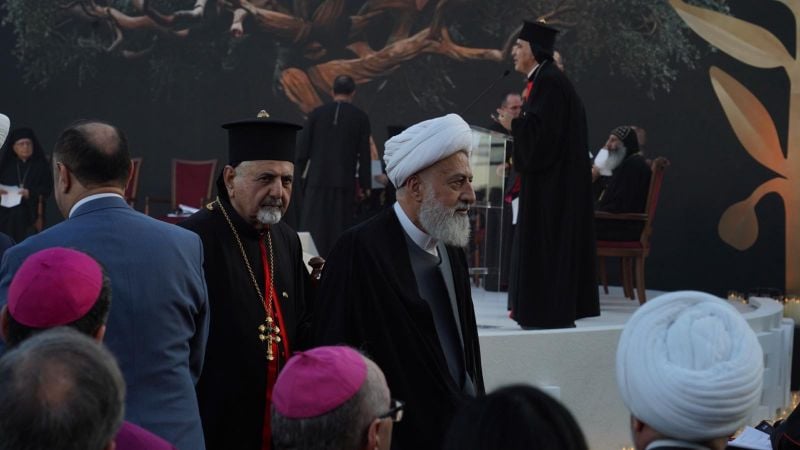
Religious dignitaries join the site of the interfaith meeting, including Ali al-Khatib (R), vice-president of the Supreme Shiite Council. (Credit: Téa Ziadeh/L'Orient Today)
Religious figures hailing from Lebanon's various and diverse sects gather ahead of the forthcoming interfaith meeting in downtown Beirut's Martyrs' Square.
The atmosphere in Dbayeh: 'We are a land of saints, going through trials sent by the devil'
“The pope is coming to have coffee with us! I swear!” 45-year-old Joelle Daccache explains to her sister-in-law Jackie Khoury, 38, and her nephews, who are gathered on the side of the highway in Dbayeh.
For Jackie, “the pope is here to bless Lebanon, a country already blessed with all its saints.”
She hopes that Leo XIV's speeches and visit will encourage people, as well as political leaders, to show “solidarity, to stand together,” and that this “will show the world that Lebanon is a country that wants peace and encourage the international community to stop putting so much pressure on us.”
Having lived in France, she also hopes that Leo XIV will encourage the diaspora to return to Lebanon, a point he has already raised twice in speeches given since arriving in Lebanon.
“When you come back, you realize that even the air here is different, it’s better," she says. "But we are also the only country where everyone's religion matters… That's not the case there.”
For Joelle, “the small measure of peace we have today is because we are a land of saints. We have spiritual peace. All the problems we have are trials sent by the devil."
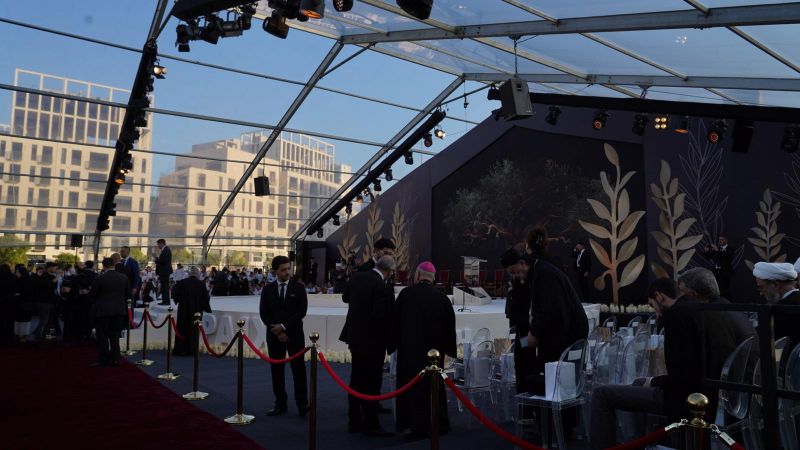
(Credit: Téa Ziadeh/L'Orient Today)
In Martyrs' Square, participants in the ecumenical and interreligious meeting are beginning to arrive, under the tent set up especially for the occasion and decorated with olive branches.
Thousands already gathered along the road to Bkirki ahead of the pope's return from Beirut
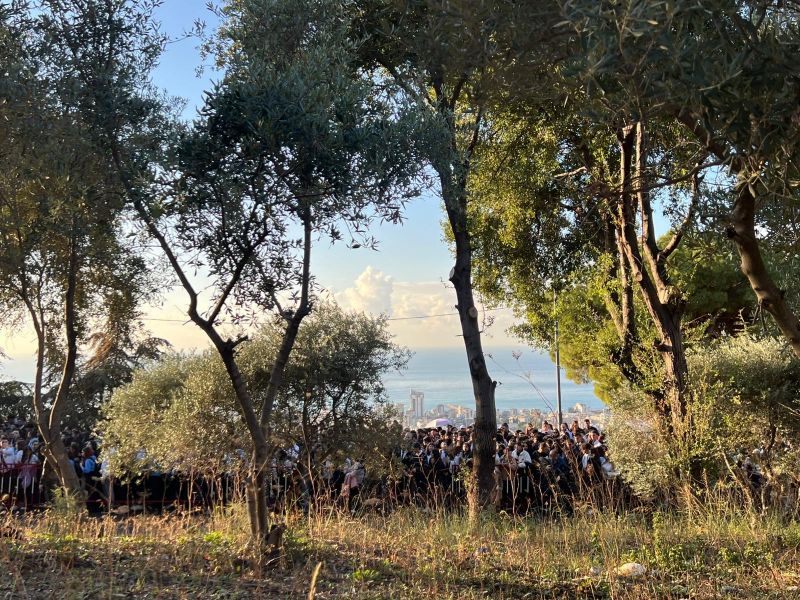
(Credit: Julia Mokdad/L'Orient Today)
On the road leading to the Patriarchate's headquarters in Bkirki, where a large meeting with young people is to take place later in the evening, thousands of people have already gathered, awaiting Leo XIV's return from Beirut, according to our reporter on the ground, Julia Mokdad.
Downtown is restlessly awaiting Leo XIV
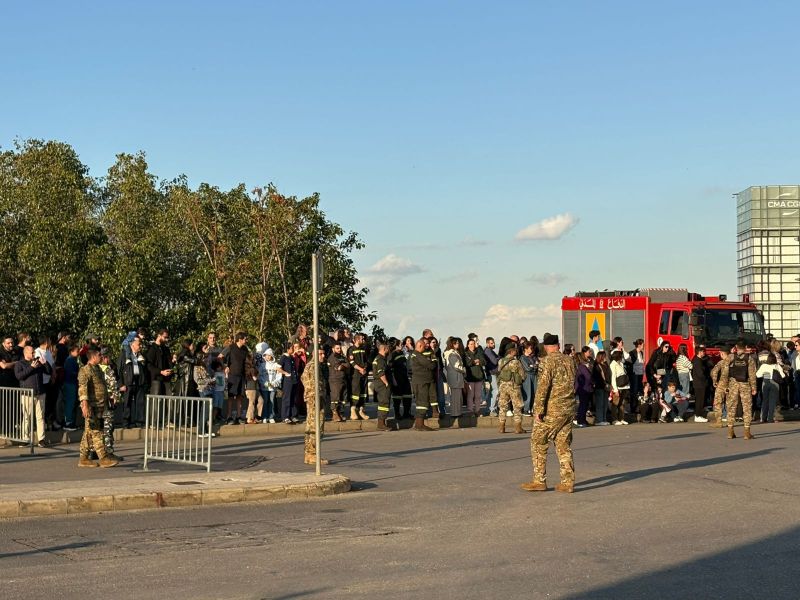
(Credit: Ghadir Hamadi/L'Orient Today)
In downtown Beirut, dozens of people are waiting for the pope to arrive. In front of the Kataeb Party headquarters in Saifi, the crowd waves Lebanese and Vatican flags.
Families are present, some with babies or toddlers. Among them, Dalida Tannous tells L'Orient Today that she wants her daughter, Taline, to catch a glimpse of the pope, "even if only for a moment."
She says, with tears in her eyes, that she is happy to be able to experience this "historic day" with her family.
However, nearby, altercations broke out between several members of the crowd and soldiers who refuse to let them cross the road. As in the morning, many of those present are growing impatient and complaining about the pope's apparent delay, although he is not yet behind schedule...
From Harissa to Beirut, a good-natured crowd gathers, although with varying degrees of optimism
Ahead of the pope's 4 p.m. ecumenical and interreligious meeting in Martyrs' Square in downtown Beirut, dozens of people have gathered along the highway to watch his motorcade pass.
Near Dbayeh, the atmosphere is lighthearted; people are taking photos while children play on the sidewalk with Vatican flags and sticks.
Hanane, 55, tells our reporter Marguerita Sejaan that, for her, "the pope represents peace; he is God on earth."
She says she believes that "his visit will bring peace to Lebanon," while in the South, Israeli attacks continue against Lebanese, albeit on a smaller scale today.
Next to her, Tanios, also in his 50s, bursts out laughing and looks up at the sky skeptically: "What can the pope do? He can't do anything."
“I know he’s doing all these meetings and we’re all excited to be here because he’s the pope, but what’s it really going to change? Nothing,” he says.
There is a prominent fear among those in Lebanon that as soon as Pope Leo leaves Lebanon, Israel will escalate its already unabated attacks into another full-out war.
Joumblatt welcomes Leo XIV's call for dialogue
Druze leader and former head of the Progressive Socialist Party Walid Joumblatt released a statement on X welcoming Pope Leo XIV's remarks declaring dialogue "a national duty."
"The pope's call to rise above personal or collective wounds and for dialogue to be a national duty at every moment and every day is the best message to advocates of isolationism, federalism, or warmongers," Joumblatt wrote.
Who’s funding Pope Leo XIV’s visit to Lebanon?
"'Preparations began even before the Vatican confirmed the visit on Oct. 7,' says Roger Zaccar, who was appointed shortly afterward as head of the event's finance committee.
Historically involved in every papal visit, this year, the assembly will provide a larger contribution because the state's resources are limited by a slew of recent crises, and its ability to finance events outside the scope of an official trip is restricted, he says.
While acknowledging criticism of the Catholic Church for raising funds for this visit when its aid might be needed elsewhere, Zaccar believes it would be hard not to allocate resources for such an important event for the country.
Without setting a budget, he noted that Benedict XVI's 2012 visit, which included a mass attended by 350,000 people, cost approximately $5 million, mostly paid for by the government."
Wondering who is paying for all this in a bankrupt country? Read Phillipe Hage-Boutros' breakdown of the budget, who’s footing the bill and why the funding has sparked criticism.
Lindsey Graham says he hopes pope visit will 'reconcile Lebanon and Israel'
U.S. Senator Lindsey Graham, a staunch supporter of Israel and its genocide in Gaza, published a statement on X about Pope Leo XIV's visit in Lebanon, saying it "comes at a critical moment."
"His presence is a reminder of the strength and unity of Lebanon’s Christian community, and his message of peace offers hope for a nation that has endured so much," Graham wrote. "May his visit bring comfort, healing, and a renewed commitment to reconciliation between Lebanon, Israel, and all its neighbors."
The U.S. has been pressuring Lebanon and Israel to enter into direct negotiations with each other, while the latter continues its attacks and violations of the cease-fire. Lebanon's authorities have stated multiple times their willingness, while Israel's refuse to address the possibility of dialogue.
Lebanese Army releases video of its escort of Leo XIV's plane as it landed in Beirut
The Lebanese Army released a short video showing Air Force Tucano aircraft escorting the pope's plane as it descended toward the Beirut international airport yesterday.
Filmed from one of the military aircraft, the video shows the plane carrying the Pope as it prepares to land. "Welcome to Lebanese airspace. We are honored to escort you to the land of the sacred cedars," an Air Force commander says in an audio message addressed to the visiting pope. "Millions of Lebanese welcome you and await your visit in support of peace."
Pope Leo XIV, after the ceremony at Notre-Dame Basilica, headed to the Apostolic Nunciature in the same village, where he will hold private meetings.
Religion and geopolitics: A look back at the visits of Paul VI, John Paul II and Benedict XVI to Lebanon
Pope Leo is the fourth pope to set foot in Lebanon, a trip that comes 13 years after Pope Benedict XVI’s visit in September 2012.
To date, it was John Paul II's 32-hour-long visit to Lebanon in May 1997 that left the deepest mark on the Lebanese collective memory and an episode largely forgotten is when Pope Paul VI, the first head of the Catholic Church to visit Lebanon, made a brief stop at Beirut Airport in 1964.
As for Pope Francis, Leo XIV’s predecessor, who passed away on April 21, 2025, he had repeatedly expressed his desire to make the trip, but health issues prevented him from doing so.
To put the pope’s visit into perspective, check out Nemtala Edde's article going back through the three previous papal trips to Lebanon and the political moments they coincided with from 1964 to 2012.
Gifts exchanged and pictures taken
After the pope’s address, representatives of the Harissa shrine presented him with gifts, including a bronze statue created by sculptor Bernard Ghossoub depicting a bridge between Lebanon and the Holy See. The Pope posed for a souvenir photo with several religious leaders, including Maronite Patriarch Bechara Rai, before members of the clergy took turns greeting him.
Pope says prayer offers hope amid war
“It is with great joy that I meet you on this journey,” Pope Leo said during his Harissa meetings, thanking those who had shared their testimonies.
“Our prayer gives us the strength to continue hoping and working, even when the sound of gunfire rumbles all around,” he added.
He once again praised the Lebanese for their faith despite so many difficulties. “I am thinking of the responsibility we all have in this regard, particularly towards young people,” he emphasized, echoing the testimonies of the religious and the migrant worker and commending everyone’s commitment.
“The spirit in which we strive to live each day is love,” LEO XIV added, before presenting the Harissa shrine with a Golden Rose, an ornament blessed by the pope and intended to honor Catholic sovereigns or shrines.
Priest who works in prisons says mission particularly difficult due to poverty, overcrowding, lagging court system
Father Tony Fayad, who works as a chaplain in Lebanon's prisons told the pope that he sees God in the prisoners he encounters behind bars.
“Each encounter is an encounter with the living Christ," he says. "We see reflected the tenderness of the Father who never tires of forgiving.”
“The context in Lebanon makes our mission particularly difficult, with poverty, prison overcrowding, the slowness of the justice system, and personal wounds,” he adds. “In Lebanon’s prisons, mercy comes alive when a prisoner realizes he is not alone.”
“One day, a prisoner told me: ‘You came all the way here, so God hasn’t forgotten me.’”
Two domestic workers once walked three days to a parish with newborn child after being abandoned by Lebanese employers
Lauren, a migrant domestic worker, who was invited to speak during the meetings with the pope at Harissa says she has found purpose in volunteering at her parish of Saint Joseph in Tabaris.
“Our church has become a refuge; I’m proud to serve here," she tells the pope. "I’ve met people who have lost everything,” she adds, sharing the story of James and Leila, migrant workers, a couple, who were abandoned by their Lebanese employers when the war broke out last year.
“They were left alone, trapped, with nowhere to go. When their daughter was born, they walked for three days to get to the parish.”
“We migrants are never alone. We contribute to this country," Lauren says. "We are workers, builders. We bring our culture, open our hearts, care for children, cook. I’ve witnessed things, small acts of love that open hearts.”
Nun shares her experiences during the war in Baalbeck
At Harissa, a nun from the Sacred Hearts convent in Baalbeck tells the pope that she stayed in the heavily bombed area during the war because of her faith.
“When the war broke out last fall, everything could have stopped, but I decided to stay because I had already given my life to the Lord.”
“Together with the bishopric, we welcomed Christian and Muslim families” fleeing Israeli aggression, giving them shelter at the convent. “We shared bread, fear, and hope,” she recalls.
“When militias came to smash the convent’s security cameras,” she says, she found refuge “in prayer, in silence.”
“With the NGOs that remained in Baalbeck, we continued to serve there. I recognized the breath of the risen Christ who teaches us to love even in fear. In the heart of the war, I discovered the peace of Christ.”
Tripoli priests calls for support for North Lebanon's 'vibrant faith'
During the meetings with the pope, Youhanna Fouad Fahd, a priest in the Diocese of Tripoli, spoke of Dbabieh, a town in northern Lebanon near Syria, and the poverty, fear, and faith experienced in this town during the Syrian conflict and even after the fall of the Assad regime.
"I met families who had fled persecution and others who had sold everything," he told the pope. "In their eyes, I saw a fragile faith, but incredibly vibrant. A faith that needs to be supported."
Pope Leo arrives at Basilica of Our Lady of Lebanon in Harissa
Leo XIV arrived at the Basilica of Our Lady of Lebanon in Harissa, on the hill overlooking Jounieh, for a meeting with bishops, priests, and people working in pastoral ministry.
He was greeted with cheers from the audience and shook hands with participants from various religious congregations.
Aoun and his wife Neemat, having been with the pope at Saint Charbel's tomb, also came with him to Harissa.
Pope made a surprise visit to Harissa convent
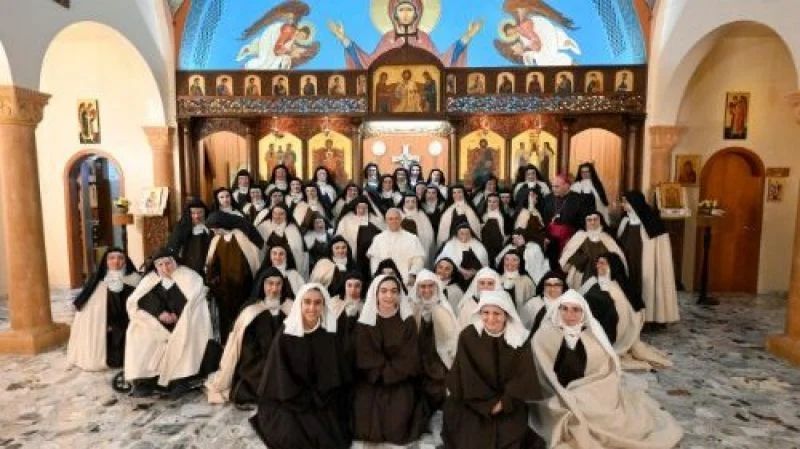
Pope Leo posing with the Carmelite nuns at the convent in Harissa. (Credit: Vatican Media)
Last night, after a long day between his departure from Istanbul and his arrival in Lebanon, the pope made a surprise half-hour visit to the Carmelite convent in Harissa, according to the Vatican News.
According to the Holy See Press Office, the pope greeted each of the sisters individually during his visit, which was not on the official schedule, before receiving greetings from the superiors of both communities. He recited the Lord's Prayer with them and gave them his apostolic blessing.
The Vatican, Arabs and the unarmed prophet’s diplomacy
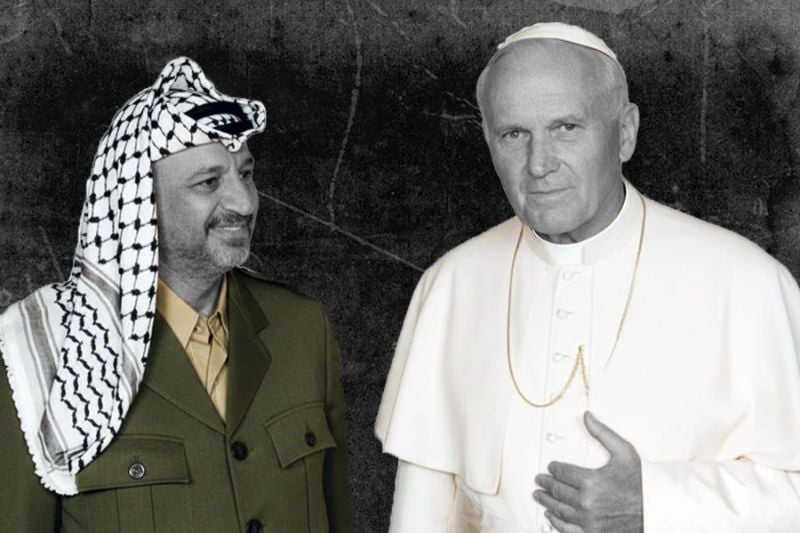
Pope John Paul II and PLO leader Yasser Arafat. (Collage by Céline Bejjani/L'Orient-Le Jour)
"On Sept. 15, 1982, at 4:30 p.m., Yasser Arafat arrived at the Vatican. Three months after the Israeli invasion, the Lebanese Civil War weighed on everyone’s mind.
This encounter proved to be the first of many: John Paul II and Arafat met 12 times in total over the years.
These one-on-one meetings, a sign of friendship between the two, also reflected certain diplomatic finesse and the product of a long history."
If you’d like to understand the Vatican’s Middle East playbook, read Stephanie Khouri's article explaining how Rome has positioned itself with regard to Arab regimes and wars, and what kind of “unarmed” diplomacy Leo XIV is bringing with him to Lebanon.
Pope leaves Anaya, heads to Harissa for the next event on his agenda
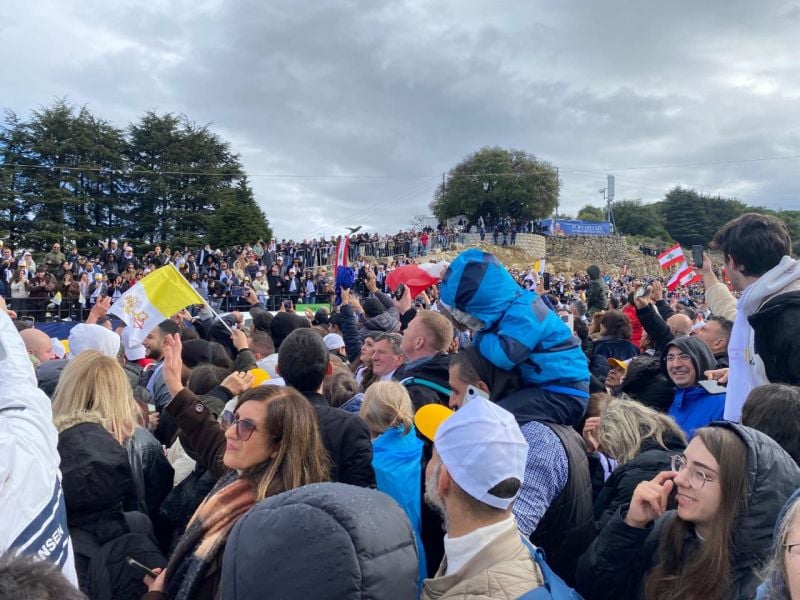
(Credit: Nemtalla Edde/L'Orient Today)
After greeting the monks of Saint Maron Monastery, Pope Leo XIV got back into the popemobile to leave Anaya, while the hundreds of people gathered kept up their cheery attitude despite the rain, waving Lebanese and Vatican flags.
Next, the pope is meeting with religious figures at the Shrine of Our Lady of Lebanon in Harissa, in the Kesrouan district.
MP Simon Abi Ramia, originally from Ehmej, told L'Orient Today that he was "very proud" of the pope's visit to Anaya. "It's symbolic," he declared. His family owned the land on which the monastery stands. For him, it was therefore "a sentimental moment, not just a spiritual one."
Rain dampens crowd's spirits, peeking through umbrellas for a 10-second glimpse of the pope
“I didn’t see him,” a little girl cries, huddled close to her mother under her umbrella.
“It’s really bad luck, he arrived at the worst possible moment,” says Maryam Khalil, 35, her hair soaked, as she prepares to head back while waiting for one of the shuttle buses.
“I saw him briefly between the umbrellas," she says. "We waited three hours to see him for only ten seconds… but it doesn’t matter, it will remain a beautiful memory. We’re still happy we came.”
“I’m a little disappointed with how it went, honestly," says Antoine Khoury, who came from Achrafieh. "I wish he had passed by more slowly so we could have really greeted him.”
“It wasn’t [the pope’s] fault because it was pouring rain. I’ll go to Mass tomorrow in Beirut; God willing, it will be better. Let’s hope the weather is better.”
'Qozhaya Psalter,' the first book published in the eastern Ottoman Empire
The book that Pope Leo was gifted is a copy of "Qozhaya Psalter," published in 1610 by Sergius Risius (born Sarkis al-Rizzi) at Saint Anthony Monastery in the Qadisha Valley, a valley in northern Lebanon known for its centuries of religious events, sites and pilgrimages.
According to an article published by Holy Spirit University of Kaslik (USEK), the 260-page Psalter was also the first book ever printed in the eastern Ottoman Empire and features text in both Syriac and Garshuni — Arabic written using Syriac script.
Printing biblical texts in both of these ancient languages contributed significantly to their preservation and dissemination, the article adds.
The printing press on which the book was printed is believed to have been the first in the whole Middle East and is still on display in the monastery today.
Pope blesses gifts to cheers from the crowd
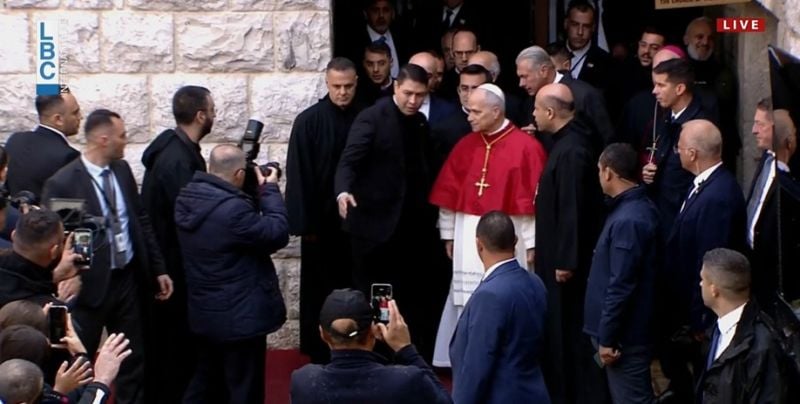
Pope Leo leave the monastery. (Screenshot taking from LBC live broadcast)
An exchange of gifts then took place in the newly renovated crypt: the pope received from the Maronite Order a copy of the first book printed in the Qadisha Valley, a candle, and a lantern that, according to local belief, had miraculously lit itself while sitting on the saint's tomb.
In return, the Pope presented the monastery with a candle he had brought from Rome.
He then visited the museum at the monastery, where some of Saint Charbel's belongings are on display.
Father Hadi Mahfouz and Pope Leo reflect on the life and miracles of Saint Charbel
Superior-General of the Lebanese Maronite Order Father Hadi Mahfouz delivered a speech inside the monastery, thanking, in French, the Pope for his visit and reflecting on the life of Saint Charbel and his canonization in 1977.
The Pope responded with a speech, also given in French. "Saint Charbel reminds us of the ecumenical demands of our mission," he declared.
“We want to entrust to the intercession of Saint Charbel the needs of the Church, of Lebanon and of the world,” Leo XIV said.
He recalled the miracle of Jan. 22, 1993, when a paralyzed woman named Nouhad Chami was healed after praying at Saint Charbel's tomb. Ever since that day, hundreds of pilgrims travel to the monastery on the 22nd of every month.
Father Hadi Mahfouz and Pope Leo reflect on the life and miracles of Saint Charbel
Superior-General of the Lebanese Maronite Order Father Hadi Mahfouz delivered a speech inside the monastery, thanking, in French, the Pope for his visit and reflecting on the life of Saint Charbel and his canonization in 1977.
The Pope responded with a speech, also given in French. "Saint Charbel reminds us of the ecumenical demands of our mission," he declared.
“We want to entrust to the intercession of Saint Charbel the needs of the Church, of Lebanon and of the world,” Leo XIV said.
He recalled the miracle of Jan. 22, 1993, when a paralyzed woman named Nouhad Chami was healed after praying at Saint Charbel's tomb. Ever since that day, hundreds of pilgrims travel to the monastery on the 22nd of every month.
Father Hadi Mahfouz and Pope Leo reflect on the life and miracles of Saint Charbel
Superior-General of the Lebanese Maronite Order Father Hadi Mahfouz delivered a speech inside the monastery, thanking, in French, the Pope for his visit and reflecting on the life of Saint Charbel and his canonization in 1977.
The Pope responded with a speech, also given in French. "Saint Charbel reminds us of the ecumenical demands of our mission," he declared.
“We want to entrust to the intercession of Saint Charbel the needs of the Church, of Lebanon and of the world,” Leo XIV said.
He recalled the miracle of Jan. 22, 1993, when a paralyzed woman named Nouhad Chami was healed after praying at Saint Charbel's tomb. Ever since that day, hundreds of pilgrims travel to the monastery on the 22nd of every month.
Joy Younane, who traveled from Amchit, Batroun district, to Annaya, believes this is “a historic day for Lebanon, especially since the Pope will declare this site a World Heritage Site, which will boost religious tourism in Lebanon.”
Check out a selection (non-exhaustive) of heritage sites in Lebanon, from North to South, that carry a special spiritual significance here. 👈
Hopes that Pope Leo's speech at Baabda yesterday will 'encourage political leaders to act in the right way'
Patrick Chalhoub, 25, from Jbeil, is standing in a square just below the monastery.
"The fact that the Pope came to Lebanon for his first official visit makes us very proud as Christians, but also as Lebanese," he tells L'Orient Today. "It's a day of communion for all of Lebanon, bringing together people from all regions."
This communications student was a big fan of Leo XIV's speech from Baabda last night.
"The message of peace he sent is very important in the current context of the country," Patrick says. "I hope that the political leaders listened to his words and that this will encourage them to act in the right way."
Pope walks the red carpet into the monastery
The bells of the Monastery of Saint Maron rang, announcing the pope's arrival. The crowd cheered as he passed, throwing rice and flower petals. “Viva Baba!” one woman shouted.
On the red carpet at the entrance to the monastery, Leo XIV was greeted by the head of the Lebanese Maronite Order, Father Hadi Mahfouz, and members of the clergy.
Inside, Leo XIV was welcomed by President Joseph Aoun and his wife, as well as by Maronite Patriarch Bechara Rai.
Lebanon 'desperate needs' message of peace
Melissa, on the road to Jounieh, tells L'Orient Today that Pope Leo's visit it coming at a critical time. “We desperately need a message of peace in Lebanon right now.”
Melissa has attended all the papal visits to Lebanon and she wanted her daughter, 2-year-old Jaimee to follow in her footsteps. “I want her to have the same experience, even if she’s still too young to remember it later.”
This visit “is very short, so we wanted to make the most of it. Especially since his message is one of peace, which is what we desperately need in Lebanon right now.”
Jaimee pipes up: “We love Pope Leo!”
Pope is 'truly seeking to restore hope for the region's Christians'
Charbel, 24, and his younger brother Kevin, 10, got up at 3 a.m. this morning to travel from Mansourieh, in Metn distrct, to Anaya.
“We thought we could stay in the car; it would have been less tiring for Kevin," Charbel says. "And we would have liked to see the monastery before the Pope’s visit, but it’s not possible. We have a four-hour wait, but it’s worth it!”
“We’re waiting for a message of ‘Peace for Lebanon,’" Kevin says in a small voice, "and that ‘there be no more war.’”
Jimmy, in his twenties, woke up at 4:30 a.m. to come from the neighboring village of Ehmej with three of his friends. Equipped with coffee in hand, Jimmy says they're here "because it's exceptional: we could have lived our whole lives without seeing him."
"I don't know much about this pope but I am grateful to him: it's hard to come to Lebanon in this context." Jimmy believes Pope Leo "is really trying to give hope back to Christians in the region."
Saint Maron Monastery prepares to be flooded with people
"We have no idea how many there will be, all I can say is that it'll be packed here," a member of the Civil Defense on site told L'Orient Today.
Those who had already arrived were crowding in front of the monastery, in an area designated for watching the pope drive by. This area reach capacity at 7 a.m.
"It's full earlier than expected; it's a decision made by the municipality, there's nothing I can do about it," a security officer said.
The early arrivals are passing the time discussing how tired they are and the rain's unfortunate timing.
"They could have put up tents for people," says Georges, a student in his twenties at AUT (American University of Technology).
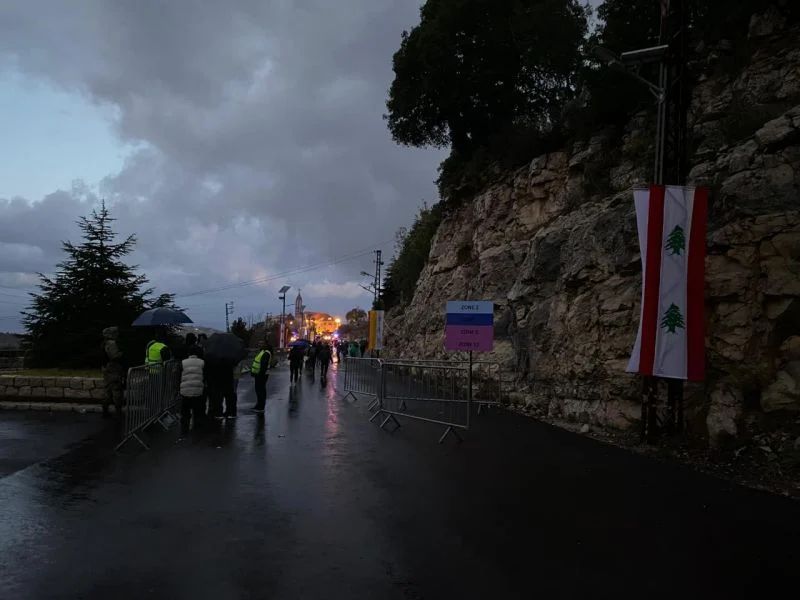
The journey begins before sunrise
(Credit: Nemtala Edde/L'Orient Today)
Starting at 5 a.m., more than four hours before the pope's arrival, people have been making the journey up to the tomb of Saint Charbel, which is located at the Monastery of Saint Maron in Anaya, in the hills above Jbeil.
At the military checkpoint in Anaya, Lebanese Army soldiers directed cars to the shuttle buses chartered to take them up to the monastery. "You must stay in your car until you reach the bus," a soldier calls out. This instruction is easily followed given the pouring rain.
During his first speech, following meetings with Aoun, Berri, and Salam at Baabda Palace, Pope Leo urged Lebanon's leaders not to lose touch with the people and to confront their collective difficult histories.
The pope stressed that peace is "not simply an abstraction, but a daily necessity, a desire, and a calling" and urged leaders to confront "the wounds of the past," whether personal or collective, referring to Lebanon’s 15-year Civil War.
He called on officials to "put themselves at the service of the people" and to prioritize the common good, warning that disengagement from citizens — especially young people who continue to emigrate en masse — threatens the country’s future.
Read the full wrap-up of day one for the pope in Lebanon here. 👈
Good morning and welcome to today's live coverage of Pope Leo XIV's second day in Lebanon. He's kicking off today's itinerary with a prayer given at the tomb of Saint Charbel, a 19th century Lebanese priest and monk who was known for his ability to unite people across various faiths.
Thank you for following our live news coverage of the pope's visit to Lebanon
Thank you for following our live coverage of the pope's second day in Lebanon, in which he visited Annaya and Harissa, participated in interfaith meetings at Beirut's Martyrs' Square, and spoke to young people at Bkirki.
Amongst crowds of people lining the streets to catch a glimpse of him, meetings with various religious figures from different sects, and an impassioned speech to the youth of the country, one takeaway line from day two of the pope's visit is: "Your homeland, Lebanon, will flourish again, beautiful and strong like the cedar tree."
We look forward to seeing you tomorrow, Tuesday, for the continuation of Pope Leo XIV's historic trip to Lebanon.
Tomorrow, the pontiff will continue his busy schedule. Starting at 8:30 a.m., he will visit the Sisters of the Cross psychiatric hospital in Jal al-Dib, north of Beirut, to meet with medical staff and patients.
At 9:30 a.m., he will participate in a silent prayer at the site of the Aug. 4, 2020, Beirut Port explosion before celebrating a large communal mass on the capital's seafront at 10:30 a.m.
The visit will conclude with a farewell ceremony at Beirut airport at 12:45 p.m., before his scheduled departure from Lebanon at 1:15 p.m.
Pope joins members of the clergy for a photo op
The pope greets the crowd and then makes his way to the courtyard of the Bkirki Maronite Patriarchate for a photo op with the clergy present.
'The true renewal that a young heart desires begins with everyday gestures'
"God, who is love, builds solid and fruitful relationships on mutual trust... Think of the many young people who, like you, have not allowed themselves to be discouraged by injustices or bad examples, even those within the Church," says the pope.
"As young people, you find it easier to build relationships with others, even those from different cultural and religious backgrounds," he continues.
"The true renewal that a young heart desires begins with everyday gestures: welcoming those who are close and those who are far away, reaching out to friends and refugees alike, and forgiving enemies: a difficult but necessary task."
"Let us look at the many admirable examples set by the saints. Think of Pier Giorgio Frassati and Carlo Acutis, two young people canonized in this jubilee year," he says.
"Think also of the many Lebanese saints. What singular beauty there is in the life of Saint Rafqa, who endured years of suffering with strength and gentleness. How many acts of compassion were performed by Blessed Jacques Haddad, in the service of those whom everyone had forgotten. What a powerful light emanates from the darkness into which Saint Charbel chose to withdraw, he who has become one of the symbols of Lebanon throughout the world. His eyes are always depicted as closed, as if to veil an infinitely greater mystery. Through the eyes of Saint Charbel, closed so as to see God better, we continue to perceive God's light more clearly.
"Dear young people, may divine light also illuminate your eyes, and may the incense of prayer blossom there. In a world of distractions and vanities, take time each day to close your eyes and look only at God," says the pope.
'Your homeland, Lebanon, will flourish again, beautiful and vigorous like the cedar'
"Dear young people, live in the light of the Gospel, and you will be blessed in the eyes of the Lord. Your homeland, Lebanon, will flourish again, beautiful and vigorous like the cedar, symbol of the unity and fertility of the people. You know well that the strength of the cedar lies in its roots, which often have the same span as its branches," says the pope.
"The many good things we see today in Lebanese society are the fruit of the humble, discreet and sincere work of so many people of good will, many good roots that seek not to produce just one branch of the Lebanese cedar, but the whole tree in all its beauty," he continues.
'Peace is not authentic when it is the product of partisan interests'
"May the good roots of those who devote themselves to serving society without personal gain, and who generously commit themselves to justice, a common project for a future of peace and development, spring forth: may they be the source of hope awaited by the country."
The pope continues, "Peace is not authentic when it is the product of partisan interests. It is only real when I do to others what I would like them to do to me."
Pope Leo XIV echoes the words of John Paul II, saying, "There is no peace without justice, nor justice without forgiveness." "This is profoundly true. Forgiveness leads to justice, which is the foundation of peace," he affirms.
"It is true that we live in an age where personal relationships are fragile and consumed like objects. Even among young people, personal interests can sometimes take precedence over trust... Such attitudes transform even beautiful realities such as friendship and love into superficial things, confusing them with selfish satisfaction. If the ego is at the center of a friendship or love relationship, it cannot bear fruit," he says.
"Friendship is authentic when it puts 'you' before 'me,'" says the pope. A respectful and welcoming view of others allows us to build a broader 'us,' open to society as a whole and to all of humanity. Love is authentic, and can last forever, only when it reflects the eternal splendor of God."
'The true opposition to evil is not evil, but love'
"You have a gift that we adults often seem to have lost," says Pope Leo XIV. "You have hope, you have time. You have more time to dream, to plan, and to do good."
"You are the present, and the future is already taking shape in your hands. You have the enthusiasm necessary to change the course of history," he continues.
The true opposition to evil is not evil, but love, a love capable of healing its own wounds while caring for the wounds of others."
"Blessed are the meek, for they shall inherit the earth. Blessed are the peacemakers, for they shall be called children of God," says the pope.
'In all these conflicts, many of us can recognize our own experiences, good or bad'
The pope greets the young people who spoke earlier.
"Their stories bear witness to courage in the midst of suffering. They speak of hope in the face of disappointment and of inner peace, even in times of war," he says.
"They are like bright stars in the night sky, offering us a glimpse of the first rays of dawn."
"In all these conflicts, many of us can recognize our own experiences, good or bad," he continues. "Lebanon's history is woven with moments of glory, but it is also marked by deep wounds that are slow to heal."
"These wounds have causes that transcend national borders and are intertwined with very complex social and political dynamics," he adds.
"Dear young people, you may regret inheriting a world torn apart by wars and disfigured by social injustice. Yet there is hope, and that hope lies within you."
'I extend a special greeting to the young people from Syria and Iraq'
"The enthusiasm we feel in our hearts expresses God's loving closeness, which unites us as brothers and sisters to share our faith in him and our communion with one another," says the pope.
"I thank you all for your warm welcome ... I extend a special greeting to the young people from Syria and Iraq, as well as to the Lebanese who have returned to their country from abroad. We are all gathered here to listen to one another and to ask the Lord to inspire our future decisions."
Pope Leo XIV commences his speech with 'peace be upon you'
The pope commences his speech: "Al-Salam 'Aalaykom."
"Peace be upon you," he continues in English.
'Our dreams have been buried,' says a young man in front of the pope
A young man speaks up. "Since the beginning of the crisis, a voice inside me has been telling me to leave the country, like so many Lebanese," he confides.
"I know that nothing is guaranteed here. I worked hard, and overnight, we lost everything: our dreams were buried, and I was back to square one."
"I had many opportunities elsewhere," he continues. "My relatives encouraged me to leave. But nothing convinced me. I decided to stay because, deep in my heart, I believe that difficulties are not there to destroy us, but to teach us resilience."
"How can I leave when my country is suffering? When God is at work on this earth? I am convinced that my desire to stay draws its strength from a responsibility: that of taking care of my brothers and sisters," the young man continues. Pope Leo XIV, we stayed because we have faith.
Faith that God will not abandon us, that life will go on despite everything. No country can survive without its youth. And Lebanon still deserves our dreams."
Young people re-enact scenes of recent pain and suffering
While a sound and light show is projected onto the exterior walls of the patriarchal headquarters, young people re-enact some of the painful events of the past few years: the economic crisis of 2019, the Covid pandemic, the Beirut Port explosion, and last year's war with Israel.
Rai begins his address to Pope Leo XIV
Maronite Patriarch Bechara al-Rai takes the floor to welcome the pope to Lebanon, "a country small in size but great in its mission."
"Welcome to Lebanon," he says. "Today Lebanon welcomes you and offers you its purest gift: tears transformed into pearls of hope."
"In your footsteps, we hear the echo of Christ walking on our roads ... whispering: 'Do not be afraid,'" he continues.
"You are contemplating a youth that is seeking a future here in Lebanon."
"Our young people want to build a new Lebanon where faith is a strength and pluralism is a source of wealth," he added.
"The youth of Lebanon love you and await you with ardent hearts, eager to hear words of hope from you amid the trying times they are going through."
"Thank you for looking upon us not with sorrow but with confidence. Your words will be a light for us. Thank you for your presence and your blessing," he concluded.
The pope meets with young people at Bkirki
During the meeting with the pope in Bkirki, young people offered him symbolic gifts: a handful of soil, symbolizing the refusal of exile; wheat seeds, reminiscent of the silos in the port of Beirut; a sculpture representing hands in prayer; and, of course, a Lebanese cedar sapling.
The pope arrives at Bkirki
The pope has arrived at Bkirki, greeted by a crowd waving Lebanese and Vatican flags.
First Lady and large crowds of people gather at Bkirki
Thousands of people have gathered in Bkirki, site of the Maronite Patriarchate headquarters where the pontiff is scheduled to meet with young people.
First Lady Neemat Aoun has also arrived there.
In a nod to the reference in his speech, Pope Leo XIV plants an olive tree
Surrounded by the Patriarch of Antioch and All the East of the Greek Orthodox Church, Jean X Yazigi, and the Druze Sheikh Akl, Sami Abi al-Mona, the pope planted a young olive tree handed to him by two children, while the choir sang the Psalm of Creation.
Pope Leo XIV makes his concluding remarks at Martyr's Square
"Dear brothers and sisters, every year on March 25, you gather to venerate Mary, Our Lady of Lebanon, honored in her sanctuary at Harissa, which is adorned with an impressive statue of the Virgin with outstretched arms, embracing all the Lebanese people," recalled the pontiff.
"May this loving and maternal embrace of the Virgin Mary, Mother of Jesus and Queen of Peace, guide each of you, so that in your homeland, throughout the Middle East and throughout the world, the gift of reconciliation and peaceful coexistence may spring forth 'like the living waters that flow from Lebanon,' bringing hope and unity to all ," he concluded.
'While Lebanon is renowned for its majestic cedars, the olive tree is also a pillar of its heritage'
"While Lebanon is renowned for its majestic cedars, the olive tree is also a pillar of its heritage: the olive tree not only embellishes this space where we are gathered today, but is also revered in the sacred texts of Christianity, Judaism and Islam, where it is considered a timeless symbol of reconciliation and peace," he said.
"Its long life and remarkable ability to flourish even in the most difficult environments symbolize endurance and hope, reflecting the unwavering commitment necessary to foster peaceful coexistence," added the pope as he blessed an olive tree at the end of his speech.
"Just as the roots of cedars and olive trees sink deep and spread widely into the earth, the Lebanese people are scattered throughout the world, but united by the enduring strength and timeless heritage of your homeland," said Leo XIV.
"Your presence here and throughout the world enriches it with your millennia-old heritage, but it also manifests a vocation."
"In an increasingly interconnected world," the pope called on the Lebanese "to be artisans of peace: to confront intolerance, overcome violence and banish exclusion, lighting the way to justice and harmony for all through the witness of your faith."
'Our common humanity and our belief in a God of love and mercy unite us,' says Pope Leo XIV
"At a time when coexistence may seem like a distant dream, the Lebanese people, despite embracing different religions, forcefully remind us that fear, mistrust and prejudice do not have the last word, and that unity, reconciliation and peace are possible," the pope said.
"It is a mission that has remained unchanged throughout the history of this beloved land: to bear witness to the enduring truth that Christians, Muslims, Druze and so many others can live together and build a country united by respect and dialogue," he added.
The Pope takes the floor
"For many years, and particularly in recent times, the eyes of the world have been fixed on the Middle East, the cradle of the Abrahamic religions, observing the laborious journey and the relentless quest for the precious gift of peace. Faced with such complex and persistent conflicts, humanity sometimes looks at the Middle East with a sense of apprehension and discouragement. Yet, in the midst of these struggles, we can feel hope and encouragement when we focus on what unites us: our common humanity and our belief in a God of love and mercy," said the pontiff during his speech at Martyrs' Square.
Syriac Orthodox Patriarch Ignatius Ephrem welcomes the pope 'to this holy land of Lebanon'
"I welcome you on behalf of the See of Antioch ... and on behalf of all Eastern Christians who have borne witness to Christ since the dawn of Christianity. This is despite the trials and persecutions they have endured over the centuries, to the point that their numbers have been dramatically reduced and their presence in the land of their ancestors is now threatened," he continued.
"In recent years, our countries have been victims of extremist terrorist campaigns, bloody wars, and the persistent aggression of a relentless Israeli enemy, causing the exodus of many inhabitants," he added.
At the same time, these existential challenges have strengthened cooperation between the various Churches of the Middle East, giving rise to what your predecessor, Pope Francis, called 'the ecumenism of blood.'"
"Your apostolic visit comes at a sensitive moment in the history of this region, at a time of profound turmoil and change," he continued, expressing his hope that your visit would lead "to stability, justice, and peace, which our region has not known for a very long time."
"The peoples of this land aspire to a peace based on justice, guaranteeing the dignity and freedom of every human being, within the framework of a state where the rule of law prevails and where equal rights and duties are ensured," the patriarch added. Christians and Muslims have lived on this blessed land for centuries, sharing their sufferings and their hopes, and aspiring to continue a common life based on the experience of their ancestors. While dialogue between representatives of religions is important, the concrete experience of living together remains the cornerstone that consolidates it."
"The East is not a border drawn on a map: it is a life to be shared, a memory to be preserved, a fabric of human relations woven over centuries between Muslims and Christians, said the patriarch. Here, we have learned that living together is not a slogan, but a dialogue of life based on sincere encounter, mutual respect, and collective responsibility towards human beings."
Sheikh Ali al-Khatib to Pope Leo XIV: 'We are not weapon enthusiasts'
In his speech delivered during the ecumenical meeting at Martyrs' Square, the vice president of the Supreme Shiite Council (CSC), Sheikh Ali al-Khatib, told the pontiff that "we are happy, on this occasion, to welcome you to Lebanon on behalf of the Supreme Shiite Islamic Council and the Shiite community, and we appreciate your visit to our country and your positions during this difficult period that Lebanon is going through."
He added that "we welcome your visit in these circumstances, and the Holy See has always considered Lebanon as a message. We all hope that your visit will help strengthen the faltering national unity of this country ravaged by ongoing Israeli aggression."
He concluded: "We are not lovers of weapons, and we place the cause of Lebanon in your hands, in the hope that the world will help our country to emerge from this situation."
Mufti Derian welcomes the pope: 'Lebanon, a country of coexistence and diversity'
"It is with great joy that we welcome Pope Leo XIV on his visit to Lebanon, a country of coexistence and religious diversity, a source of wealth and enrichment for humanity, where citizenship is the very foundation of equal rights and duties, without any discrimination," said the Grand Mufti Abdel-Latif Derian, during his meeting with the pope at Martyrs' Square.
"In Lebanon, we constantly reaffirm our national principles during our spiritual summits. We respect religious freedoms and human rights, the pillars of coexistence in our diverse and multiple societies, and we do not interfere in the specificities of each. Our Constitution protects the right of communities to practice their religious laws," he continued.
He also added that "Islam is a path of faith in one God, stretching from Adam to Noah, from Abraham to Moses and Jesus, and ending with Muhammad," while recalling that "the Charter of Medina, on which the first form of state in Islam was based, stipulates that believers and other components of Medinan society, in all its diversity, form with Muslims 'one community.'"
He added that "on these foundations of faith, [he] welcomes Pope Leo XIV, wishing him success in steering the Christian ship, for the good of humanity, in the spirit embodied in the Document on Human Fraternity signed between the Sheikh of al-Azhar, Ahmed al-Tayeb, and Pope Francis.
The mufti concluded by saying that "Lebanon is the land of this message; it is its bearer and its architect. That is why we consider ourselves the custodians — religiously, morally, and nationally — of this mission, so that security and peace may reign in the world, and love may prevail among all nations and peoples."
Patriarch of Antioch: Welcome to Lebanon, land of coexistence
In his speech delivered during the ecumenical gathering at Martyrs' Square, Patriarch John X of Antioch and All the East welcomed Pope Leo XIV.
"Welcome to this land where the cross of Christ has taken root. Welcome to Lebanon, this unique country that breathes both Christian and Muslim environments, this country of coexistence and components that unite to form Lebanon," he said.
Patriarch of Syrian Catholics speaks with the pope
The Patriarch of Syrian Catholics, Mar Ignatius III Younan, during his meeting with Pope Leo XIV in Martyrs' Square: "The purpose of today's visit is to build peace and stability in the region, particularly in Lebanon, which is small on the map but great in its message, its role and its Islamic-Christian mosaic."
The interfaith meeting has begun in Martyrs' Square
(Credit: Téa Ziadeh/ L'Orient Today)
The meeting between Pope Leo and representatives of Lebanon's various religious communities has just begun in Beirut. Army helicopters are continuously circling Martyrs' Square.
Once the pope had passed the crowds gathered along the road leading to the square, the hundreds who cheered him on quickly dispersed, heading to restaurants and cafes in the nearby Saifi Village.
"I can't believe I saw this angel made man," Dany Haroun exclaimed, still ecstatic, to our reporter Ghadir Hamadi.
Aboard the popemobile, Leo XIV arrives at Martyrs' Square, waving to the cheering crowd from inside the vehicle's glass box.
Religious dignitaries join the site of the interfaith meeting, including Ali al-Khatib (R), vice-president of the Supreme Shiite Council. (Credit: Téa Ziadeh/L'Orient Today)
Religious figures hailing from Lebanon's various and diverse sects gather ahead of the forthcoming interfaith meeting in downtown Beirut's Martyrs' Square.
The atmosphere in Dbayeh: 'We are a land of saints, going through trials sent by the devil'
“The pope is coming to have coffee with us! I swear!” 45-year-old Joelle Daccache explains to her sister-in-law Jackie Khoury, 38, and her nephews, who are gathered on the side of the highway in Dbayeh.
For Jackie, “the pope is here to bless Lebanon, a country already blessed with all its saints.”
She hopes that Leo XIV's speeches and visit will encourage people, as well as political leaders, to show “solidarity, to stand together,” and that this “will show the world that Lebanon is a country that wants peace and encourage the international community to stop putting so much pressure on us.”
Having lived in France, she also hopes that Leo XIV will encourage the diaspora to return to Lebanon, a point he has already raised twice in speeches given since arriving in Lebanon.
“When you come back, you realize that even the air here is different, it’s better," she says. "But we are also the only country where everyone's religion matters… That's not the case there.”
For Joelle, “the small measure of peace we have today is because we are a land of saints. We have spiritual peace. All the problems we have are trials sent by the devil."
(Credit: Téa Ziadeh/L'Orient Today)
In Martyrs' Square, participants in the ecumenical and interreligious meeting are beginning to arrive, under the tent set up especially for the occasion and decorated with olive branches.
Thousands already gathered along the road to Bkirki ahead of the pope's return from Beirut
(Credit: Julia Mokdad/L'Orient Today)
On the road leading to the Patriarchate's headquarters in Bkirki, where a large meeting with young people is to take place later in the evening, thousands of people have already gathered, awaiting Leo XIV's return from Beirut, according to our reporter on the ground, Julia Mokdad.
Downtown is restlessly awaiting Leo XIV
(Credit: Ghadir Hamadi/L'Orient Today)
In downtown Beirut, dozens of people are waiting for the pope to arrive. In front of the Kataeb Party headquarters in Saifi, the crowd waves Lebanese and Vatican flags.
Families are present, some with babies or toddlers. Among them, Dalida Tannous tells L'Orient Today that she wants her daughter, Taline, to catch a glimpse of the pope, "even if only for a moment."
She says, with tears in her eyes, that she is happy to be able to experience this "historic day" with her family.
However, nearby, altercations broke out between several members of the crowd and soldiers who refuse to let them cross the road. As in the morning, many of those present are growing impatient and complaining about the pope's apparent delay, although he is not yet behind schedule...
From Harissa to Beirut, a good-natured crowd gathers, although with varying degrees of optimism
Ahead of the pope's 4 p.m. ecumenical and interreligious meeting in Martyrs' Square in downtown Beirut, dozens of people have gathered along the highway to watch his motorcade pass.
Near Dbayeh, the atmosphere is lighthearted; people are taking photos while children play on the sidewalk with Vatican flags and sticks.
Hanane, 55, tells our reporter Marguerita Sejaan that, for her, "the pope represents peace; he is God on earth."
She says she believes that "his visit will bring peace to Lebanon," while in the South, Israeli attacks continue against Lebanese, albeit on a smaller scale today.
Next to her, Tanios, also in his 50s, bursts out laughing and looks up at the sky skeptically: "What can the pope do? He can't do anything."
“I know he’s doing all these meetings and we’re all excited to be here because he’s the pope, but what’s it really going to change? Nothing,” he says.
There is a prominent fear among those in Lebanon that as soon as Pope Leo leaves Lebanon, Israel will escalate its already unabated attacks into another full-out war.
Joumblatt welcomes Leo XIV's call for dialogue
Druze leader and former head of the Progressive Socialist Party Walid Joumblatt released a statement on X welcoming Pope Leo XIV's remarks declaring dialogue "a national duty."
"The pope's call to rise above personal or collective wounds and for dialogue to be a national duty at every moment and every day is the best message to advocates of isolationism, federalism, or warmongers," Joumblatt wrote.
Who’s funding Pope Leo XIV’s visit to Lebanon?
"'Preparations began even before the Vatican confirmed the visit on Oct. 7,' says Roger Zaccar, who was appointed shortly afterward as head of the event's finance committee.
Historically involved in every papal visit, this year, the assembly will provide a larger contribution because the state's resources are limited by a slew of recent crises, and its ability to finance events outside the scope of an official trip is restricted, he says.
While acknowledging criticism of the Catholic Church for raising funds for this visit when its aid might be needed elsewhere, Zaccar believes it would be hard not to allocate resources for such an important event for the country.
Without setting a budget, he noted that Benedict XVI's 2012 visit, which included a mass attended by 350,000 people, cost approximately $5 million, mostly paid for by the government."
Wondering who is paying for all this in a bankrupt country? Read Phillipe Hage-Boutros' breakdown of the budget, who’s footing the bill and why the funding has sparked criticism.
Lindsey Graham says he hopes pope visit will 'reconcile Lebanon and Israel'
U.S. Senator Lindsey Graham, a staunch supporter of Israel and its genocide in Gaza, published a statement on X about Pope Leo XIV's visit in Lebanon, saying it "comes at a critical moment."
"His presence is a reminder of the strength and unity of Lebanon’s Christian community, and his message of peace offers hope for a nation that has endured so much," Graham wrote. "May his visit bring comfort, healing, and a renewed commitment to reconciliation between Lebanon, Israel, and all its neighbors."
The U.S. has been pressuring Lebanon and Israel to enter into direct negotiations with each other, while the latter continues its attacks and violations of the cease-fire. Lebanon's authorities have stated multiple times their willingness, while Israel's refuse to address the possibility of dialogue.
Lebanese Army releases video of its escort of Leo XIV's plane as it landed in Beirut
The Lebanese Army released a short video showing Air Force Tucano aircraft escorting the pope's plane as it descended toward the Beirut international airport yesterday.
Filmed from one of the military aircraft, the video shows the plane carrying the Pope as it prepares to land. "Welcome to Lebanese airspace. We are honored to escort you to the land of the sacred cedars," an Air Force commander says in an audio message addressed to the visiting pope. "Millions of Lebanese welcome you and await your visit in support of peace."
Pope Leo XIV, after the ceremony at Notre-Dame Basilica, headed to the Apostolic Nunciature in the same village, where he will hold private meetings.
Religion and geopolitics: A look back at the visits of Paul VI, John Paul II and Benedict XVI to Lebanon
Pope Leo is the fourth pope to set foot in Lebanon, a trip that comes 13 years after Pope Benedict XVI’s visit in September 2012.
To date, it was John Paul II's 32-hour-long visit to Lebanon in May 1997 that left the deepest mark on the Lebanese collective memory and an episode largely forgotten is when Pope Paul VI, the first head of the Catholic Church to visit Lebanon, made a brief stop at Beirut Airport in 1964.
As for Pope Francis, Leo XIV’s predecessor, who passed away on April 21, 2025, he had repeatedly expressed his desire to make the trip, but health issues prevented him from doing so.
To put the pope’s visit into perspective, check out Nemtala Edde's article going back through the three previous papal trips to Lebanon and the political moments they coincided with from 1964 to 2012.
Gifts exchanged and pictures taken
After the pope’s address, representatives of the Harissa shrine presented him with gifts, including a bronze statue created by sculptor Bernard Ghossoub depicting a bridge between Lebanon and the Holy See. The Pope posed for a souvenir photo with several religious leaders, including Maronite Patriarch Bechara Rai, before members of the clergy took turns greeting him.
Pope says prayer offers hope amid war
“It is with great joy that I meet you on this journey,” Pope Leo said during his Harissa meetings, thanking those who had shared their testimonies.
“Our prayer gives us the strength to continue hoping and working, even when the sound of gunfire rumbles all around,” he added.
He once again praised the Lebanese for their faith despite so many difficulties. “I am thinking of the responsibility we all have in this regard, particularly towards young people,” he emphasized, echoing the testimonies of the religious and the migrant worker and commending everyone’s commitment.
“The spirit in which we strive to live each day is love,” LEO XIV added, before presenting the Harissa shrine with a Golden Rose, an ornament blessed by the pope and intended to honor Catholic sovereigns or shrines.
Priest who works in prisons says mission particularly difficult due to poverty, overcrowding, lagging court system
Father Tony Fayad, who works as a chaplain in Lebanon's prisons told the pope that he sees God in the prisoners he encounters behind bars.
“Each encounter is an encounter with the living Christ," he says. "We see reflected the tenderness of the Father who never tires of forgiving.”
“The context in Lebanon makes our mission particularly difficult, with poverty, prison overcrowding, the slowness of the justice system, and personal wounds,” he adds. “In Lebanon’s prisons, mercy comes alive when a prisoner realizes he is not alone.”
“One day, a prisoner told me: ‘You came all the way here, so God hasn’t forgotten me.’”
Two domestic workers once walked three days to a parish with newborn child after being abandoned by Lebanese employers
Lauren, a migrant domestic worker, who was invited to speak during the meetings with the pope at Harissa says she has found purpose in volunteering at her parish of Saint Joseph in Tabaris.
“Our church has become a refuge; I’m proud to serve here," she tells the pope. "I’ve met people who have lost everything,” she adds, sharing the story of James and Leila, migrant workers, a couple, who were abandoned by their Lebanese employers when the war broke out last year.
“They were left alone, trapped, with nowhere to go. When their daughter was born, they walked for three days to get to the parish.”
“We migrants are never alone. We contribute to this country," Lauren says. "We are workers, builders. We bring our culture, open our hearts, care for children, cook. I’ve witnessed things, small acts of love that open hearts.”
Nun shares her experiences during the war in Baalbeck
At Harissa, a nun from the Sacred Hearts convent in Baalbeck tells the pope that she stayed in the heavily bombed area during the war because of her faith.
“When the war broke out last fall, everything could have stopped, but I decided to stay because I had already given my life to the Lord.”
“Together with the bishopric, we welcomed Christian and Muslim families” fleeing Israeli aggression, giving them shelter at the convent. “We shared bread, fear, and hope,” she recalls.
“When militias came to smash the convent’s security cameras,” she says, she found refuge “in prayer, in silence.”
“With the NGOs that remained in Baalbeck, we continued to serve there. I recognized the breath of the risen Christ who teaches us to love even in fear. In the heart of the war, I discovered the peace of Christ.”
Tripoli priests calls for support for North Lebanon's 'vibrant faith'
During the meetings with the pope, Youhanna Fouad Fahd, a priest in the Diocese of Tripoli, spoke of Dbabieh, a town in northern Lebanon near Syria, and the poverty, fear, and faith experienced in this town during the Syrian conflict and even after the fall of the Assad regime.
"I met families who had fled persecution and others who had sold everything," he told the pope. "In their eyes, I saw a fragile faith, but incredibly vibrant. A faith that needs to be supported."
Pope Leo arrives at Basilica of Our Lady of Lebanon in Harissa
Leo XIV arrived at the Basilica of Our Lady of Lebanon in Harissa, on the hill overlooking Jounieh, for a meeting with bishops, priests, and people working in pastoral ministry.
He was greeted with cheers from the audience and shook hands with participants from various religious congregations.
Aoun and his wife Neemat, having been with the pope at Saint Charbel's tomb, also came with him to Harissa.
Pope made a surprise visit to Harissa convent
Pope Leo posing with the Carmelite nuns at the convent in Harissa. (Credit: Vatican Media)
Last night, after a long day between his departure from Istanbul and his arrival in Lebanon, the pope made a surprise half-hour visit to the Carmelite convent in Harissa, according to the Vatican News.
According to the Holy See Press Office, the pope greeted each of the sisters individually during his visit, which was not on the official schedule, before receiving greetings from the superiors of both communities. He recited the Lord's Prayer with them and gave them his apostolic blessing.
The Vatican, Arabs and the unarmed prophet’s diplomacy
Pope John Paul II and PLO leader Yasser Arafat. (Collage by Céline Bejjani/L'Orient-Le Jour)
"On Sept. 15, 1982, at 4:30 p.m., Yasser Arafat arrived at the Vatican. Three months after the Israeli invasion, the Lebanese Civil War weighed on everyone’s mind.
This encounter proved to be the first of many: John Paul II and Arafat met 12 times in total over the years.
These one-on-one meetings, a sign of friendship between the two, also reflected certain diplomatic finesse and the product of a long history."
If you’d like to understand the Vatican’s Middle East playbook, read Stephanie Khouri's article explaining how Rome has positioned itself with regard to Arab regimes and wars, and what kind of “unarmed” diplomacy Leo XIV is bringing with him to Lebanon.
Pope leaves Anaya, heads to Harissa for the next event on his agenda
(Credit: Nemtalla Edde/L'Orient Today)
After greeting the monks of Saint Maron Monastery, Pope Leo XIV got back into the popemobile to leave Anaya, while the hundreds of people gathered kept up their cheery attitude despite the rain, waving Lebanese and Vatican flags.
Next, the pope is meeting with religious figures at the Shrine of Our Lady of Lebanon in Harissa, in the Kesrouan district.
MP Simon Abi Ramia, originally from Ehmej, told L'Orient Today that he was "very proud" of the pope's visit to Anaya. "It's symbolic," he declared. His family owned the land on which the monastery stands. For him, it was therefore "a sentimental moment, not just a spiritual one."
Rain dampens crowd's spirits, peeking through umbrellas for a 10-second glimpse of the pope
“I didn’t see him,” a little girl cries, huddled close to her mother under her umbrella.
“It’s really bad luck, he arrived at the worst possible moment,” says Maryam Khalil, 35, her hair soaked, as she prepares to head back while waiting for one of the shuttle buses.
“I saw him briefly between the umbrellas," she says. "We waited three hours to see him for only ten seconds… but it doesn’t matter, it will remain a beautiful memory. We’re still happy we came.”
“I’m a little disappointed with how it went, honestly," says Antoine Khoury, who came from Achrafieh. "I wish he had passed by more slowly so we could have really greeted him.”
“It wasn’t [the pope’s] fault because it was pouring rain. I’ll go to Mass tomorrow in Beirut; God willing, it will be better. Let’s hope the weather is better.”
'Qozhaya Psalter,' the first book published in the eastern Ottoman Empire
The book that Pope Leo was gifted is a copy of "Qozhaya Psalter," published in 1610 by Sergius Risius (born Sarkis al-Rizzi) at Saint Anthony Monastery in the Qadisha Valley, a valley in northern Lebanon known for its centuries of religious events, sites and pilgrimages.
According to an article published by Holy Spirit University of Kaslik (USEK), the 260-page Psalter was also the first book ever printed in the eastern Ottoman Empire and features text in both Syriac and Garshuni — Arabic written using Syriac script.
Printing biblical texts in both of these ancient languages contributed significantly to their preservation and dissemination, the article adds.
The printing press on which the book was printed is believed to have been the first in the whole Middle East and is still on display in the monastery today.
Pope blesses gifts to cheers from the crowd
Pope Leo leave the monastery. (Screenshot taking from LBC live broadcast)
An exchange of gifts then took place in the newly renovated crypt: the pope received from the Maronite Order a copy of the first book printed in the Qadisha Valley, a candle, and a lantern that, according to local belief, had miraculously lit itself while sitting on the saint's tomb.
In return, the Pope presented the monastery with a candle he had brought from Rome.
He then visited the museum at the monastery, where some of Saint Charbel's belongings are on display.
Father Hadi Mahfouz and Pope Leo reflect on the life and miracles of Saint Charbel
Superior-General of the Lebanese Maronite Order Father Hadi Mahfouz delivered a speech inside the monastery, thanking, in French, the Pope for his visit and reflecting on the life of Saint Charbel and his canonization in 1977.
The Pope responded with a speech, also given in French. "Saint Charbel reminds us of the ecumenical demands of our mission," he declared.
“We want to entrust to the intercession of Saint Charbel the needs of the Church, of Lebanon and of the world,” Leo XIV said.
He recalled the miracle of Jan. 22, 1993, when a paralyzed woman named Nouhad Chami was healed after praying at Saint Charbel's tomb. Ever since that day, hundreds of pilgrims travel to the monastery on the 22nd of every month.
Father Hadi Mahfouz and Pope Leo reflect on the life and miracles of Saint Charbel
Superior-General of the Lebanese Maronite Order Father Hadi Mahfouz delivered a speech inside the monastery, thanking, in French, the Pope for his visit and reflecting on the life of Saint Charbel and his canonization in 1977.
The Pope responded with a speech, also given in French. "Saint Charbel reminds us of the ecumenical demands of our mission," he declared.
“We want to entrust to the intercession of Saint Charbel the needs of the Church, of Lebanon and of the world,” Leo XIV said.
He recalled the miracle of Jan. 22, 1993, when a paralyzed woman named Nouhad Chami was healed after praying at Saint Charbel's tomb. Ever since that day, hundreds of pilgrims travel to the monastery on the 22nd of every month.
Father Hadi Mahfouz and Pope Leo reflect on the life and miracles of Saint Charbel
Superior-General of the Lebanese Maronite Order Father Hadi Mahfouz delivered a speech inside the monastery, thanking, in French, the Pope for his visit and reflecting on the life of Saint Charbel and his canonization in 1977.
The Pope responded with a speech, also given in French. "Saint Charbel reminds us of the ecumenical demands of our mission," he declared.
“We want to entrust to the intercession of Saint Charbel the needs of the Church, of Lebanon and of the world,” Leo XIV said.
He recalled the miracle of Jan. 22, 1993, when a paralyzed woman named Nouhad Chami was healed after praying at Saint Charbel's tomb. Ever since that day, hundreds of pilgrims travel to the monastery on the 22nd of every month.
Joy Younane, who traveled from Amchit, Batroun district, to Annaya, believes this is “a historic day for Lebanon, especially since the Pope will declare this site a World Heritage Site, which will boost religious tourism in Lebanon.”
Check out a selection (non-exhaustive) of heritage sites in Lebanon, from North to South, that carry a special spiritual significance here. 👈
Hopes that Pope Leo's speech at Baabda yesterday will 'encourage political leaders to act in the right way'
Patrick Chalhoub, 25, from Jbeil, is standing in a square just below the monastery.
"The fact that the Pope came to Lebanon for his first official visit makes us very proud as Christians, but also as Lebanese," he tells L'Orient Today. "It's a day of communion for all of Lebanon, bringing together people from all regions."
This communications student was a big fan of Leo XIV's speech from Baabda last night.
"The message of peace he sent is very important in the current context of the country," Patrick says. "I hope that the political leaders listened to his words and that this will encourage them to act in the right way."
Pope walks the red carpet into the monastery
The bells of the Monastery of Saint Maron rang, announcing the pope's arrival. The crowd cheered as he passed, throwing rice and flower petals. “Viva Baba!” one woman shouted.
On the red carpet at the entrance to the monastery, Leo XIV was greeted by the head of the Lebanese Maronite Order, Father Hadi Mahfouz, and members of the clergy.
Inside, Leo XIV was welcomed by President Joseph Aoun and his wife, as well as by Maronite Patriarch Bechara Rai.
Lebanon 'desperate needs' message of peace
Melissa, on the road to Jounieh, tells L'Orient Today that Pope Leo's visit it coming at a critical time. “We desperately need a message of peace in Lebanon right now.”
Melissa has attended all the papal visits to Lebanon and she wanted her daughter, 2-year-old Jaimee to follow in her footsteps. “I want her to have the same experience, even if she’s still too young to remember it later.”
This visit “is very short, so we wanted to make the most of it. Especially since his message is one of peace, which is what we desperately need in Lebanon right now.”
Jaimee pipes up: “We love Pope Leo!”
Pope is 'truly seeking to restore hope for the region's Christians'
Charbel, 24, and his younger brother Kevin, 10, got up at 3 a.m. this morning to travel from Mansourieh, in Metn distrct, to Anaya.
“We thought we could stay in the car; it would have been less tiring for Kevin," Charbel says. "And we would have liked to see the monastery before the Pope’s visit, but it’s not possible. We have a four-hour wait, but it’s worth it!”
“We’re waiting for a message of ‘Peace for Lebanon,’" Kevin says in a small voice, "and that ‘there be no more war.’”
Jimmy, in his twenties, woke up at 4:30 a.m. to come from the neighboring village of Ehmej with three of his friends. Equipped with coffee in hand, Jimmy says they're here "because it's exceptional: we could have lived our whole lives without seeing him."
"I don't know much about this pope but I am grateful to him: it's hard to come to Lebanon in this context." Jimmy believes Pope Leo "is really trying to give hope back to Christians in the region."
Saint Maron Monastery prepares to be flooded with people
"We have no idea how many there will be, all I can say is that it'll be packed here," a member of the Civil Defense on site told L'Orient Today.
Those who had already arrived were crowding in front of the monastery, in an area designated for watching the pope drive by. This area reach capacity at 7 a.m.
"It's full earlier than expected; it's a decision made by the municipality, there's nothing I can do about it," a security officer said.
The early arrivals are passing the time discussing how tired they are and the rain's unfortunate timing.
"They could have put up tents for people," says Georges, a student in his twenties at AUT (American University of Technology).
The journey begins before sunrise
(Credit: Nemtala Edde/L'Orient Today)
Starting at 5 a.m., more than four hours before the pope's arrival, people have been making the journey up to the tomb of Saint Charbel, which is located at the Monastery of Saint Maron in Anaya, in the hills above Jbeil.
At the military checkpoint in Anaya, Lebanese Army soldiers directed cars to the shuttle buses chartered to take them up to the monastery. "You must stay in your car until you reach the bus," a soldier calls out. This instruction is easily followed given the pouring rain.
During his first speech, following meetings with Aoun, Berri, and Salam at Baabda Palace, Pope Leo urged Lebanon's leaders not to lose touch with the people and to confront their collective difficult histories.
The pope stressed that peace is "not simply an abstraction, but a daily necessity, a desire, and a calling" and urged leaders to confront "the wounds of the past," whether personal or collective, referring to Lebanon’s 15-year Civil War.
He called on officials to "put themselves at the service of the people" and to prioritize the common good, warning that disengagement from citizens — especially young people who continue to emigrate en masse — threatens the country’s future.
Read the full wrap-up of day one for the pope in Lebanon here. 👈
Good morning and welcome to today's live coverage of Pope Leo XIV's second day in Lebanon. He's kicking off today's itinerary with a prayer given at the tomb of Saint Charbel, a 19th century Lebanese priest and monk who was known for his ability to unite people across various faiths.
Already have an account? Login here
You have reached your article limit
Add L'Orient Today to your syllabus.
Subscribe for $0.5/month for 3 months.
This article is only available to L’Orient Today subscribers.
Already have an account? Login here