


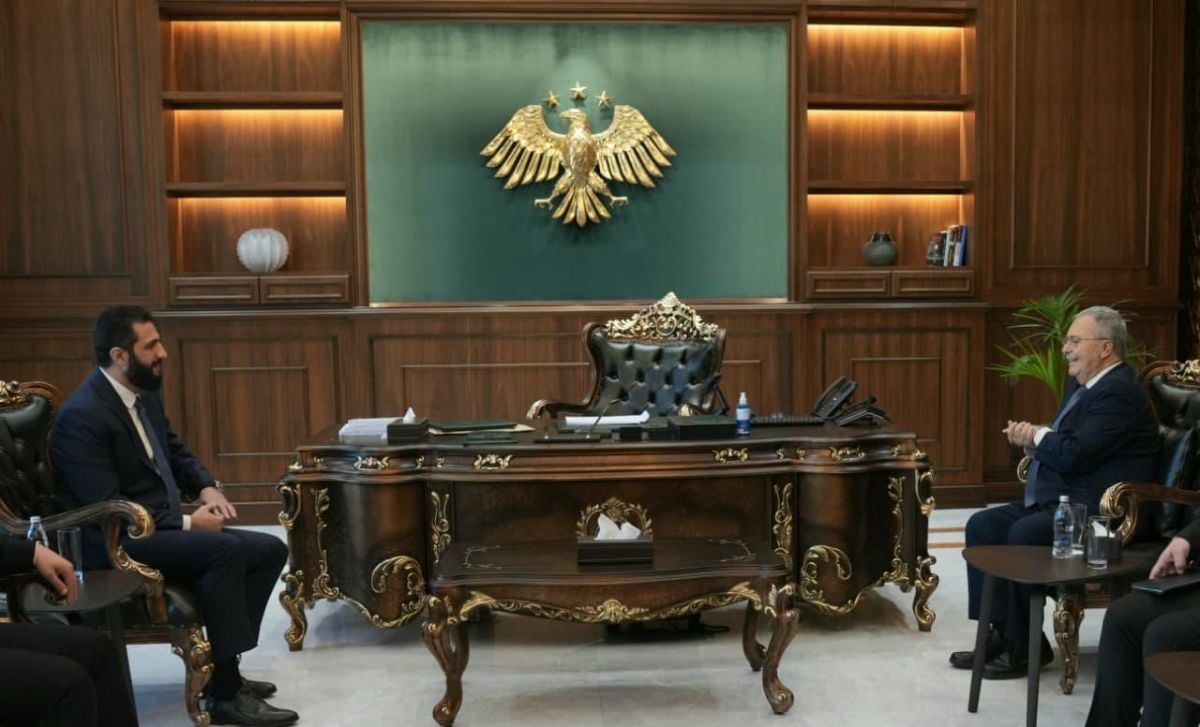
Deputy Prime Minister Tarek Mitri (right) speaking with Syrian President Ahmad el-Chareh in Damascus on November 20, 2025. Photo from his X account.






Lebanese Deputy Prime Minister Tarek Mitri paid an official visit to Syria on Thursday, where he met with interim President Ahmad al-Sharaa and several ministers to discuss delicate issues between Beirut and Damascus, with a focus on the question of Syrian detainees in Lebanon and the demarcation of borders between the two countries.
The meeting with the Syrian president allowed for "an in-depth exchange on ways to improve and develop relations between Lebanon and Syria, in the shared interest of both countries and in order to strengthen stability and cooperation at all levels," the official state-run National News Agency (NNA) reported.
Mitri also held a series of meetings with several senior Syrian officials, including Foreign Minister Assaad al-Chaibani and Justice Minister Mazhar al-Wais.
The discussions covered various joint issues, in particular those of detainees, the missing and borders. Both sides reaffirmed their commitment "to work seriously to find fair solutions to this issue, in a manner that guarantees rights and strengthens judicial cooperation between the two countries."
They also emphasized "the importance of continuing coordination and developing relations in the political, security, judicial and economic fields, in order to enhance constructive cooperation between Lebanon and Syria."
The issue of Syrian detainees in Lebanese prisons is seen by Damascus as one of the main challenges in bilateral relations. Recent media reports have mentioned some Syrian discontent over the matter, which Lebanese authorities categorically deny. A well-informed source told L'Orient-Le Jour that a Lebanese judicial delegation will travel to Damascus in early December to agree on a mechanism to address this issue.
The matter has resurfaced strongly since the rebel coalition came to power in Damascus in December 2024.
Lebanon's Interior Minister Ahmad Hajjar said in August that 2,400 Syrian prisoners, equating to 30 percent of the total inmate population, are incarcerated in Lebanon.
Syrian detainees in Lebanon fall into three categories: those convicted of misdemeanors and crimes, and those who have yet to be tried. Syria is demanding the repatriation of all of them so that they can be tried or serve their sentences on its territory.
While the Syrians have wanted from the outset the release of all detainees considered, seen in the eyes of Damascus as "political prisoners," Lebanon ultimately insisted on its position: those among them who have not committed a crime on Lebanese soil would be released. In the meantime, Lebanon will review the cases individually to sort through them.
A source close to the Justice Ministry told our publication that the draft agreement is nearly finalized and the Syrian side has already reviewed the draft. The agreement will thus "allow for the transfer of detainees so they can be tried in Syria or to finish their sentences there. This will apply to those who have not committed rape or murder in Lebanon, as well as those who have not fought against the Lebanese Army."

 7 p.m. recap: Netanyahu seeks mastermind behind Flydubai incident; Washington sanctions 2 French nationals; Ben Gvir's 'I want to kill you' threat