











Vote.
Since the signing of the Taif Accord, Lebanese citizens have been deprived of that right so often that each opportunity to do so felt like a moment of defiance, a way to push back against adversity and to defy Parliament Speaker Nabih Berri, who regularly locked the doors of Parliament.
On the eve of each electoral deadline, once the date was finally set, Lebanon would slip into turmoil.
The bad players turned to rumors and denunciations, a sport that candidates everywhere practice, but they also turned to violence, sometimes through a series of attacks.
The method, favored by the Assad clan’s Syria, which pulled the strings for a time, had the advantage of ending the suspense of vote counting.
Lacking champions, the camp of the assassinated, Rafik Hariri’s at the time, could do no more than surrender.
(Here is the link to register if you haven’t yet: diasporavote.mfa.gov.lb)
The camp of the assassins, Hezbollah and the pro-Syrians, only needed to preserve the majority it had seized. It constantly claimed the country’s instability, which it willingly fueled, as a reason to postpone elections.
Parliament renewed its own term, political life stalled and the shadow of weapons overshadowed every debate.
From 2009 to 2018, an entire generation of voting-age Lebanese felt pushed aside. They quickly understood that with or without elections, their ballot carried no weight as long as Lebanon remained under tutelage.
Many grew disillusioned and withdrew from political life. They no longer sought, as earlier generations once had, to fix the system. They wanted only to leave the country, obtain a foreign passport and turn away from the sterile tension that kept them from moving forward.
Between Hezbollah’s dominance and its Syrian Iranian alignment, the often violent internal clashes, including the group’s punitive operation in May 2008, and the external threats — especially from Israel since 2006 — public life sank into a cycle of hostility.
Hate speech reached new lows. Televised debates frequently collapsed into brawls. What mobilized people instead were crises tied to daily life, especially the collapsing electricity supply and the garbage crisis, the two cash cows of the political mafia.
More and more, it seemed to them that salvation would come only from themselves, hand in hand and shoulder to shoulder. The impossible unity of forced national governments and the inefficiency of a stripped-down state left a void that citizens believed they alone could fix.
The riots that broke out in October 2019 exposed what official Lebanon, the central bank, its governor at the time, Riad Salameh, and the banks aligned with him could no longer hide.
The country was bankrupt and, worse, it had no friends left to help pull it out of crisis. The uprising became a burst of anger and despair that faded with the hours people lost at bank counters as they tried to scrape together a few dollars, then with the COVID-19 pandemic that banned crowds.
The devastating Aug. 4, 2020, explosion revived that revolution in a different way.
The solidarity that had taken shape in 2019 found new channels during the deep solitude that followed the disaster. Action, for the first time, became the guiding word.
Civil society took on real meaning. Groups of young Lebanese traveled from far away to rescue, clear debris, help with reconstruction and distribute aid. That new force was destined to show itself in the next elections.
In 2022, many voters rallied behind independent candidates who seemed to embody their hopes. Despite a respectable breakthrough, those candidates eventually disappointed, but the traditional establishment watched its stars fade. The thirst for renewal reshuffled the old deck.
That year, the elections carried a different feeling.
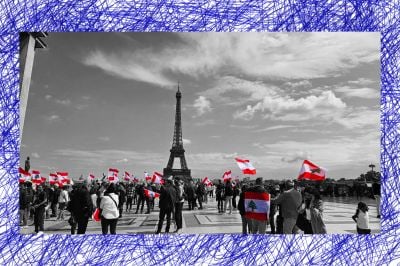
Outside Lebanese consulates around the world, young expatriates found comfort in the long lines and in the sense of belonging they revived. There was a kind of joy in exercising that rare freedom to turn an opinion into weight, even if it amounted to a slip of paper.
There was also the effort to respect an opposing view without coming to blows, unlike what happens in Lebanon. They stood proud and striking, with fingers dyed violet with gentian, held up like a permanent oath.
In the villages of the country’s interior, hollowed out by the pull of the cities, voters arrived with a sense of awe. Many barely lifted their eyes toward the places of their childhood and the people who had stayed behind, now older and missing teeth.
Dabkeh troupes, brass bands and the national anthem — which seemed to recover its meaning — greeted them.
The past few months have been difficult to say the least. The new team in power raises questions. Are they really the people in whom Lebanese citizens placed so much hope?
Society now has another chance to refine its choices and to believe once more in its ability to open a path toward the future.
For those living abroad, today is the last day to register.
Yalla.
This article was originally published in L'Orient-Le Jour and translated by Sahar Ghossoub.

 Evening recap: Netanyahu announces West Bank offensive; 7 killed in Jordan church shooting; tents burned in south Lebanon
 US strike on Iran this weekend? ‘Absolutely,’ says Barrack; ‘I have no idea,’ says Trump