


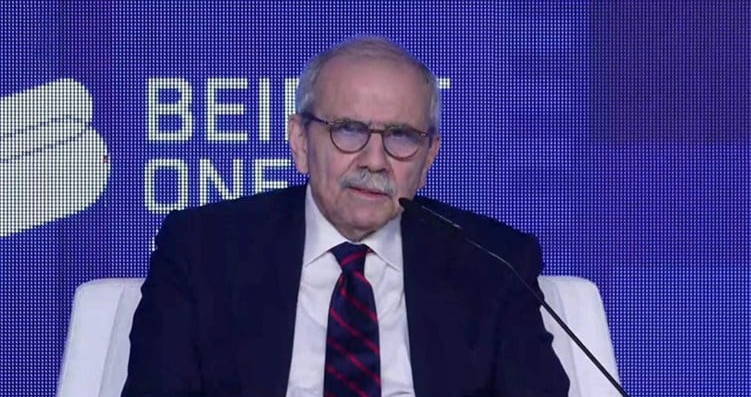
Prime Minister Nawaf Salam at the Beirut One conference. (Credit: NNA)






BEIRUT — Prime Minister Nawaf Salam on Wednesday emphasized the crucial importance of security and stability for Lebanon’s recovery, during the closing of the Beirut One conference organized by the Economy Ministry and the Economic, Social and Environmental Council (CESE).
"Without security and stability, Lebanon will miss the opportunity to recover and investments will not come. Security can only be guaranteed if the state extends its legitimate authority over the entire Lebanese territory," Salam said.
The head of government also insisted on Lebanon's return to the Arab scene. "Lebanon is once again present in the Arab world, and the Arab world is beginning to return to Lebanon. We hope the ban on Lebanese exports will be lifted," he added.
He also announced that "tomorrow, scanners at the Port of Beirut will be inaugurated, and I am convinced the Arabs will come back to Lebanon."
On Monday, just days after last Thursday's Saudi announcement of an imminent revival of commercial relations between Riyadh and Beirut, Saudi envoy Yazid bin Farhan, visiting Beirut, discussed with Salam the measures regarding the resumption of Lebanese exports to Saudi Arabia.
The prime minister then stressed "the need for the relevant authorities to act quickly to remove all obstacles hindering this vital sector of the Lebanese economy." He also "reaffirmed Lebanon's commitment not to serve as a platform for destabilizing the security of Arab countries or as a transit point for drug trafficking or any other illicit goods."
During the conference on Wednesday, Salam announced the closure of more than 30 captagon drug labs. "We have taken serious security measures to protect the country," he said.
"We have set the country on a new path and, for the first time, there is serious work underway to expand the state’s authority across the entire territory. We must continue on this trajectory," he declared.
However, Lebanon is struggling to implement the government decisions of August 5 and 7 aimed at disarming militias, notably Hezbollah, which still rejects this option. Meanwhile, the risk of Israeli military escalation looms over the country, as Israel continues to bomb South Lebanon and the Bekaa in violation of the cease-fire that took effect on Nov. 27, 2024.
Salam also highlighted the reform efforts undertaken by his government. "Lebanon remains a country of promising opportunities. We have begun a series of reforms, but we still have a long way to go and it is essential to continue," he stated.
He stressed the importance of the agreement with the International Monetary Fund (IMF). "We must not consider reversing this agreement. It is crucial, not only for the funds it will bring, but also because it serves as a certificate of good conduct paving the way for investments," he said.
"The reforms requested by the IMF are those we need. We must notably finalize the financial regularization law and a series of other economic reforms."
Regarding bank deposits, which have been frozen by restrictions illegally imposed by banks since the 2019 financial crisis, Salam assured that "all depositors will recover their money within a reasonable timeframe." "Not all depositors are equal," he added.
"There are those whose deposits are legitimate and those whose deposits are not. For those whose deposits come from corruption or drug trafficking, not only should they not recover their money, but they should be prosecuted and tried."

 7 p.m. recap: Sharaa in Riyadh; Qassem signals openness to cooperation; Ben-Gvir: ‘We demolish, again and again’